


On the role of skeletal muscle acidosis and inorganic phosphates as determinants of central and peripheral fatigue: A 31 P-MRS study
- PMID: 35593645
- PMCID: PMC9250628
- DOI: 10.1113/JP283036
On the role of skeletal muscle acidosis and inorganic phosphates as determinants of central and peripheral fatigue: A 31 P-MRS study
Abstract
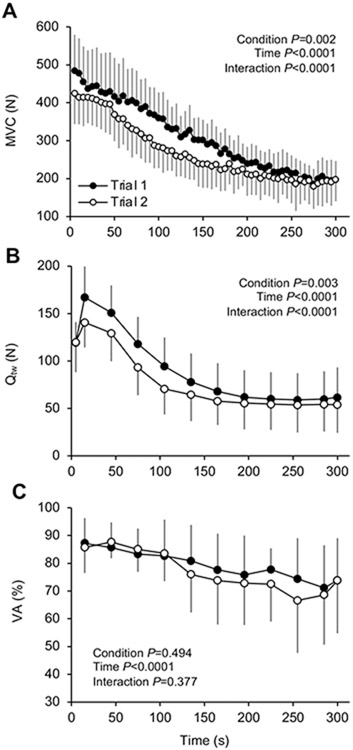
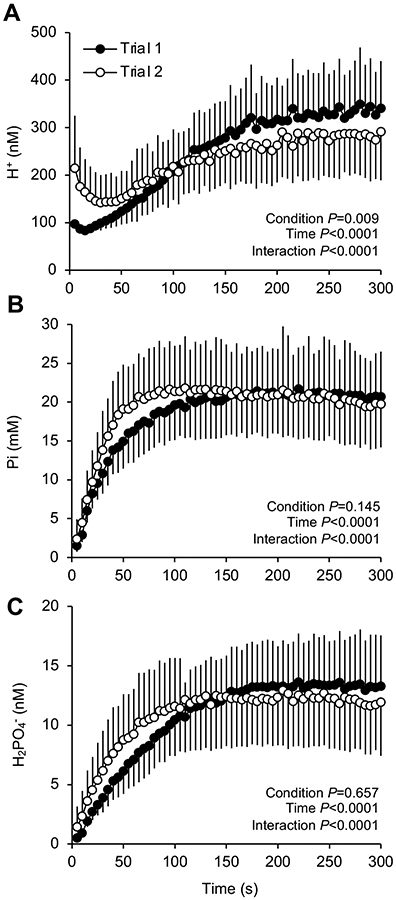
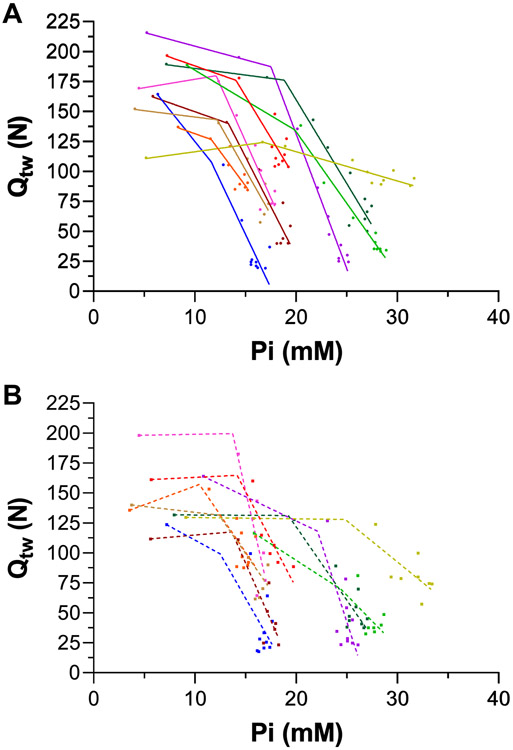
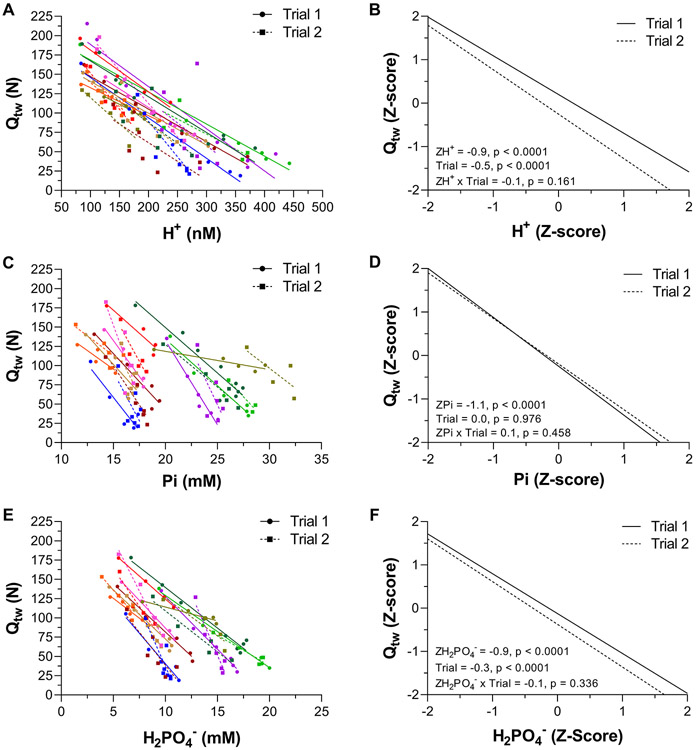
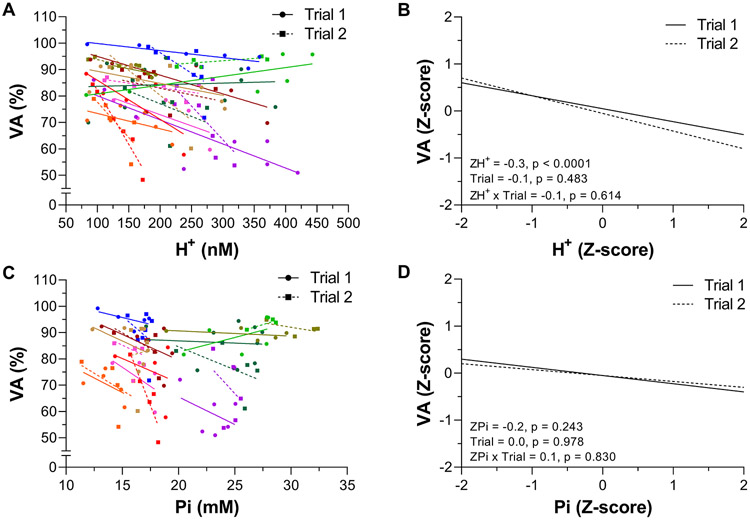
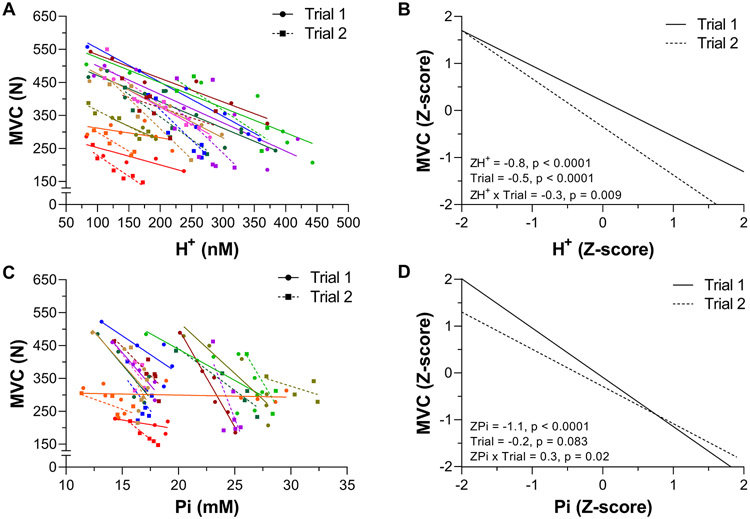
Intramuscular hydrogen ion (H+ ) and inorganic phosphate (Pi) concentrations were dissociated during exercise to challenge their relationships with peripheral and central fatigue in vivo. Ten recreationally active, healthy men (27 ± 5 years; 180 ± 4 cm; 76 ± 10 kg) performed two consecutive intermittent isometric single-leg knee-extensor trials (60 maximal voluntary contractions; 3 s contraction, 2 s relaxation) interspersed with 5 min of rest. Phosphorus magnetic resonance spectroscopy (31 P-MRS) was used to continuously quantify intramuscular [H+ ] and [Pi] during both trials. Using electrical femoral nerve stimulation, quadriceps twitch force (Qtw ) and voluntary activation (VA) were quantified at rest and throughout both trials. Decreases in Qtw and VA from baseline were used to determine peripheral and central fatigue, respectively. Qtw was strongly related to both [H+ ] (β coefficient: -0.9, P < 0.0001) and [Pi] (-1.1, P < 0.0001) across trials. There was an effect of trial on the relationship between Qtw and [H+ ] (-0.5, P < 0.0001), but not Qtw and [Pi] (0.0, P = 0.976). This suggests that, unlike the unaltered association with [Pi], a given level of peripheral fatigue was associated with a different [H+ ] in Trial 1 vs. Trial 2. VA was related to [H+ ] (-0.3, P < 0.0001), but not [Pi] (-0.2, P = 0.243), across trials and there was no effect of trial (-0.1, P = 0.483). Taken together, these results support intramuscular Pi as a primary cause of peripheral fatigue, and muscle acidosis, probably acting on group III/IV muscle afferents in the interstitial space, as a contributor to central fatigue during exercise. KEY POINTS: We investigated the relationship between intramuscular metabolites and neuromuscular function in humans performing two maximal, intermittent, knee-extension trials interspersed with 5 min of rest. Concomitant measurements of intramuscular hydrogen (H+ ) and inorganic phosphate (Pi) concentrations, as well as quadriceps twitch-force (Qtw ) and voluntary activation (VA), were made throughout each trial using phosphorus magnetic resonance spectroscopy (31 P-MRS) and electrical femoral nerve stimulations. Although [Pi] fully recovered prior to the onset of the second trial, [H+ ] did not. Qtw was strongly related to both [H+ ] and [Pi] across both trials. However, the relationship between Qtw and [H+ ] shifted leftward from the first to the second trial, whereas the relationship between Qtw and [Pi] remained unaltered. VA was related to [H+ ], but not [Pi], across both trials. These in vivo findings support the hypotheses of intramuscular Pi as a primary cause of peripheral fatigue, and muscle acidosis, probably acting on group III/IV muscle afferents, as a contributor to central fatigue.
Keywords: exercise; intramuscular metabolic by-product; magnetic resonance spectroscopy; neuromuscular fatigue.
© 2022 The Authors. The Journal of Physiology © 2022 The Physiological Society.
Conflict of interest statement
Competing interest
The authors declare no conflict of interest.
Figures
Comment in
-
Insights into neuromuscular fatigue using 31 P-MRS.J Physiol. 2022 Jul;600(13):3011-3012. doi: 10.1113/JP283331. Epub 2022 Jun 10. J Physiol. 2022. PMID: 35687052 Free PMC article. No abstract available.
-
Exercise-induced metabolites and fatigue: can an inorganic phosphate breakpoint predict the rapid onset of peripheral fatigue?J Physiol. 2022 Aug;600(15):3391-3392. doi: 10.1113/JP283428. Epub 2022 Jul 6. J Physiol. 2022. PMID: 35751541 No abstract available.
References
-
- Adams GR, Fisher MJ & Meyer RA. (1991). Hypercapnic acidosis and increased H2PO4- concentration do not decrease force in cat skeletal muscle. Am J Physiol 260, C805–812. - PubMed
-
- Allen DG, Lamb GD & Westerblad H. (2008). Skeletal muscle fatigue: cellular mechanisms. Physiol Rev 88, 287–332. - PubMed
Publication types
MeSH terms
Substances
Grants and funding
LinkOut - more resources
Full Text Sources
Research Materials
Miscellaneous
