


doi: 10.1007/s00134-022-06719-9.
Epub 2022 May 20.
Automation to improve lung protection
Affiliations
- PMID: 35593938
- PMCID: PMC9273559
- DOI: 10.1007/s00134-022-06719-9
Item in Clipboard
Automation to improve lung protection
Intensive Care Med.
2022 Jul.
No abstract available
Conflict of interest statement
LAB-K visited Hamilton Medical in 2021 to take part in an advisory board meeting and to give lectures. The expenses for lodging were covered, she had her travel expenses reimbursed and received an advisory- and speaker’s fee of € 1500. MJS attended a workshop organized by Hamilton in 2018. The expenses for lodging were covered for the invited experts, and participants from abroad had their travel expenses reimbursed. Additionally, speakers received a speaker’s fee of CHF 800. He is the Team Leader of Medical Affairs at Hamilton Medical AG, Switzerland, since 2022. ASN received personal speaker fees from Dräger.
Figures
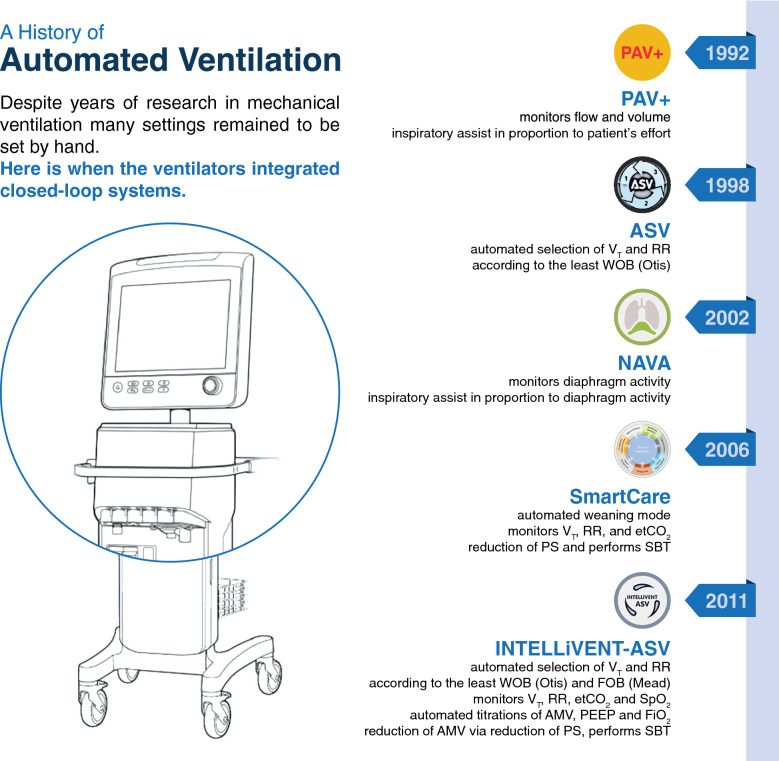
A history of automated ventilation. Overview of currently available closed–loop ventilation modes, with brief explanations of how they work. The here described examples of automated ventilation modes are Proportional Assist Ventilation with load–adjustable gain factors (PAV +), available on Puritan Bennett ventilators (Puritan Bennett, Minneapolis, USA), SmartCare, available on Dräger ventilators (Dräger, Lübeck, Germany), Neurally Adjusted Ventilatory Assist ventilation (NAVA), available on Maquet ventilators (Getinge, Goteborg, Sweden), and Adaptive Support Ventilation (ASV) and its successor INTELLiVENT–ASV, available on Hamilton ventilators (Hamilton Medical AG, Bonaduz, Switzerland). Abbreviations: VT: tidal volume, RR: respiratory rate, etCO2: end-tidal carbon dioxide, PS: pressure support, SBT: spontaneous breathing trial, WOB: Work of Breathing, FOB: Force of Breathing, SpO2: pulse oximetry, FiO2: fraction of inspired oxygen
References
-
- Urner M, Jüni P, Hansen B, Wettstein MS, Ferguson ND, Fan E. Time-varying intensity of mechanical ventilation and mortality in patients with acute respiratory failure: a registry-based, prospective cohort study. Lancet Respir Med. 2020;8(9):905–913. doi: 10.1016/S2213-2600(20)30325-8. - DOI - PMC - PubMed
-
- Angus DC, Kelley MA, Schmitz RJ, White A, Popovich J., Jr Caring for the critically ill patient. Current and projected workforce requirements for care of the critically ill and patients with pulmonary disease: can we meet the requirements of an aging population? JAMA. 2000;284(21):2762–2770. doi: 10.1001/jama.284.21.2762. - DOI - PubMed
MeSH terms
LinkOut - more resources
Full Text Sources
