


Palate evolution in early-branching crocodylomorphs: Implications for homology, systematics, and ecomorphology
- PMID: 35595547
- PMCID: PMC9543995
- DOI: 10.1002/ar.24993
Palate evolution in early-branching crocodylomorphs: Implications for homology, systematics, and ecomorphology
Abstract
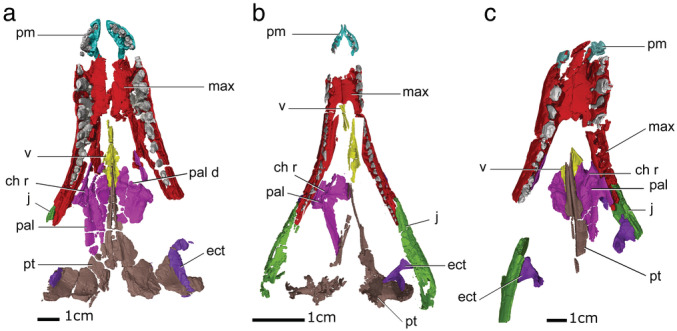
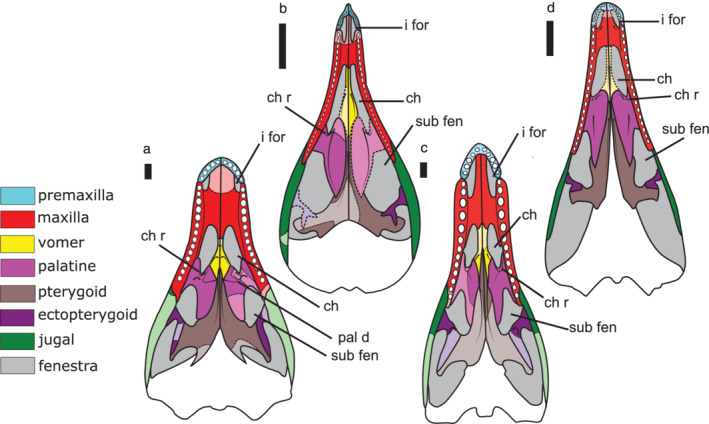
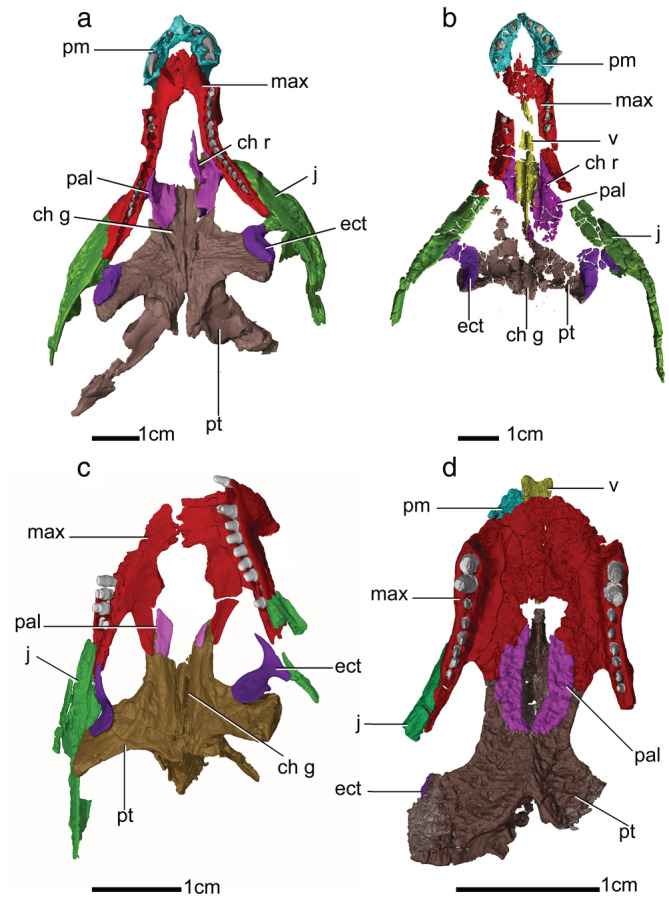
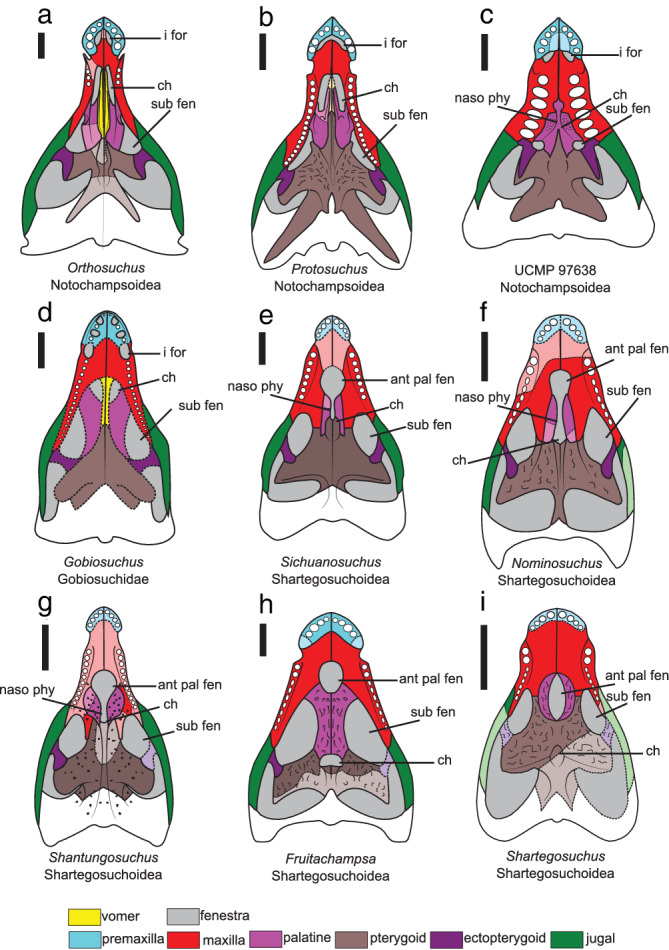
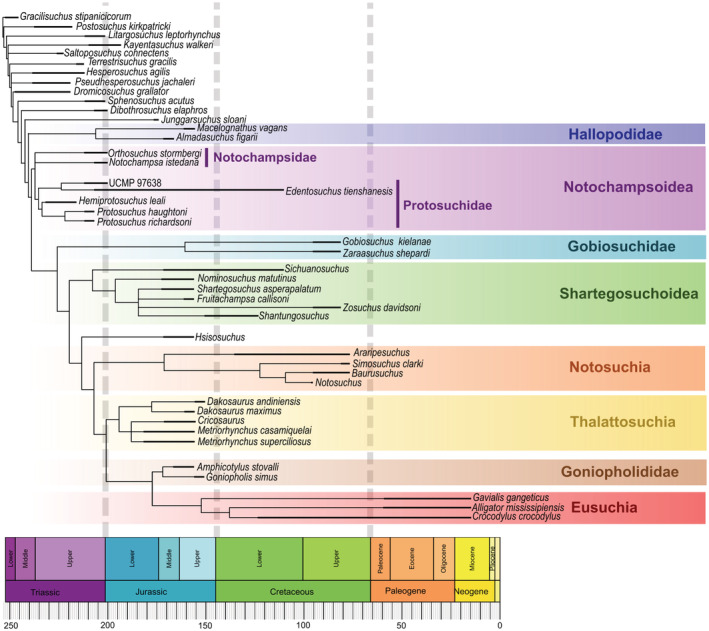
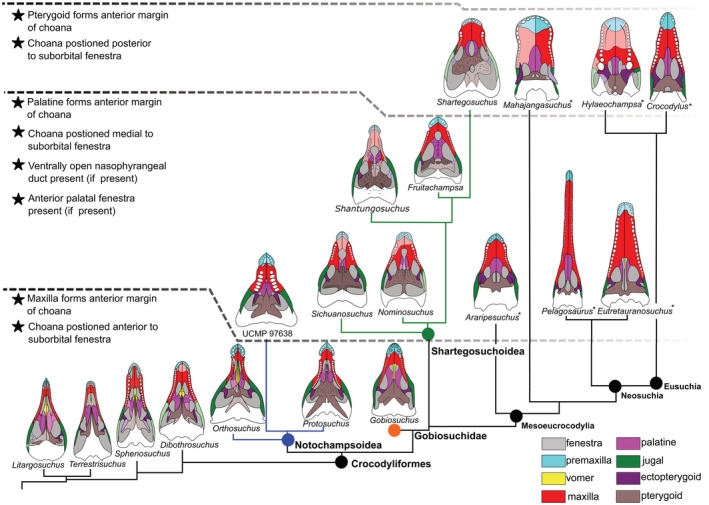
Living crocodylomorphs have an ossified secondary palate with a posteriorly positioned choana that enables their semi-aquatic, predatory ecology. In contrast, the earliest branching members of Crocodylomorpha have an open palate with anteriorly positioned choanae. The evolution of an ossified secondary palate and a posteriorly positioned choana features strongly in hypotheses of broad-scale phylogenetic relationships within Crocodylomorpha. Renewed investigations into palatal morphology among extinct members of the clade show surprising variability in the anatomy of the palate, with at least one and potentially a second independent occurrence of "eusuchian-type" palate outside of Eusuchia. Understanding the trajectory of crocodylomorph palatal evolution is, therefore, a key to inferring crocodylomorph interrelationships and ecomorphology. To document early-branching crocodylomorph palatal anatomy, we developed an anatomical comparative dataset using computed tomography scan data and literature, comprising 12 early-branching crocodylomorph taxa. To understand discrete phenotypic changes in palatal structure, we compiled a phylogenetically broadly sampled character-taxon matrix from the existing literature, and revised its palatal characters, adding 10 new palatal characters. Our comparative anatomical investigations allow us to propose an adapted hypothesis for the closure of the palate and the posterior migration of the choana. Our phylogenetic findings corroborate previous research showing that non-crocodyliform crocodylomorphs ("sphenosuchians") are paraphyletic, with the exclusion of the clade Hallopodidae. Non-mesoeucrocodylian crocodyliforms ("protosuchians") are paraphyletic, but form three monophyletic clades: Notochampsoidea, Shartegosuchoidea, and Gobiosuchidae. We find a potential association between secondary palate development and dietary shifts, particularly with regard to hypothesized origins of herbivory.
Keywords: crocodylian; phylogenetics; secondary palate.
© 2022 The Authors. The Anatomical Record published by Wiley Periodicals LLC on behalf of American Association for Anatomy.
Figures
References
-
- Andrade, M. , Bertini, R. , & Pinheiro, A. (2006). Observations on the palate and choanae structures in mesoeucrocodylia (Archosauria, Crocodylomorpha): Phylogenetic implications. Revista Brasileria de Paleontologia, 9, 323–332.
-
- Barrios, F. , Bona, P. , Paulina‐Carabajal, A. , & Gasparini, Z. (2018). Re‐description of the cranio‐mandibular anatomy of Notosuchus terrestris (Crocodyliformes, mesoeucrocodylia) from the upper cretaceous of Patagonia. Cretaceous Research, 83, 3–39.
-
- Busbey, A. B. (1995). The structural consequences of skull flattening in crocodilians. In Thomason J. J. (Ed.), Functional morphology in vertebrate paleontology (pp. 173–192). Cambridge Press.
-
- Butler, R. , Barrett, P. , Kenrick, P. , & Penn, M. (2009). Diversity patterns amongst herbivorous dinosaurs and plants during the cretaceous: Implications for hypotheses of dinosaur/angiosperm co‐evolution. Journal of Evolutionary Biology, 22, 446–459. - PubMed
-
- Clark, J. M. (1994). Patterns of evolution in Mesozoic Crocodyliformes. In Fraser N. C. & Sues H. (Eds.), In the shadow of dinosaurs (pp. 84–97). Cambridge University Press.
Publication types
MeSH terms
LinkOut - more resources
Full Text Sources
