


The correlation of small fiber neuropathy with pain intensity and age in patients with Fabry's disease: A cross sectional study within a large Taiwanese family
- PMID: 35595648
- PMCID: PMC9250089
- DOI: 10.1016/j.bj.2021.04.011
The correlation of small fiber neuropathy with pain intensity and age in patients with Fabry's disease: A cross sectional study within a large Taiwanese family
Abstract
Background: The relationships among small fiber neuropathy, age, sex and pain intensity in the context of Fabry's disease remain unclear. We aim to study the correlations of small fiber neuropathy, age, sex and pain intensity in Fabry patients.
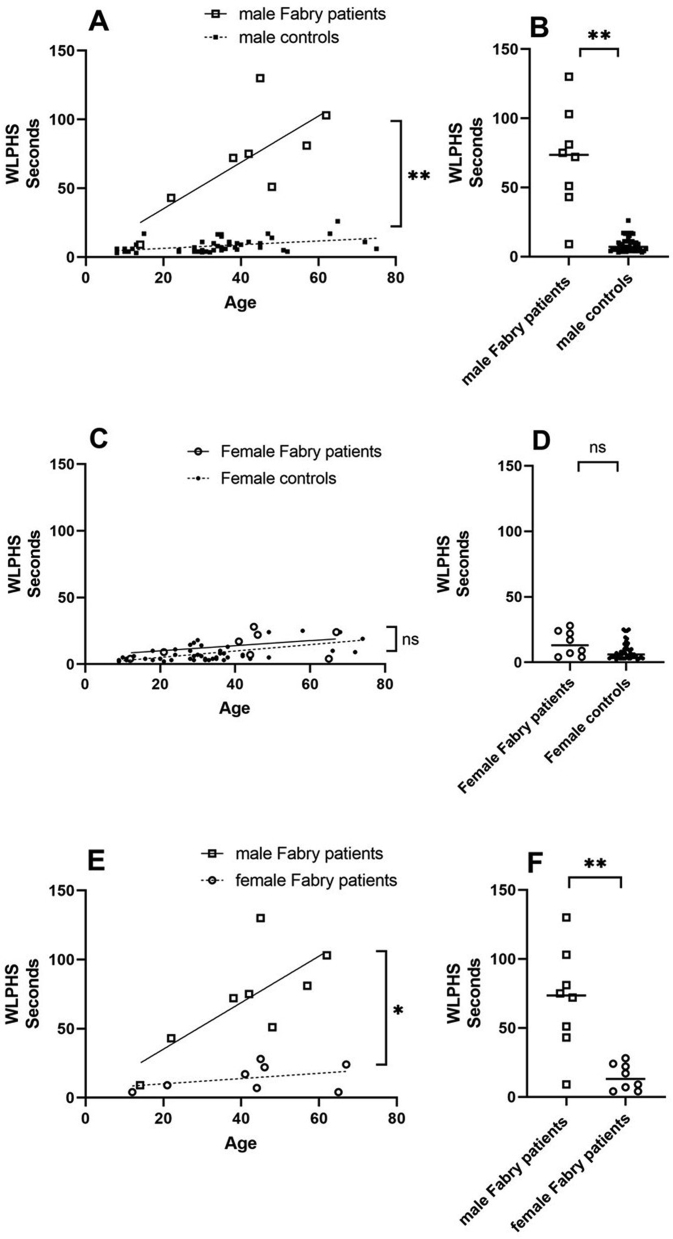
Methods: We evaluated C-fiber function by recording the withdrawal latencies to painful heat stimulus (WLPHS) when each subject's right hand was immersed in a 50 °C hot water bath and correlated this parameter with the patient's perceived pain intensity and quality of life assessed by the short-form McGill Pain Questionnaire (SF-MPQ) in a large Taiwanese Fabry family and normal controls.
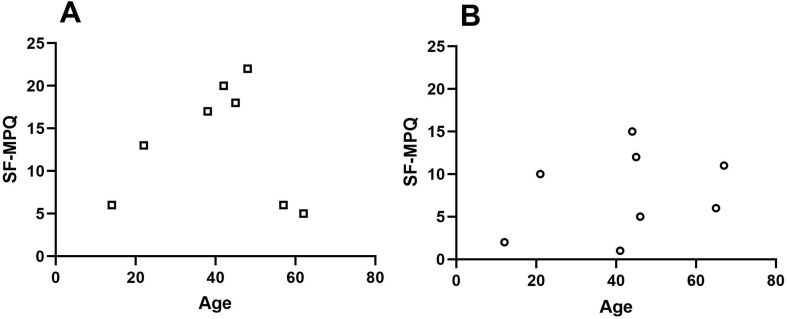
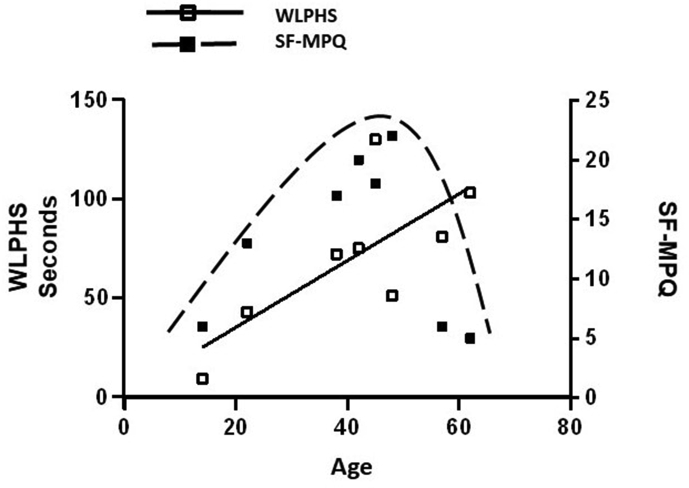
Results: Male Fabry patients showed a significantly increased WLPHS compared to that of normal controls. Furthermore, male Fabry patients showed a positive correlation of increased WLPHS with patient age. The SF-MPQ of male Fabry patients showed a bell distribution with age, and maximal pain scores were detected between the ages of the early 20s and late 40s. In contrast, the female Fabry patients had variable associations of WLPHS and SF-MPQ with age.
Conclusions: We proposed a probable mechanism by which globotriaosylceramide (Gb3) or globotriaosylsphingosine (lyso-Gb3) is gradually deposited into the small nerve bundles with increasing age, which induces continuous damage and produces injury discharges to sustain neuropathic pain in young male Fabry patients. However, once the small fibers are reduced to a certain degree, they no longer produce enough noxious discharges to sustain neuropathic pains in older male Fabry patients, which leads these patients to have lower SF-MPQ scores. In contrast, female Fabry patients had less and variable small fiber damage, pain intensity and clinical signs/symptoms.
Keywords: Acroparesthesia; Fabry's disease; Neuropathic pain; Small fiber neuropathy; Unmyelinated fiber.
Copyright © 2021 Chang Gung University. Published by Elsevier B.V. All rights reserved.
Conflict of interest statement
Conflicts of interest The authors declare no conflicts of interest.
Figures

References
-
- Clarke J.T. Narrative review: Fabry disease. Ann Intern Med. 2007;146:425–433. - PubMed
-
- Zarate Y.A., Hopkin R.J. Fabry's disease. Lancet. 2008;372:1427–1435. - PubMed
-
- Cable W.J., Dvorak A.M., Osage J.E., Kolodny E.H. Fabry disease: significance of ultrastructural localization of lipid inclusions in dermal nerves. Neurology. 1982;32:347–353. - PubMed
-
- Hilz M.J. Evaluation of peripheral and autonomic nerve function in Fabry disease. Acta Paediatr Suppl. 2002;91:38–42. - PubMed
-
- Cable W.J., Kolodny E.H., Adams R.D. Fabry disease: impaired autonomic function. Neurology. 1982;32:498–502. - PubMed
MeSH terms
LinkOut - more resources
Full Text Sources
Medical
