


The inflammatory potential of the diet in childhood is associated with cardiometabolic risk in adolescence/young adulthood in the ALSPAC birth cohort
- PMID: 35596006
- PMCID: PMC9464173
- DOI: 10.1007/s00394-022-02860-9
The inflammatory potential of the diet in childhood is associated with cardiometabolic risk in adolescence/young adulthood in the ALSPAC birth cohort
Abstract
Purpose: This study examined the association between a Dietary Inflammatory Score adapted for children (cDIS) and Cardiometabolic Risk (CMR) score in adolescence/early adulthood in the Avon Longitudinal Study of Parents and Children (ALSPAC).
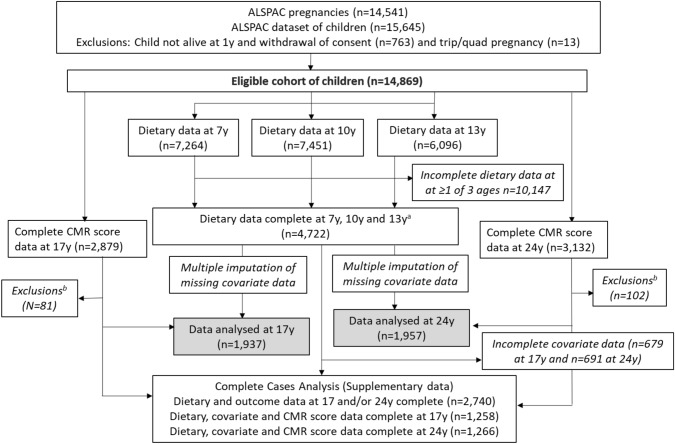
Methods: The cDIS was calculated at 7, 10 and 13 years using diet diary data. Anthropometric and biochemical data at 17 (N = 1937) and 24 (N = 1957) years were used to calculate CMR scores at each age [mean sex-specific z-scores from triacylglycerol, HDL-cholesterol, LDL-cholesterol, mean arterial blood pressure (MAP), homeostatic model assessment of insulin resistance (HOMA-IR) and fat-mass index (FMI)]. Multivariable linear regression models examined associations between cDIS at 7, 10 and 13 years and a continuous CMR z-score and individual CMR markers at 17 and 24 years.
Results: In fully adjusted models, a higher cDIS (more pro-inflammatory diet) at 7 years was associated with an increase in CMR z-score at 17 years (β 0.19; 95% CI 0.03-0.35 for third versus first cDIS tertile) and at 24 years (β 0.28; 95% CI 0.11,0.44 for third versus first cDIS tertile). There was a weak association between a higher cDIS at 10 years and an increase in CMR z-score at 17 years (β 0.16; 95% CI - 0.003, 0.32 for third versus first cDIS tertile). No other clear associations were evident. FMI, MAP and HOMA-IR were the main CMR factors contributing to these associations.
Conclusion: A more pro-inflammatory diet during childhood was associated with a worse cardiometabolic profile in late adolescence/early adulthood. A childhood diet abundant in nutrients with anti-inflammatory properties could help reduce development of CMR factors.
Keywords: Avon Longitudinal Study of Parents and Children (ALSPAC); Cardiometabolic Risk Score; Children and Adolescents; Dietary Inflammatory Score; Prospective Cohort Study.
© 2022. The Author(s).
Conflict of interest statement
On behalf of all authors, the corresponding author states that there is no conflict of interest (CMT and PME have received funding from Nestle Nutrition for projects unrelated to this research).
Figures
References
MeSH terms
Substances
Grants and funding
LinkOut - more resources
Full Text Sources
