


Implementation and costs of housing adaptations among older adults with different functional limitations in Japan
- PMID: 35596138
- PMCID: PMC9123739
- DOI: 10.1186/s12877-022-03100-9
Implementation and costs of housing adaptations among older adults with different functional limitations in Japan
Abstract
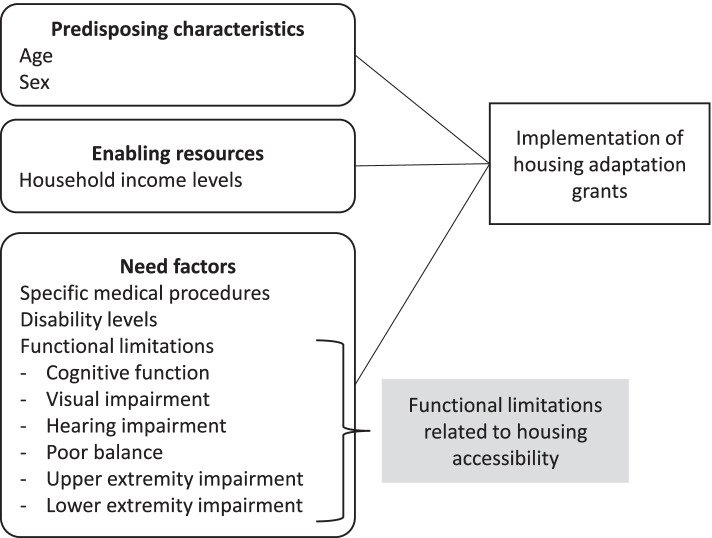
Background: Accessible housing is crucial to maintain a good quality of life for older adults with functional limitations, and housing adaptations are instrumental in resolving accessibility problems. It is unclear to what extent older adults, who have a high risk of further functional decline, use housing adaptation grants acquired through the long-term care (LTC) insurance systems. This study aimed to examine the utilization of housing adaptation grants in terms of implementation and costs, for older adults with different types of functional limitations related to accessibility problems.
Methods: The study sample included individuals from a suburban city in the Tokyo metropolitan area who were certified for care support levels (indicative of the need for preventive care) for the first time between 2010 and 2018 (N = 10,372). We followed the study participants over 12 months since the care needs certification. We matched and utilized three datasets containing the same individual's data: 1) care needs certification for LTC insurance, 2) insurance premium levels, and 3) LTC insurance claims. We conducted a multivariable logistic regression analysis to estimate the likelihood of individuals with different functional limitations of having housing adaptations implemented. Afterward, we conducted a subgroup analysis of only older adults implementing housing adaptation grants to compare costs between groups with different functional limitations using the Mann-Whitney U and Kruskal-Wallis tests.
Results: Housing adaptations were implemented among 15.6% (n = 1,622) of the study sample, and the median cost per individual was 1,287 USD. Individuals with lower extremity impairment or poor balance were more likely to implement housing adaptations (adjusted odds ratio (AOR) = 1.290 to AOR = 2.176), while those with visual impairment or lower cognitive function were less likely to implement housing adaptations (AOR = 0.553 to AOR = 0.861). Costs were significantly lower for individuals with visual impairment (1,180 USD) compared to others (1,300 USD).
Conclusion: Older adults with visual or cognitive limitations may not receive appropriate housing adaptations, despite their high risk of accessibility problems. Housing adaptation grants should include various types of services that meet the needs of older people with different disabilities, and the results indicate there may be a need to improve the system.
Keywords: Accessibility; Claims data; Costs; Disability; Housing adaptations.
© 2022. The Author(s).
Conflict of interest statement
The authors declare that they have no competing interests.
References
-
- Scharlach AE, Moore KD. Aging in place. In: Bengtson, Vern L Settersten Jr, Rchard A Handbook of Theories of Aging. 3rd editio. New York, NY, USA: Springer Publishing Company, LLC; 2016. p. 407–25.
-
- Cabinet Office, Government of Japan. The 8th International Comparative Survey on the Life and Recognition of the Elderly People [Internet]. 2015. Available from: https://www8.cao.go.jp/kourei/ishiki/h27/zentai/pdf/kourei_h27_2-6.pdf.
-
- Lawton M, Nahemow L. Ecology and the aging process. In: Lawton MP, editor. Psychology of Adult Development and Aging. Washington, D.C.: American Psychological Association; 1973. pp. 619–674.
-
- Turner S, Arthur G, Lyons RA, Weightman AL, Mann MK, Jones SJ, et al. Modification of the home environment for the reduction of injuries. Cochrane Database Syst Rev [Internet]. 2011 Feb 16 [cited 2020 Sep 25];(2). Available from: https://www.cochranelibrary.com/cdsr/doi/10.1002/14651858.CD003600.pub3/... - PMC - PubMed
Publication types
MeSH terms
LinkOut - more resources
Full Text Sources
