


Association between the 24-hour movement guidelines and executive function among Chinese children
- PMID: 35596171
- PMCID: PMC9121539
- DOI: 10.1186/s12889-022-13420-5
Association between the 24-hour movement guidelines and executive function among Chinese children
Abstract
Objective: Childhood is a critical period for brain development. However, it remains unknown whether the behaviors in a typical 24-h day are related to children's executive function (EF). This study aimed to investigate the relationship between the 24-h movement guidelines and children's EF.
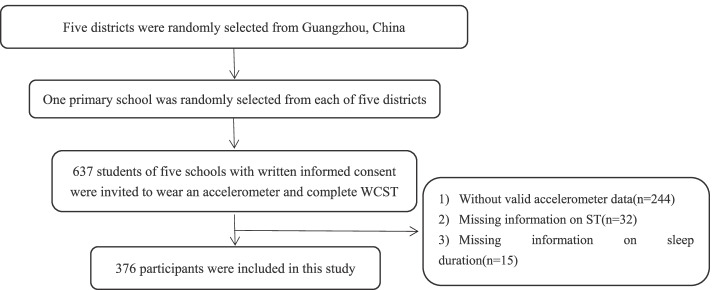
Method: Children aged 7-12 years (n = 376) were studied in 2017 in China. Physical activity (PA) was accelerometer-derived, while screen time (ST) and sleep duration were self-reported. Meeting the 24-h movement guidelines was defined as: 1) ≥ 60 min/day of moderate-to-vigorous PA; 2) ≤ 2 h/day of recreational ST; 3) 9-11 h/night of sleep. EF was assessed by the Wisconsin Card Sorting Test (WCST). Number of completed categories (CC), shifting efficiency (SE), non-perseverative errors (NPE), and failure to maintain set (FMS) were used to measure four processes of EF, respectively represented global performance, cognitive flexibility, efficiency in rule discovery, and sustained attention. Generalized linear mixed models (GLMM) were completed to explore the associations of meeting the PA, ST, and sleep duration recommendations with four processes of EF.
Results: Statistically significant positive associations were observed between the number of guidelines met, regarded as a continuous variable, with CC [β = 0.343 (95% confidence interval [CI]: 0.125, 0.561)] and SE [β = 4.028 (95% CI: 0.328, 7.727)], while number of guidelines met negatively related to NPE [β = - 4.377 (95% CI:-7.952,-0.802)]. Participants not meeting the two recommendations for PA and sleep duration had lower scores in CC [β = -0.636(95% CI:-1.125,-0.147)] and SE [β = -10.610 (95% CI:-18.794,-2.425)] compared with those meeting the two, suggesting inferior global performance and worse efficiency in rule discovery. However, ST recommendation had no significant association with any processes of EF.
Conclusion: Meeting more recommendations of the 24-h movement guidelines was associated with superior EF in children. Specifically, more PA and healthy sleep duration should be encouraged to promote children's EF.
Keywords: Children; Executive function; The 24-h movement guidelines.
© 2022. The Author(s).
Conflict of interest statement
The authors declare that they have no conflicts of interests.
Figures

References
-
- Zelazo, PD, and Carlson, SM. Hot and Cool Executive Function in Childhood and Adolescence Development and Plasticity. Child Dev Perspect. doi:10.1111/j.1750-8606.2012.00246.x.
-
- Lindenberger U. Lifespan Theories of Cognitive Development. Int Encycl Soc Behav Sci. 2001;8848–54. 10.1016/b0-08-043076-7/01572-2.
Publication types
MeSH terms
LinkOut - more resources
Full Text Sources
Medical
Miscellaneous
