


Dietary carotenoid intake and risk of developing preeclampsia: a hospital-based case-control study
- PMID: 35597902
- PMCID: PMC9123797
- DOI: 10.1186/s12884-022-04737-5
Dietary carotenoid intake and risk of developing preeclampsia: a hospital-based case-control study
Abstract
Background: The effect of carotenoids on the risk of preeclampsia (PE) is uncertain. We aimed to examine the associations between the intake of dietary carotenoids and related compounds by pregnant women in China, and the risk of their developing PE.
Methods: Four hundred and forty PE cases and 440 age- (± 3 years), gestational age- (± 1 weeks) and gestational diabetes mellitus status- (yes/no) matched healthy controls were recruited from March 2016 to June 2019. Dietary intake of carotenoids was assessed using a 79-item validated food-frequency questionnaire. Odds ratios (ORs) and 95% confidence intervals (CIs) were estimated using conditional logistic regression.
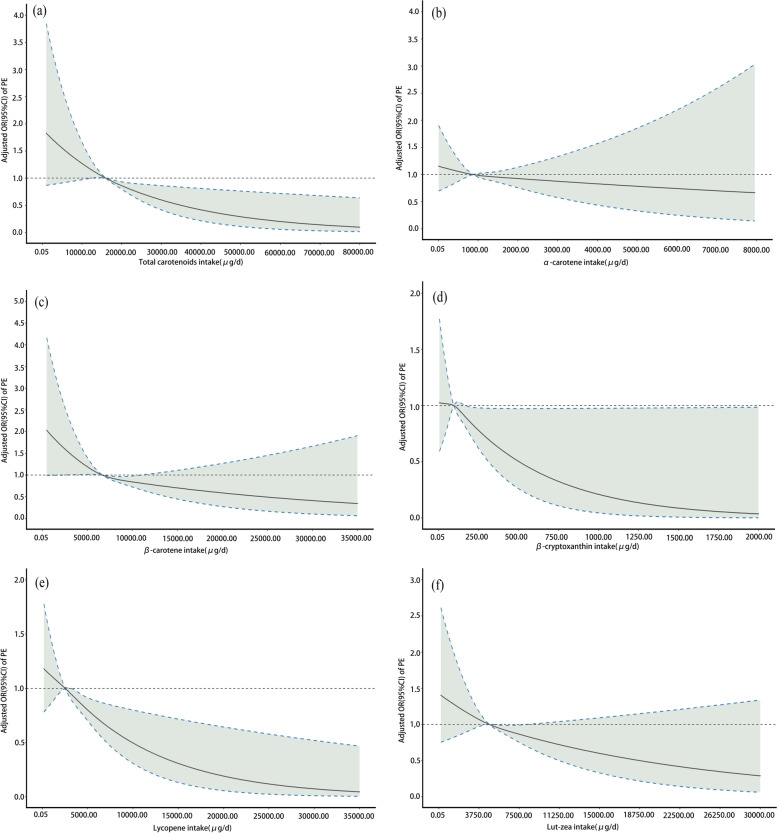
Results: After adjusting for potential confounders, we found that the intake of total carotenoids, β-carotene, β-cryptoxanthin, lycopene, and lutein and zeaxanthin (lut-zea) were negatively associated with the odds of developing PE. Compared with the lowest quartile intake, the multivariate-adjusted OR (95% CI) of the highest quartile intake was 0.29 (0.16-0.54, Ptrend < 0.001) for total carotenoids, 0.31 (0.16-0.58, Ptrend < 0.001) for β-carotene, 0.50 (0.27-0.90, Ptrend = 0.007) for β-cryptoxanthin, 0.55 (0.30-0.99, Ptrend = 0.04) for lycopene and 0.32 (0.17-0.61, Ptrend = 0.001) for lut-zea. However, no significant associations were observed between the risk of developing PE and α-carotene intake (OR = 0.75, 95% CI: 0.41-1.36, Ptrend = 0.28). Moreover, similar negative associations were found for every one-standard-deviation increase in the intake of total carotenoids, β-carotene, β-cryptoxanthin, lycopene and lut-zea.
Conclusion: These results indicate that a high intake of total carotenoids, β-carotene, β-cryptoxanthin, lycopene and lut-zea may be associated with a low risk of developing PE.
Keywords: Carotenoids; Case–control study; Chinese; Preeclampsia; Pregnant women.
© 2022. The Author(s).
Conflict of interest statement
The authors declare that they have no competing interests.
Figures
References
-
- Abalos E, Cuesta C, Carroli G, Qureshi Z, Widmer M, Vogel JP, Souza JP. Maternal WHOMSo, newborn Health Research N: pre-eclampsia, eclampsia and adverse maternal and perinatal outcomes: a secondary analysis of the World Health Organization multicountry survey on maternal and newborn health. BJOG. 2014;121(Suppl 1):14–24. doi: 10.1111/1471-0528.12629. - DOI - PubMed
MeSH terms
Substances
LinkOut - more resources
Full Text Sources
