. 2022 May 21;20(1):117.
doi: 10.1186/s12915-022-01316-0.

APOBEC3 mutational signatures are associated with extensive and diverse genomic instability across multiple tumour types

Affiliations

APOBEC3 mutational signatures are associated with extensive and diverse genomic instability across multiple tumour types

G Maria Jakobsdottir et al. BMC Biol. .

Abstract

Background: The APOBEC3 (apolipoprotein B mRNA editing enzyme catalytic polypeptide 3) family of cytidine deaminases is responsible for two mutational signatures (SBS2 and SBS13) found in cancer genomes. APOBEC3 enzymes are activated in response to viral infection, and have been associated with increased mutation burden and TP53 mutation. In addition to this, it has been suggested that APOBEC3 activity may be responsible for mutations that do not fall into the classical APOBEC3 signatures (SBS2 and SBS13), through generation of double strand breaks.Previous work has mainly focused on the effects of APOBEC3 within individual tumour types using exome sequencing data. Here, we use whole genome sequencing data from 2451 primary tumours from 39 different tumour types in the Pan-Cancer Analysis of Whole Genomes (PCAWG) data set to investigate the relationship between APOBEC3 and genomic instability (GI).

Results and conclusions: We found that the number of classical APOBEC3 signature mutations correlates with increased mutation burden across different tumour types. In addition, the number of APOBEC3 mutations is a significant predictor for six different measures of GI. Two GI measures (INDELs attributed to INDEL signatures ID6 and ID8) strongly suggest the occurrence and error prone repair of double strand breaks, and the relationship between APOBEC3 mutations and GI remains when SNVs attributed to kataegis are excluded.We provide evidence that supports a model of cancer genome evolution in which APOBEC3 acts as a causative factor in the development of diverse and widespread genomic instability through the generation of double strand breaks. This has important implications for treatment approaches for cancers that carry APOBEC3 mutations, and challenges the view that APOBECs only act opportunistically at sites of single stranded DNA.

Keywords: APOBEC3; Genomic instability; Mutational signatures.


Conflict of interest statement

The authors declare that they have no competing interests.

Figures
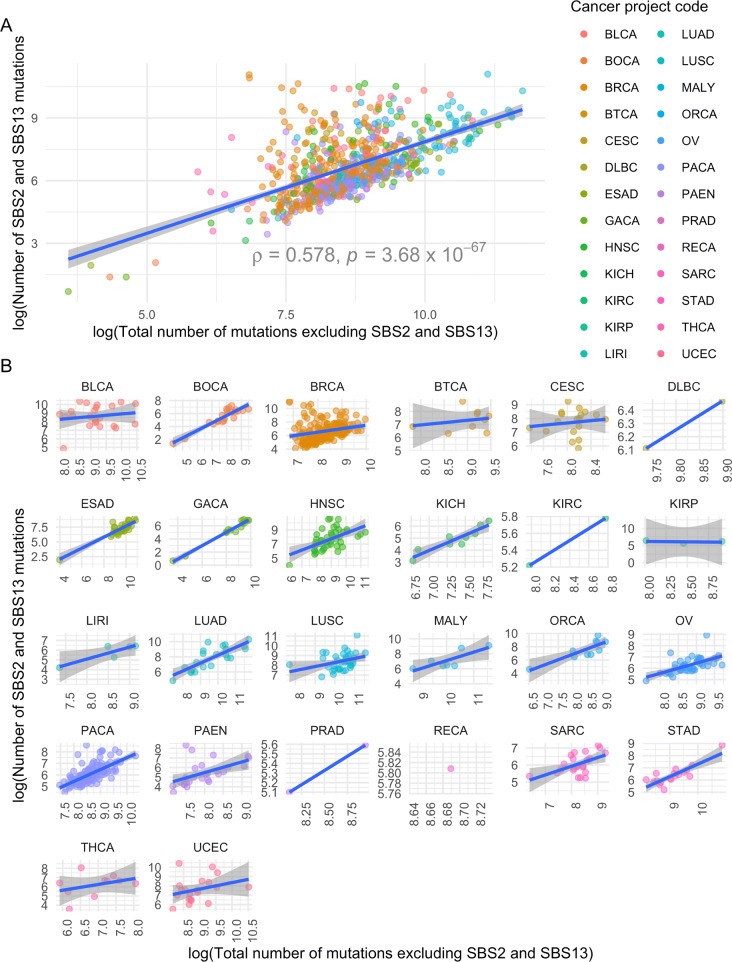
Fig. 1.
Fig. 1.
Correlation between number of SBS2 and SBS13 mutations and non-SBS2 and SBS13 mutations. A All tumour types. B Tumour types represented individually. Spearman correlation between the number of SBS2 and SBS13 SNVs and the total number of non-SBS2 and SBS13 SNVs for samples containing at least one SNV attributed to SBS2 and SBS13, coloured by tumour type and project code. The number of mutations was log transformed, using the natural logarithm. Shaded area represents the 95% confidence interval. Spearman’s ρ and p values for each of the correlations between the number of SBS2 and SBS13 and non-SBS2 and SBS13 SNVs by project code are presented in Additional file 1: Supplementary Table 1 (n=741)
Fig. 2.
Fig. 2.
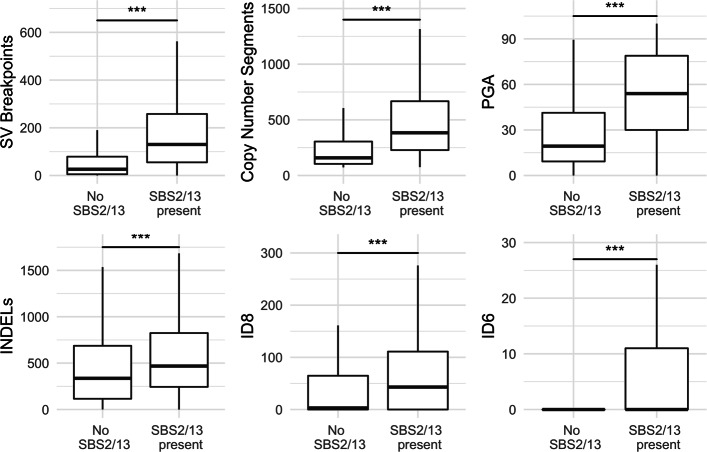
The effect of SBS2 and SBS13 presence on genomic instability. Measures of genomic instability by presence of SBS2- and SBS13-related signatures. PGA, Percentage of the Genome Altered. INDELs, Insertions and Deletions. ID8, insertion and deletion signature 8. ID6, insertion and deletion signature 6. (Wilcoxon Rank Sum test; * = p <0.05, ** = p <0.01, *** = p <0.001, n = 2451 for INDELs, ID8, ID6, PGA and Copy Number Segments. n = 2427 for SVs.). Individual p values are provided in Additional file 1: Supplementary Table 4
Fig. 3.
Fig. 3.
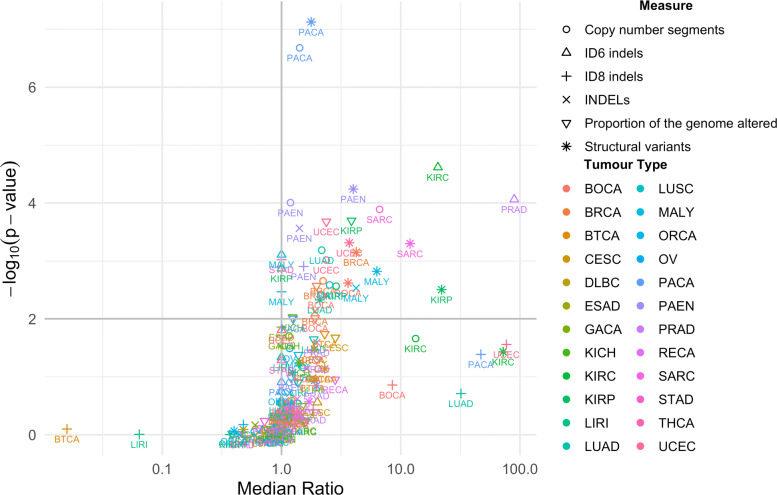
The effect of SBS2 and SBS13 presence on genomic instability by tumour type. Ratio of the median value of each measure of genomic instability for tumours containing SBS2 and SBS13 mutation to those that do not contain SBS2 and SBS13 mutations. p values were derived from one-sided Wilcoxon rank sum tests, and the horizontal grey lines indicates an FDR of 0.05, which includes points that fall on the line. The number of samples in which SBS2 and SBS13 mutations are present and absent are reported for each tumour type in Additional file 1: Supplementary Table 1. Details of the means and median ratios, and p values for each of the tumour type and genomic instability measure combinations are presented in Additional file 2: Supplementary Data 1

References

    1. Bishop KN, Holmes RK, Sheehy AM, Davidson NO, Cho SJ, Malim MH. Cytidine deamination of retroviral DNA by diverse APOBEC proteins. Curr Biol. 2004;14(15):1392–6. doi: 10.1016/j.cub.2004.06.057. - DOI - PubMed
    1. Alexandrov LB, Nik-Zainal S, Wedge DC, Aparicio SAJR, Behjati S, Biankin AV, et al. Signatures of mutational processes in human cancer. Nature. 2013;500(7463):415. doi: 10.1038/nature12477. - DOI - PMC - PubMed
    1. Harris RS, Dudley JP. APOBECs and virus restriction. Virology. 2015;479:131–45. doi: 10.1016/j.virol.2015.03.012. - DOI - PMC - PubMed
    1. Knisbacher BA, Gerber D, Levanon EY. DNA editing by APOBECs: a genomic preserver and transformer. Trends Genet. 2016;32(1):16–28. doi: 10.1016/j.tig.2015.10.005. - DOI - PubMed
    1. Sheehy AM, Gaddis NC, Choi JD, Malim MH. Isolation of a human gene that inhibits HIV-1 infection and is suppressed by the viral Vif protein. Nature. 2002;418(6898):646. doi: 10.1038/nature00939. - DOI - PubMed

Publication types