Review
. 2022 May 21;18(1):42.
doi: 10.1186/s13223-022-00676-0.

The new era of add-on asthma treatments: where do we stand?

Affiliations
Review

The new era of add-on asthma treatments: where do we stand?

William J Calhoun et al. Allergy Asthma Clin Immunol. .

Abstract

Globally, a small proportion (5-12%) of asthma patients are estimated to have severe disease. However, severe asthma accounts for disproportionately high healthcare resource utilization. The Global Initiative for Asthma (GINA) management committee recommends treating patients with asthma with inhaled corticosteroids plus long-acting β2-agonists and, when needed, adding a long-acting muscarinic receptor antagonist or biologic agent. Five biologics, targeting different effectors in the type 2 inflammatory pathway, are approved for asthma treatment. However, biologics have not been compared against each other or add-on inhaled therapies in head-to-head clinical trials. As a result, their positioning versus that of current and anticipated small-molecule strategies is largely unknown. Furthermore, with the emergence of biomarkers for predicting response to biologics, a more personalized treatment approach-currently lacking with inhaled therapies-may be possible. To gain perspective, we reviewed recent advances in asthma pathophysiology, phenotypes, and biomarkers; the place of biologics in the management and personalized treatment of severe asthma; and the future of biologics and small-molecule drugs. We propose an algorithm for the stepwise treatment of severe asthma based on recommendations in the GINA strategy document that accounts for the broad range of phenotypes targeted by inhaled therapies and the specificity of biologics. In the future, both biologics and small molecules will continue to play key roles in the individualized treatment of severe asthma. However, as targeted therapies, their application will continue to be focused on patients with certain phenotypes who meet the specific criteria for use as identified in pivotal clinical trials.

Keywords: Add-on; Add-on therapy; Biological therapy; Severe asthma; Tiotropium bromide.


Conflict of interest statement

GLC reports personal fees and other fees (consultant, speakers bureau, and clinical trial site) from GlaxoSmithKline, Boehringer Ingelheim Pharmaceuticals, Genentech, AstraZeneca, Sanofi Genzyme, and Regeneron outside the submitted work. WJC report personal fees from Genentech and grants from AstraZeneca and Sanofi, outside the submitted work.

Figures
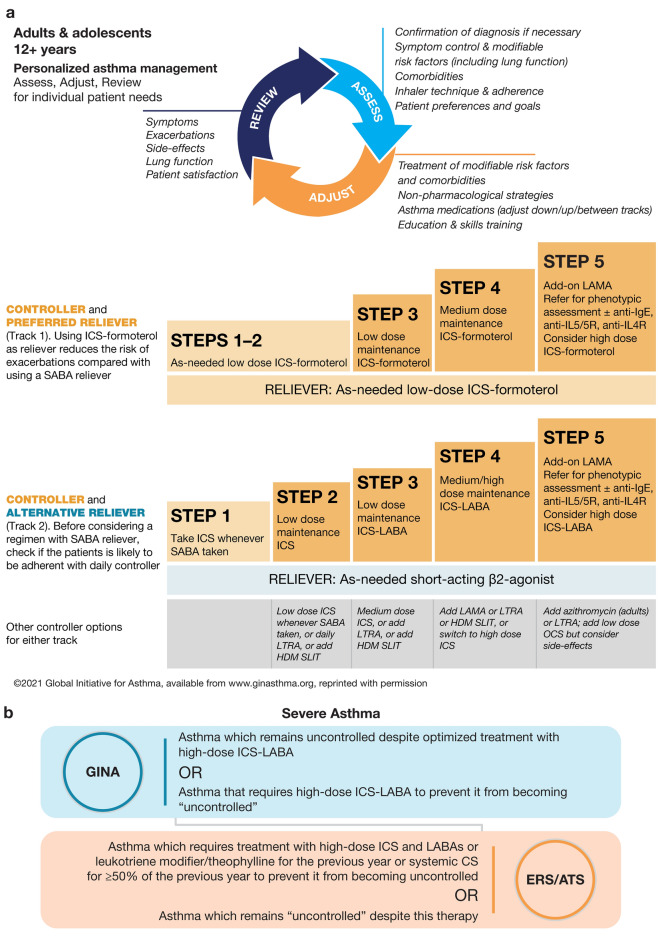
Fig. 1
Fig. 1
a GINA recommended stepwise asthma treatment. b Severe asthma definition [1, 2]. ATS American Thoracic Society, BDP budesonide propionate, CS corticosteroids, ERS European Respiratory Society, FEV1 forced expiratory volume in 1 s, GINA Global Initiative for Asthma, HDM house dust mite, ICS inhaled corticosteroids, IgE immunoglobulin E, IL interleukin, LABA long-acting β2-agonist, LAMA long-acting muscarinic antagonist; LTRA leukotriene receptor antagonist, OCS oral corticosteroids; SABA short-acting β2-agonist; SLIT sublingual immunotherapy
Fig. 2
Fig. 2
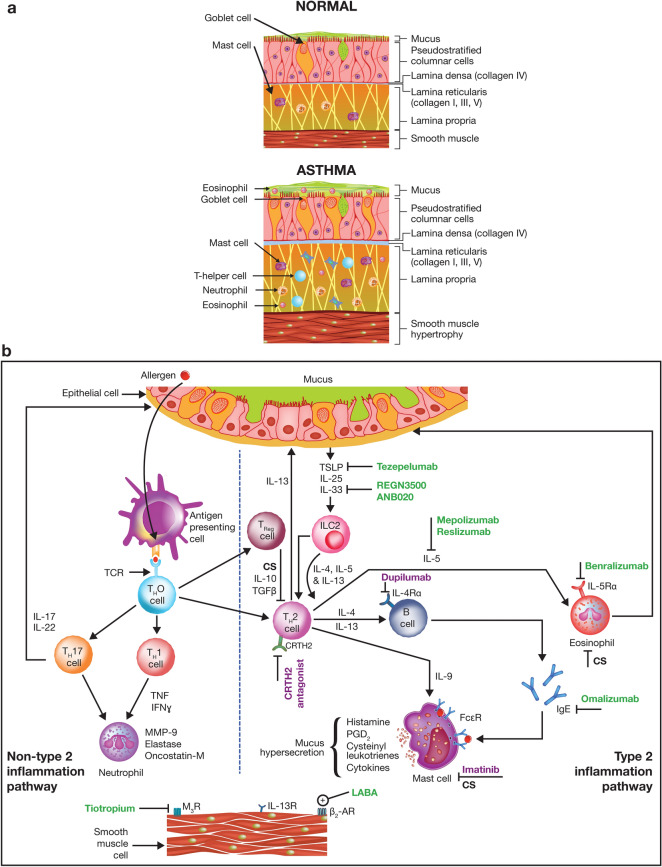
a Cross-section and histology of airways in a normal person and a patient with asthma. b Pathways of inflammatory responses, biomarkers, and mechanism of action of various therapeutic agents. β2-AR β2-adrenergic receptor, CS corticosteroids, CRTH2 chemoattractant receptor-homologous molecule expressed on Th2 cells, FcεR Fcε receptor, IFN interferon, Ig immunoglobulin, IL interleukin, ILC2 innate lymphoid cell type 2, LABA long-acting β2-agonist, MMP-9 matrix metallopeptidase 9, M3R muscarinic receptor type 3, PGD2 prostaglandin D2, TCR T-cell receptor, TGF tumor growth factor, TNF tumor necrosis factor, Th T helper, TSLP thymic stromal lymphopoietin
Fig. 3
Fig. 3
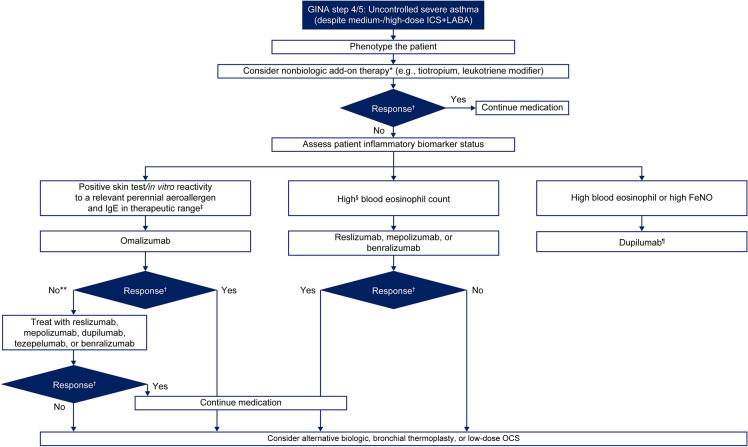
Selection of treatment options for patients with severe asthma based on clinical evaluation and biomarker levels. Biomarkers shown are not mutually exclusive. *Add-on inhaled therapy such as tiotropium may be considered before initiating biologics therapy because of the comparatively low costs associated with its use [46]. Response is defined as a reduction in exacerbations and improvement in asthma control within threshold levels. Total IgE levels should be 30–700 IU/mL. §Blood eosinophil count thresholds: reslizumab ≥ 400 µL; mepolizumab ≥ 150 cells/µL, and dupilumab and benralizumab ≥ 300 cells/µL. **Patients with high IgE levels who have blood eosinophil counts ≥ 300 cells/µL may be considered for Th2 biologic therapy. According to GINA 2021 recommendations [2], potential predictors of good asthma response include increasing baseline levels of blood eosinophils and FeNO [82]. FeNO fractional exhaled nitric oxide, FDA Food and Drug Administration, GINA Global Initiative for Asthma, ICS inhaled corticosteroids, Ig immunoglobulin, LABA long-acting β2-agonist, LTRA leukotriene receptor antagonist, OCS oral corticosteroid, Th T helper

References

    1. Chung KF, Wenzel SE, Brozek JL, Bush A, Castro M, Sterk PJ, et al. International ERS/ATS guidelines on definition, evaluation and treatment of severe asthma. Eur Respir J. 2014;43:343–373. doi: 10.1183/09031936.00202013. - DOI - PubMed
    1. Global Initiative for Asthma. Global strategy for asthma management and prevention; 2021. https://ginasthma.org/gina-reports/. Accessed 10 June 2021.
    1. Hekking PP, Wener RR, Amelink M, Zwinderman AH, Bouvy ML, Bel EH. The prevalence of severe refractory asthma. J Allergy Clin Immunol. 2015;135:896–902. doi: 10.1016/j.jaci.2014.08.042. - DOI - PubMed
    1. von Bulow A, Kriegbaum M, Backer V, Porsbjerg C. The prevalence of severe asthma and low asthma control among Danish adults. J Allergy Clin Immunol Pract. 2014;2:759–767. doi: 10.1016/j.jaip.2014.05.005. - DOI - PubMed
    1. von Bülow A, Backer V, Bodtger U, Søes-Petersen NU, Vest S, Steffensen I, et al. Differentiation of adult severe asthma from difficult-to-treat asthma—outcomes of a systematic assessment protocol. Respir Med. 2018;145:41–47. doi: 10.1016/j.rmed.2018.10.020. - DOI - PubMed