. 2023 Mar;21(3):482-496.
doi: 10.1111/pbi.13859. Epub 2023 Jan 24.

Whole-genome sequencing uncovers the structural and transcriptomic landscape of hexaploid wheat/Ambylopyrum muticum introgression lines

Affiliations

Whole-genome sequencing uncovers the structural and transcriptomic landscape of hexaploid wheat/Ambylopyrum muticum introgression lines

Benedict Coombes et al. Plant Biotechnol J. 2023 Mar.

Abstract

Wheat is a globally vital crop, but its limited genetic variation creates a challenge for breeders aiming to maintain or accelerate agricultural improvements over time. Introducing novel genes and alleles from wheat's wild relatives into the wheat breeding pool via introgression lines is an important component of overcoming this low variation but is constrained by poor genomic resolution and limited understanding of the genomic impact of introgression breeding programmes. By sequencing 17 hexaploid wheat/Ambylopyrum muticum introgression lines and the parent lines, we have precisely pinpointed the borders of introgressed segments, most of which occur within genes. We report a genome assembly and annotation of Am. muticum that has facilitated the identification of Am. muticum resistance genes commonly introgressed in lines resistant to stripe rust. Our analysis has identified an abundance of structural disruption and homoeologous pairing across the introgression lines, likely caused by the suppressed Ph1 locus. mRNAseq analysis of six of these introgression lines revealed that novel introgressed genes are rarely expressed and those that directly replace a wheat orthologue have a tendency towards downregulation, with no discernible compensation in the expression of homoeologous copies. This study explores the genomic impact of introgression breeding and provides a schematic that can be followed to characterize introgression lines and identify segments and candidate genes underlying the phenotype. This will facilitate more effective utilization of introgression pre-breeding material in wheat breeding programmes.

Keywords: Wheat; breeding; genomics; introgression; resistance; wild relative.


Conflict of interest statement

The authors declare that they have no competing interests.

Figures
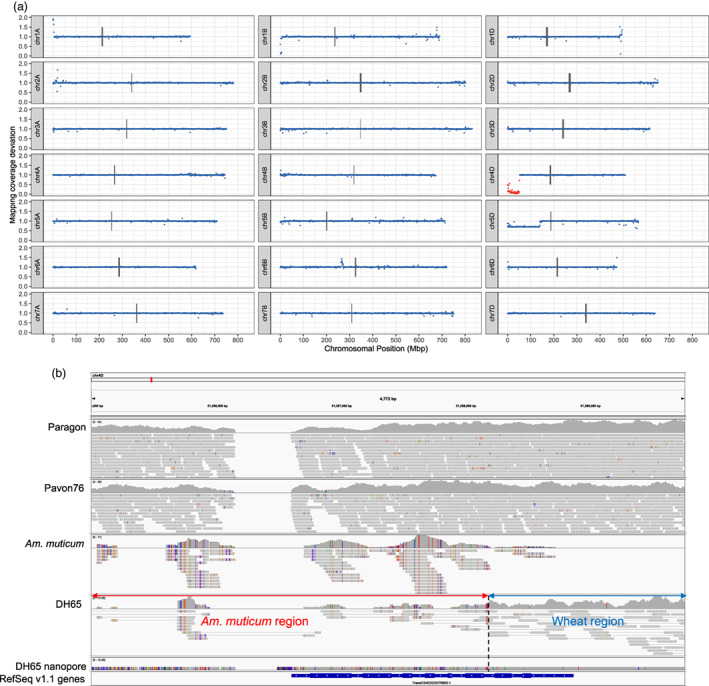
Figure 1
Figure 1
Identifying introgressed Am. muticum segments using whole‐genome sequencing data. (a) Introgression line DH65, which has a 51.29Mbp introgressed segment on chr4D and a 139.6Mbp monosomic deletion on chr5D. Each point represents the deviation in mapping coverage with the wheat parent lines in 1Mbp windows across Chinese Spring RefSeq v1.0. Windows within assigned Am. muticum introgression blocks are coloured red. (b) IGV image showing junction at the right‐hand side of chr4D segment in the introgression line DH65 (Figure 1a), spanned by both Illumina paired‐end reads and Oxford Nanopore reads from DH65. The first four tracks show mapped illumina WGS data, the fifth track shows assembled contig from aligned Oxford Nanopore reads for DH65, and the bottom track shows high confidence genes from the RefSeq v1.1 annotation.
Figure 2
Figure 2
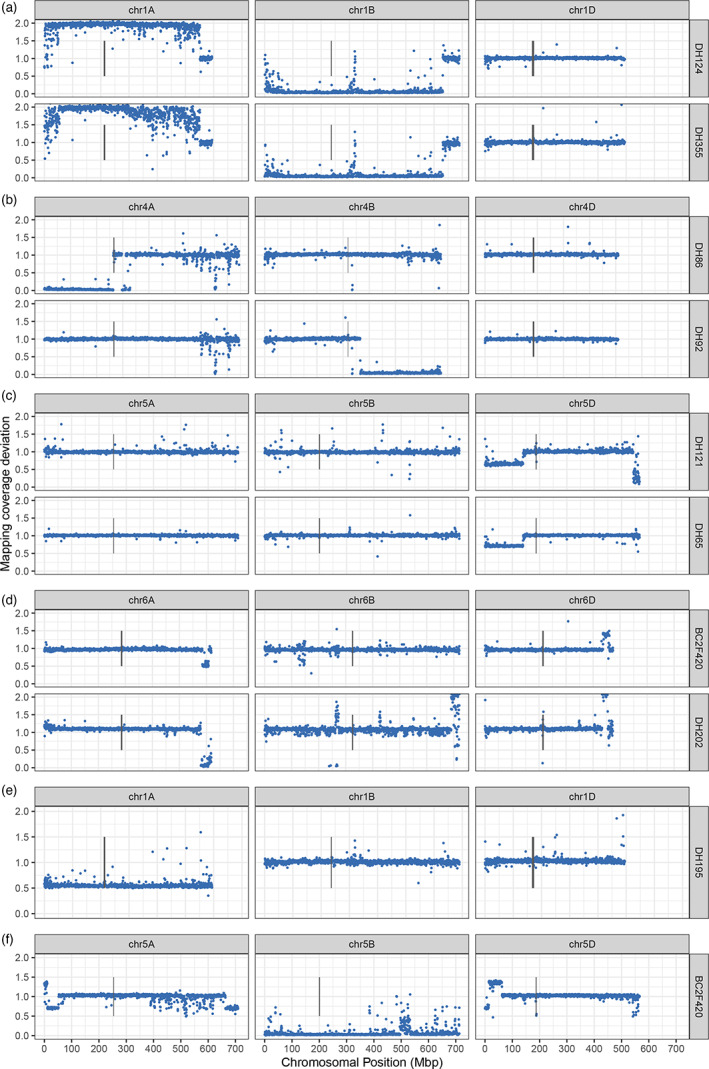
Large chromosomal aberrations in Am. muticum introgression lines. Each point shows mapping coverage deviation compared with the wheat parents in 500Kbp windows across the genome. (a) Corresponding duplication and deletion seen in both lines of the DH pair, caused by pairing of a duplicated chr1A and chr1B. Mapping coverage deviation of 1 at the end of chr1A and chr1B indicates a large translocation between chr1A and chr1B has taken place in duplicated chr1A + chr1B pair and discontiguous mapping coverage deviation change towards beginning of chr1A and chr1B suggests lots of smaller translocation events. (b) Chromosome arm deletions on homoeologous chromosomes of DH pair. (c) Monosomic deletions at the same position in two independently derived lines. (d) Homoeologous exchange within homoeologous group 6, at similar positions in two independently derived lines. (e) Monosomic deletion of chr1A in DH195. (f) Homoeologous recombination event between chr5A and chr5D and a deleted chr5B.
Figure 3
Figure 3
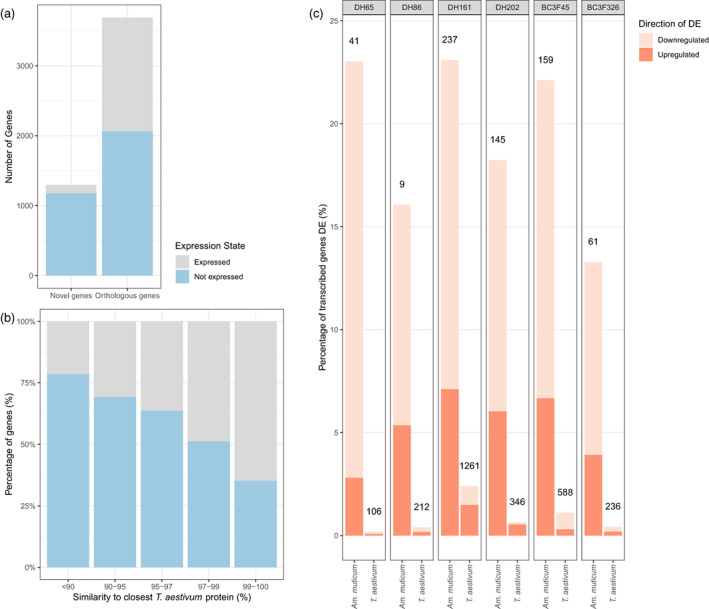
Expression of introgressed Am. muticum genes. (a) Expression state (Expressed or Not Expressed) of novel introgressed genes and introgressed genes in an orthogroup with a wheat gene (b) Expression state (Expressed or Not Expressed) of introgressed genes within an orthogroup with a wheat gene, binned by the protein identity between the Am. muticum protein and the most similar protein in the wheat reference genome annotation RefSeq v1.1. (c) Differential expression in 6 introgression lines, looking at introgressed genes compared to the orthologue they replaced in the parent lines, and background wheat genes compared with the expression in the wheat parent lines. The height of the bar represents the percentage of genes differentially expressed within introgressed and background regions for each line. The number above each bar is the number of genes called as differentially expressed.
Figure 4
Figure 4
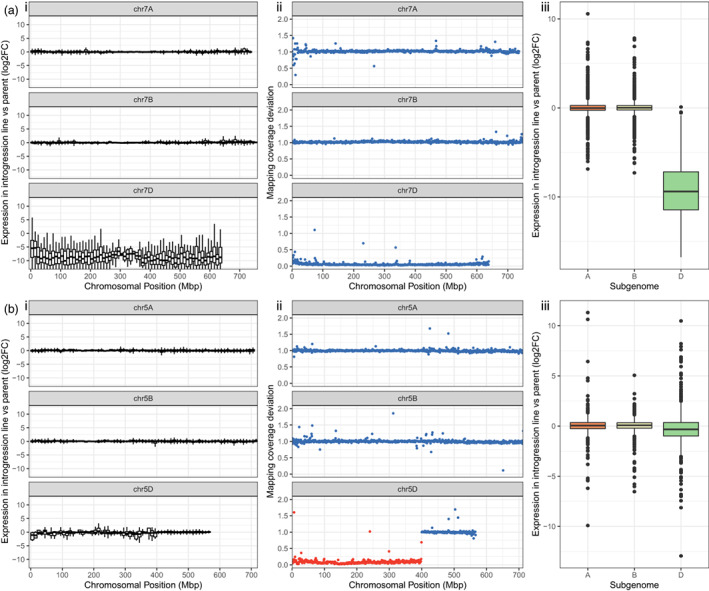
Expression profile across introgression and a deleted region and their homoeologous regions. (a) chr5A, chr5B and chr5D in BC3F45, with a chr5D:1‐400Mbp introgression where chr5D genes have been replaced by Am. muticum orthologues (b) chr7A, chr7B and chr7D in DH161 where chr7D has been deleted. i DESeq2 processed log2FC (introgression line/Paragon) of expression compared with Paragon binned into 10Mbp window ii Macro level structure in 1Mbp windows. Each point represents the deviation in mapping coverage compared to the parent lines in 1Mbp windows across Chinese Spring RefSeq v1.0. Windows within assigned Am. muticum introgression blocks are coloured red; iii. log2FC (introgression line/Paragon) of A, B and D homoeologues belonging to triads in which the D copy has been deleted or replaced by an Am. muticum gene.
Figure 5
Figure 5
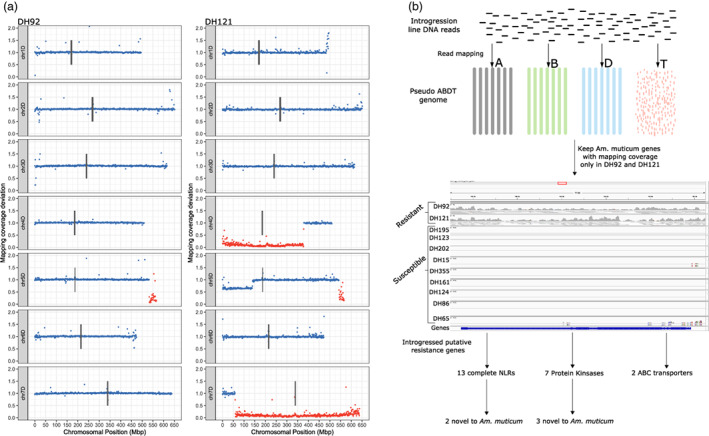
Identifying candidate introgressed resistance genes. Introgression lines DH92 and DH121 possess a partially overlapping introgressed segment on chr5D, a common resistance phenotype to stripe rust but a differential resistance phenotype to leaf and stripe rust. (a) Macro‐level structure of the D subgenome of DH92 and DH121 (no segments on A or B subgenomes). Each point represents the deviation in mapping coverage compared with the parent lines in 1Mbp windows across Chinese Spring RefSeq v1.0. Windows within assigned Am. muticum introgression blocks are coloured red. (b) Identifying resistance genes uniquely introgressed in DH92 and DH121 and thus candidates for the stripe rust resistance shared between the two lines.

References

    1. Alexa, A. , Rahnenfuhrer, J. , (2021) topGO: enrichment analysis for gene ontology. R package version 2.38.1.
    1. Bolger, A.M. , Lohse, M. and Usadel, B. (2014) Trimmomatic: a flexible trimmer for Illumina sequence data. Bioinformatics 30, 2114–2120. - PMC - PubMed
    1. Camacho, C. , Coulouris, G. , Avagyan, V. , Ma, N. , Papadopoulos, J. , Bealer, K. and Madden, T.L. (2009) BLAST+: architecture and applications. BMC Bioinformatics 10, 421. - PMC - PubMed
    1. Charmet, G. (2011) Wheat domestication: lessons for the future. C. R. Biol. 334, 212–220. - PubMed
    1. Chen, S. , Rouse, M.N. , Zhang, W. , Zhang, X. , Guo, Y. , Briggs, J. and Dubcovsky, J. (2020) Wheat gene Sr60 encodes a protein with two putative kinase domains that confers resistance to stem rust. New Phytol. 225, 948–959. - PubMed

Publication types

LinkOut - more resources