


Application of precision medicine in clinical routine in haematology-Challenges and opportunities
- PMID: 35599019
- PMCID: PMC9546002
- DOI: 10.1111/joim.13508
Application of precision medicine in clinical routine in haematology-Challenges and opportunities
Abstract
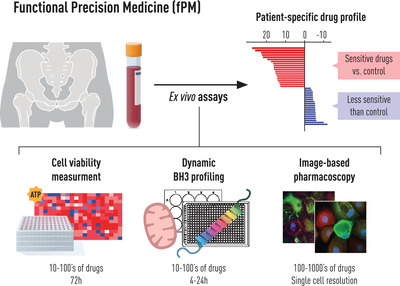
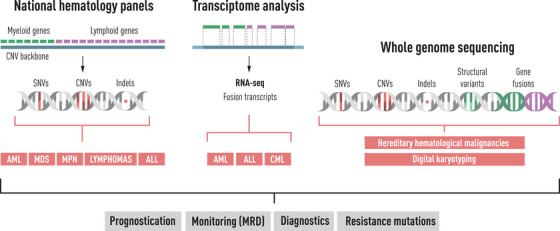
Precision medicine is revolutionising patient care in cancer. As more knowledge is gained about the impact of specific genetic lesions on diagnosis, prognosis and treatment response, diagnostic precision and the possibility for optimal individual treatment choice have improved. Identification of hallmark genetic aberrations such as the BCR::ABL1 gene fusion in chronic myeloid leukaemia (CML) led to the rapid development of efficient targeted therapy and molecular follow-up, vastly improving survival for patients with CML during recent decades. The assessment of translocations, copy number changes and point mutations are crucial for the diagnosis and risk stratification of acute myeloid leukaemia and myelodysplastic syndromes. Still, the often heterogeneous and complex genetic landscape of haematological malignancies presents several challenges for the implementation of precision medicine to guide diagnosis, prognosis and treatment choice. This review provides an introduction and overview of the important molecular characteristics and methods currently applied in clinical practice to guide clinical decision making in haematological malignancies of myeloid and lymphoid origin. Further, experimental ways to guide the choice of targeted therapy for refractory patients are reviewed, such as functional precision medicine using drug profiling. An example of the use of pipeline studies where the treatment is chosen according to the molecular characteristics in rare solid malignancies is also provided. Finally, the future opportunities and remaining challenges of precision medicine in the real world are discussed.
Keywords: MRD; drug screening; haematology; precision medicine.
© 2022 The Authors. Journal of Internal Medicine published by John Wiley & Sons Ltd on behalf of Association for Publication of The Journal of Internal Medicine.
Conflict of interest statement
L. B. has held an advisory role and/or received honoraria from AbbVie, Amgen, Astellas, BristolMyers Squibb, Celgene, Daiichi Sankyo, Gilead, Hexal, Janssen, Jazz Pharmaceuticals, Menarini, Novartis, Pfizer, Roche, Sanofi and Seattle Genetics, and has received research support from Bayer and Jazz Pharmaceuticals.
M. K. has received grants from NIH, NCI, AbbVie, Genentech, Stemline Therapeutics, Forty‐Seven, Eli Lilly, Cellectis, Calithera, Ablynx and AstraZeneca; consulting/honorarium from AbbVie, Genentech, F. Hoffman La‐Roche, Stemline Therapeutics, Amgen, Forty‐Seven and Kisoji; clinical trial support from Ascentage and has stocks/royalties in Reata Pharmaceutical. T. F. is a cofounder and board member and owns stocks in Cantargia AB and Qlucore AB. The remaining authors have no conflicts of interest to declare.
Figures
References
-
- Mullighan CG, Goorha S, Radtke I, Miller CB, Coustan‐Smith E, Dalton JD, et al. Genome‐wide analysis of genetic alterations in acute lymphoblastic leukaemia. Nature. 2007;446:758–64. - PubMed
Publication types
MeSH terms
Substances
LinkOut - more resources
Full Text Sources
Medical
Research Materials
Miscellaneous
