


Decay of anti-Bordetella pertussis antibodies in women of childbearing age following COVID-19 non-pharmaceutical measures
- PMID: 35599039
- PMCID: PMC9091163
- DOI: 10.1016/j.vaccine.2022.04.086
Decay of anti-Bordetella pertussis antibodies in women of childbearing age following COVID-19 non-pharmaceutical measures
Abstract
Background: Immunization against Bordetella pertussis during pregnancy reduces morbidity from severe pertussis in young infants via trans-placental transfer of anti-B. pertussis Immunoglobulin G (IgG). Studies have reported a near disappearance of respiratory pathogens including B. pertussis following implementation of mitigation strategies to control Coronavirus disease 2019 (COVID-19). We explored how immunity against B. pertussis changed in women of childbearing-age through the COVID-19 pandemic.
Methods: Paired blood samples from females of childbearing-age collected at the beginning (May-June 2020) and nearly one year into the COVID-19 pandemic (February-May 2021) in British Columbia (BC), Canada were tested for anti-B. pertussis IgG levels. To ascertain whether early-pandemic IgG levels in 2020 reflected levels in pregnant women early in gestation, 1st trimester sera collected from age-matched healthy pregnant women in 2018 and 2019 were tested for anti-B. pertussis IgG. Levels were compared by t tests. P-value of 0.05 was assigned and statistical significance was set as p < 0.016 using Bonferroni correction.
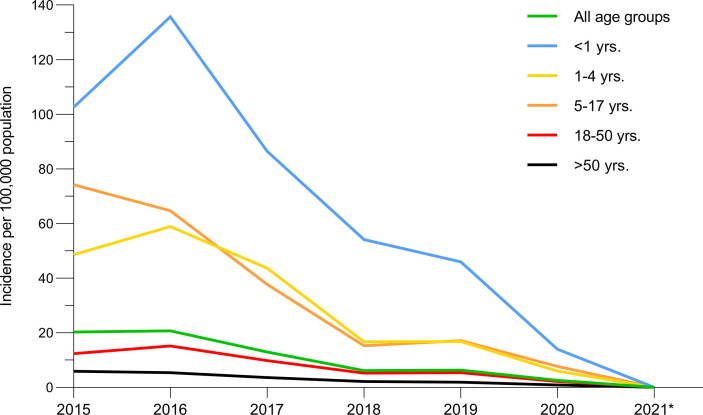
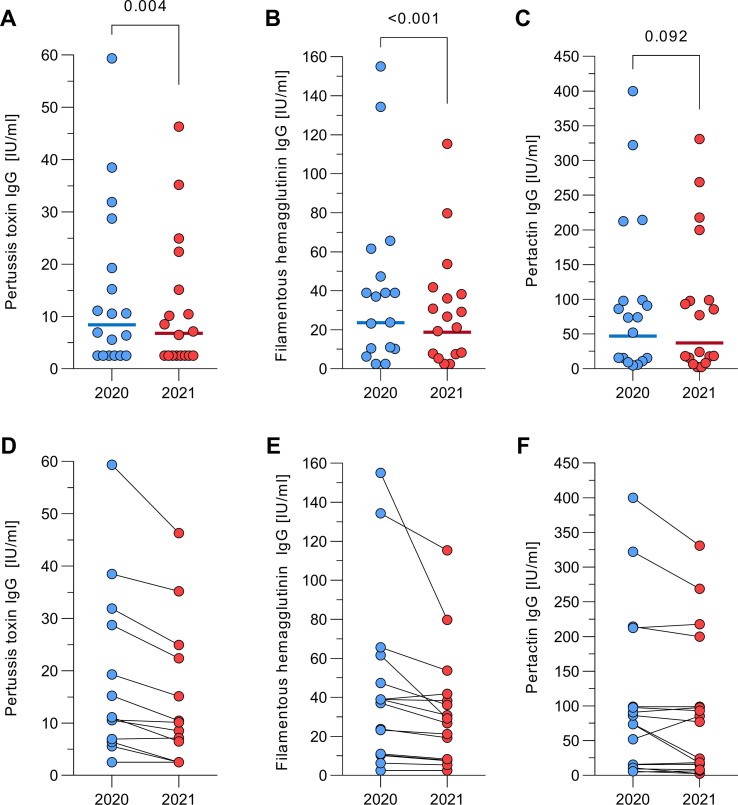
Results: Annual provincial B. pertussis incidences per 100,000 in BC in 2020 (3/100,000) and 2021 (<1/100,000) approximated the lowest levels since 1990. In 2021 vs. 2020, anti-pertussis toxin (PT), filamentous hemagglutinin (FHA) and pertactin (PRN) IgG levels declined in women of childbearing-age: 6.8 IU/ml (95 %CI, 4.2-10.9) vs. 8.4 IU/ml (5.1-13.9; p = 0.004); 18.8 IU/ml (10.9-32.2) vs. 23.6 IU/ml (13.2-42.1; p < 0.001); and 37.1 IU/ml (18.1-75.9) vs. 47.2 IU/ml (24.8-89.9; p = 0.092), respectively. Although all values were slightly higher, anti-PT, FHA and PRN IgG levels in women of childbearing age did not significantly differ in 2020 compared with early-gestation pregnant women in 2018-2019, 8.4 IU/ml (95% CI, 5.1-13.9) vs. 5.4 IU/ml (95% CI, 3.8-7.7; p = 0.166), 23.6 IU/ml (95% CI, 13.2-42.1) vs. 20.1 IU/ml (95% CI, 13.4-30.2; p = 0.656), and 47.2 IU/ml (24.8-89.9) vs. 17.3 IU/ml (95% CI, 10.5-28.7; p = 0.021), respectively.
Discussion: B. pertussis infections should be closely monitored during the relaxing of mitigation measures for COVID-19.
Keywords: Antenatal immunization; COVID-19; Immunity; Pertussis.
Copyright © 2022 Elsevier Ltd. All rights reserved.
Conflict of interest statement
Declaration of Competing Interest The authors declare that they have no known competing financial interests or personal relationships that could have appeared to influence the work reported in this paper.
Figures
References
-
- Abu Raya B., Srugo I., Kessel A., Peterman M., Vaknin A., Bamberger E. The decline of pertussis-specific antibodies after tetanus, diphtheria, and acellular pertussis immunization in late pregnancy. J Infect Dis. 2015;212(12):1869–1873. - PubMed
-
- Abu Raya B., Srugo I., Kessel A., Peterman M., Bader D., Gonen R., et al. The effect of timing of maternal tetanus, diphtheria, and acellular pertussis (Tdap) immunization during pregnancy on newborn pertussis antibody levels - a prospective study. Vaccine. 2014;32(44):5787–5793. - PubMed
-
- Hoang H.T.T., Leuridan E., Maertens K., Nguyen T.D., Hens N., Vu N.H., et al. Pertussis vaccination during pregnancy in Vietnam: Results of a randomized controlled trial Pertussis vaccination during pregnancy. Vaccine. 2016;34(1):151–159. - PubMed
-
- Vilajeliu A., Ferrer L., Munrós J., Goncé A., López M., Costa J., et al. Pertussis vaccination during pregnancy: antibody persistence in infants. Vaccine. 2016;34(33):3719–3722. - PubMed
Publication types
MeSH terms
Substances
LinkOut - more resources
Full Text Sources
Medical
