


Maternal socioeconomic and lifestyle factors and life dissatisfaction associated with a small for gestational age infant. The Survey of Neonates in Pomerania (SNiP)
- PMID: 35599250
- PMCID: PMC10023753
- DOI: 10.1007/s00404-022-06598-x
Maternal socioeconomic and lifestyle factors and life dissatisfaction associated with a small for gestational age infant. The Survey of Neonates in Pomerania (SNiP)
Abstract
Purpose: The aim is to investigate the associations of the mother's socioeconomic and lifestyle factors and life satisfaction with the delivery of a small for gestational age (SGA) infant.
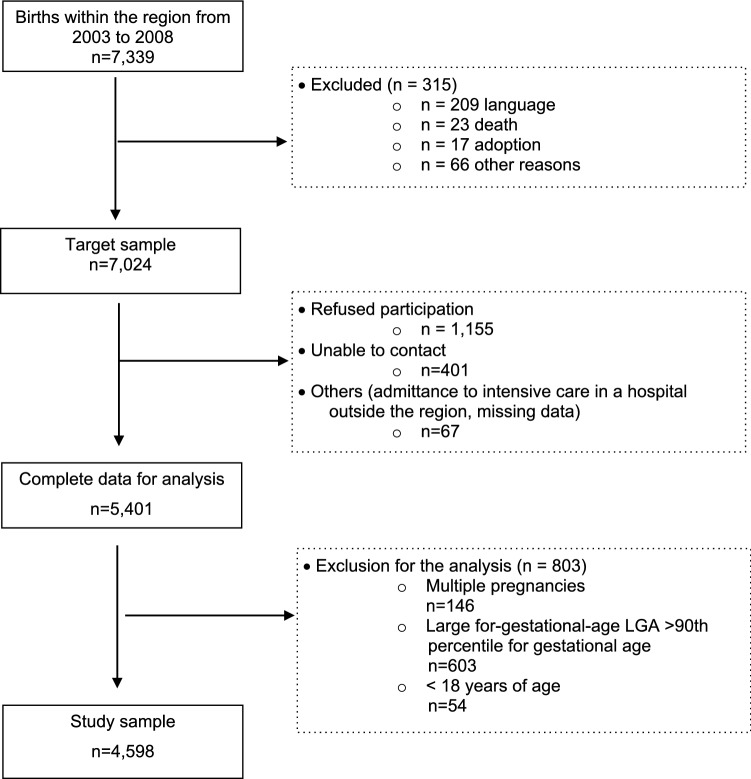
Methods: Data from 4598 participants of the population-based birth cohort study Survey of Neonates in Pomerania (SniP) including comprehensive information on pregnancies, mothers, and their offspring in Western Pomerania, Germany were used in this study. The associations were analyzed using linear and logistic regression models.
Results: After logistic regression analysis adjusted for height of the mother, women who delivered SGA infants, had lower education (p < 0.01) and smoked more frequently during pregnancy (p < 0.01) compared with mothers of adequate for gestational age (AGA) neonates. A mother with less than 10 years of education and one who continued smoking during pregnancy had an odds ratio (OR) of 2.23 [95% confidence interval (CI) = 1.44 to 3.46] and 2.68 (95% CI = 2.06-3.49) of having an SGA infant, respectively. There was no association between the employment of the mother (p = 0.28), the monthly income (p = 0.09), the family status (p = 0.80), the number of friendships outside the household that the mother would not wish to relinquish (p = 0.47), the number of people that she could rely on in case of an emergency (p = 0.75), or alcohol consumption prior to (p = 0.14) or during the pregnancy (p = 0.99) with SGA. Finally, women who delivered SGA infants were more frequently dissatisfied with their employment (p = 0.03) and financial status (p < 0.01).
Conclusions: Women who delivered SGA infants had more associated socioeconomic and lifestyle risk factors and were more frequently dissatisfied with their life conditions than mothers of AGA neonates.
Keywords: Fetal growth restriction; Infant; Pregnancy; Risk factors; Small for gestational age; Smoking in pregnancy; Socioeconomic status.
© 2022. The Author(s).
Conflict of interest statement
Financial interests: HJ Grabe has received travel grants and speakers honoraria from Fresenius Medical Care, Neuraxpharm, Servier and Janssen Cilag as well as research funding from Fresenius Medical Care. M Heckmann has received speaker honoraria from Baxter and Chiesi. All other authors have no relevant financial or non-financial interests to disclose.
References
-
- Nations U . The millennium development goals report 2013. New York: United Nations; 2013.
Publication types
MeSH terms
LinkOut - more resources
Full Text Sources
Miscellaneous
