


Relation of glycemic status with unrecognized MI and the subsequent risk of mortality: The Jackson Heart Study
- PMID: 35600110
- PMCID: PMC9119819
- DOI: 10.1016/j.ajpc.2022.100348
Relation of glycemic status with unrecognized MI and the subsequent risk of mortality: The Jackson Heart Study
Abstract
Background: Almost 1/3 to 1/2 of initial myocardial infarctions (MI) may be silent or unrecognized (UMI), which forecasts future clinical events. Further, limited data exist to describe the potential risk for UMI in African-Americans. The relationship of glucose status with UMI was examined in the Jackson Heart Study: a cohort of African-American individuals.
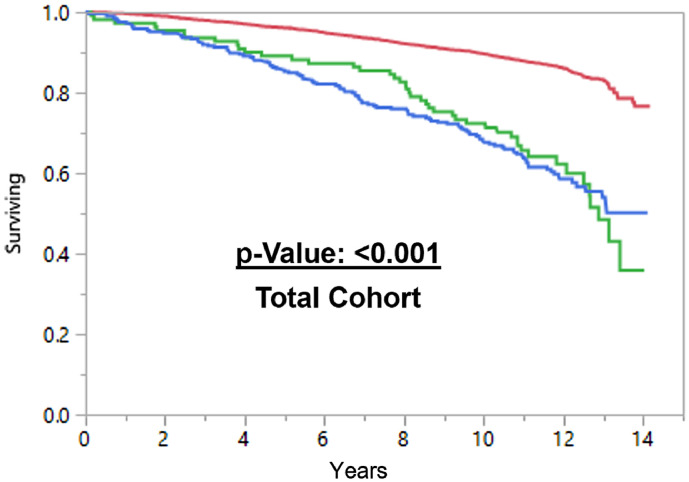
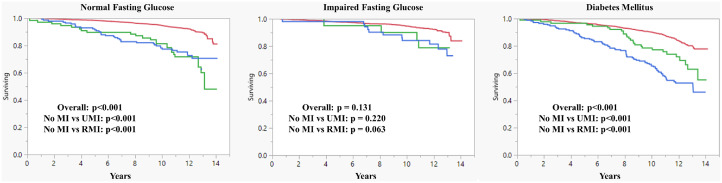
Methods and results: At baseline, there were 5,073 participants with an initial 12-lead electrocardiogram (ECG) and fasting glucose measured. Of these participants, 106(2.1%) had a UMI, and 268(4.2%) had a recognized MI. This population consisted of 3,233 (63.7%) participants with normal fasting glucose (NFG), 533 (10.5%) with IFG, and 1,039 (20.4%) with DM. Logistic regression investigated the relationship between glucose status and UMI. Cox proportional hazard models determined the significance of all-cause mortality during follow-up by MI status. The sample was 65% female with a mean age of 55.3 ± 12.9 years. Over a mean follow-up of 10.4 years, there were 795 deaths. Relative to NFG, the crude odds ratio (OR) estimates for UMI at baseline with IFG and DM were 1.00(95% CI:0.48-2.14) and 3.22(2.15-4.81), respectively. With adjustment, DM continued to be significantly associated with UMI [2.30 (1.42-3.71)]. Overall, participants with a baseline UMI had an adjusted Hazard ratio (HR) of 2.00(1.39-2.78) of death compared to no prior MI. Compared to those with no MI, those with a recognizedMI had an adjusted HR of 1.70(1.31-2.17) for mortality.
Conclusions: DM is associated with UMI in African-Americans. Further, a UMI carried similar risk of death compared to those with a recognized MI.
Keywords: Diabetes mellitus; ECG; Fasting glucose status; Silent myocardial infarction.
© 2022 The Authors. Published by Elsevier B.V.
Figures
References
-
- Zhang Z.M., Rautaharju P.M., Prineas R.J., Rodriguez C.J., Loehr L., Rosamond W.D., Kitzman D., Couper D., Soliman E.Z. Race and sex differences in the incidence and prognostic significance of silent myocardial infarction in the atherosclerosis risk in communities (ARIC) study. Circulation. 2016;133:2141–2148. - PMC - PubMed
-
- Sheifer S.E., Gersh B.J., Yanez N.D., Ades P.A., Burke G.L., Manolio T.A. Prevalence, predisposing factors, and prognosis of clinically unrecognized myocardial infarction in the elderly. J Am Coll Cardiol. 2000;35:119–126. - PubMed
-
- Davis T.M., Coleman R.L., Holman R.R. Prognostic significance of silent myocardial infarction in newly diagnosed type 2 diabetes mellitus: united Kingdom Prospective Diabetes Study (UKPDS) 79. Circulation. 2013;127:980–987. - PubMed
-
- Davis T.M.E., Fortun P., Mulder J., WA Davis, Bruce D.G. Silent myocardial infarction and its prognosis in a community-based cohort of type 2 diabetic patients: the Fremantle diabetes study. Diabetologia. 2004;47:395–399. - PubMed
-
- Dehghan A., Leening M.J., Solouki A.M., Boersma E., Deckers J.W., van Herpen G., Heeringa J., Hofman A., Kors J.A., Franco O.H., Ikram M.A., Witteman J.C. Comparison of prognosis in unrecognized versus recognized myocardial infarction in men versus women >55 years of age (from the Rotterdam study) Am J Cardiol. 2014;113:1–6. - PubMed
LinkOut - more resources
Full Text Sources
