


Topography versus non-topography-guided photorefractive keratectomy with corneal cross-linking variations in keratoconus
- PMID: 35601161
- PMCID: PMC9091898
- DOI: 10.18240/ijo.2022.05.05
Topography versus non-topography-guided photorefractive keratectomy with corneal cross-linking variations in keratoconus
Abstract
Aim: To compare the visual results of non-topography-guided and topography-guided photorefractive keratectomy (PRK) applying sequential and simultaneous corneal cross-linking (CXL) treatment for keratoconus.
Methods: Interventional and comparative prospective study. Sixty-nine eyes (36 patients) suffering from keratoconus (stages 1 Amsler-Krumeich classification) were divided into four groups: sequential topography-guided photorefractive keratectomy with CXL, simultaneous topography-guided photorefractive keratectomy with CXL, simultaneous non-topography guided photorefractive keratectomy with CXL, and sequential non-topography guided photorefractive keratectomy with CXL. The main outcome measures were pre- and postoperative uncorrected distance visual acuity (UDVA), best corrected distance visual acuity (CDVA), manifest refraction, contrast sensitivity, and keratometry.
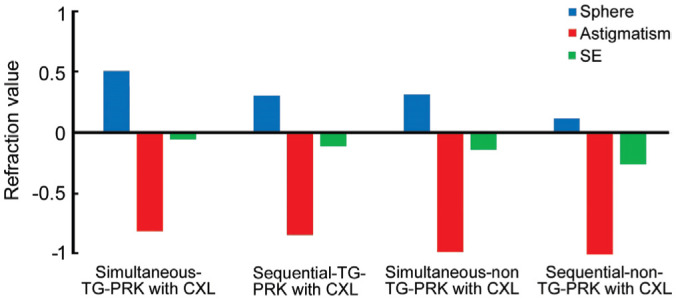
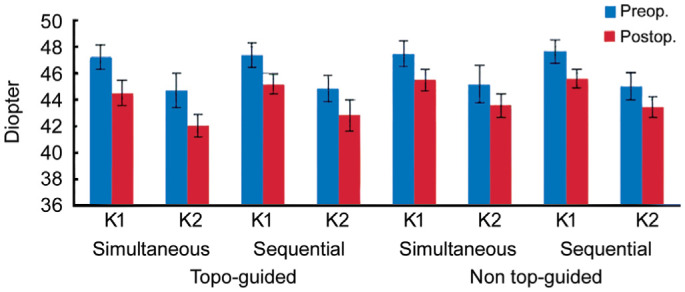
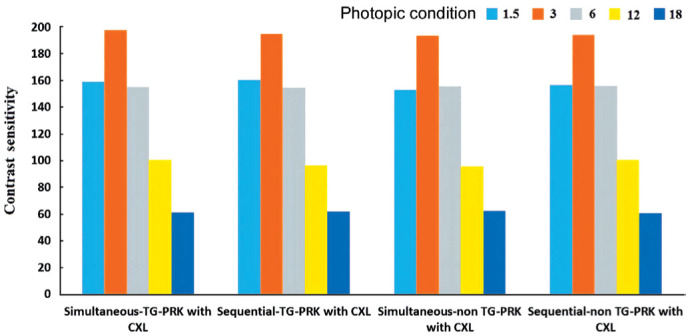
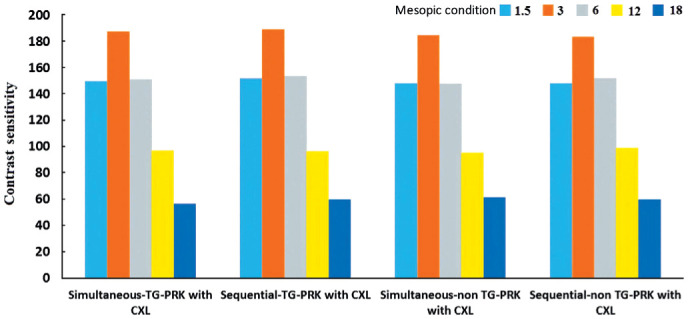
Results: All analyzed visual, contrast sensitivity, and refractive parameters showed a significant improvement in the four groups (all P<0.05). A noticeable improvement was seen in keratometry in all the groups, and a remarkable difference was observed between topography-guided groups in comparison to non-topography-guided groups (P<0.05). Interestingly, the improvement in all parameters showed a degree of stability to the end of the follow-up.
Conclusion: The treatment priorities in all four groups are safety, efficacy, and predictability in the correction of the sphero-cylindrical errors in mild and moderate keratoconus. No significant differences among groups in the recorded objective outcomes were found.
Keywords: corneal collagen cross-linking; keratoconus; photorefractive keratectomy.
International Journal of Ophthalmology Press.
Figures
References
-
- Choksi T, Sahdev S, Pawar R. Keratoconus: available treatment options. Delhi Journal of Ophthalmology. 2021;31:13–17.
-
- Dupps WJ., Jr Corneal refractive surgery in keratoconus. J Cataract Refract Surg. 2020;46(4):495–496. - PubMed
-
- Jhanji V, Sharma N, Vajpayee RB. Management of keratoconus: current scenario. Br J Ophthalmol. 2011;95(8):1044–1050. - PubMed
-
- Coskunseven E, Kymionis GD, Tsiklis NS, Atun S, Arslan E, Jankov MR, Pallikaris IG. One-year results of intrastromal corneal ring segment implantation (KeraRing) using femtosecond laser in patients with keratoconus. Am J Ophthalmol. 2008;145(5):775–779. - PubMed
LinkOut - more resources
Full Text Sources