


Impact of dehydration on perceived exertion during endurance exercise: A systematic review with meta-analysis
- PMID: 35601980
- PMCID: PMC9093000
- DOI: 10.1016/j.jesf.2022.03.006
Impact of dehydration on perceived exertion during endurance exercise: A systematic review with meta-analysis
Abstract
Background: Understanding the impact of stressors on the rating of perceived exertion (RPE) is relevant from a performance and exercise adherence/participation standpoint. Athletes and recreationally active individuals dehydrate during exercise. No attempt has been made to systematically determine the impact of exercise-induced dehydration (EID) on RPE.
Objective: The present meta-analysis aimed to determine the effect of EID on RPE during endurance exercise and examine the moderating effect of potential confounders.
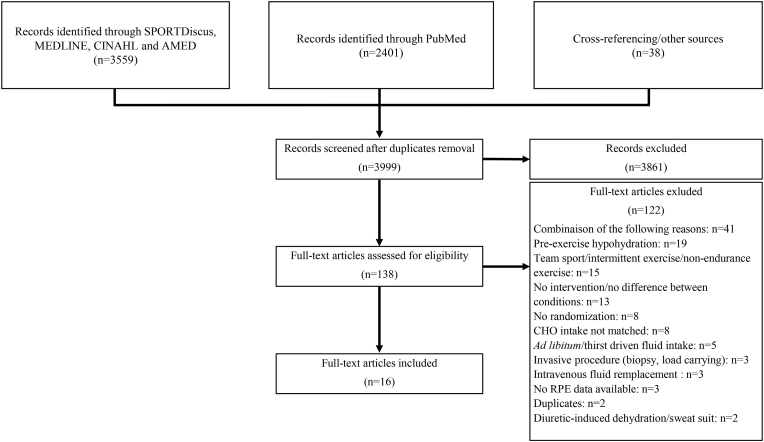
Data analyses: Performed on raw RPE values using random-effects models weighted mean effect summaries and meta-regressions with robust standard errors, and with a practical meaningful effect set at 1 point difference between euhydration (EUH) and EID. Only controlled crossover studies measuring RPE with a Borg scale in healthy adults performing ≥30 min of continuous endurance exercise while dehydrating or drinking to maintain EUH were included.
Results: Sixteen studies were included, representing 147 individuals. Mean body mass loss with EUH was 0.5 ± 0.4%, compared to 2.3 ± 0.5% with EID (range 1.7-3.1%). Within an EID of 0.5-3% body mass, a maximum difference in RPE of 0.81 points (95% CI: 0.36-1.27) was observed between conditions. A meta-regression revealed that RPE increases by 0.21 points for each 1% increase in EID (95% CI: 0.12-0.31). Humidity, ambient temperature and aerobic capacity did not alter the relationship between EID and RPE.
Conclusion: Therefore, the effect of EID on RPE is unlikely to be practically meaningful until a body mass loss of at least 3%.
Keywords: Hydration; Hypohydration; Performance; RPE; Rating of perceived exertion.
© 2022 The Society of Chinese Scholars on Exercise Physiology and Fitness. Published by Elsevier (Singapore) Pte Ltd.
Figures


References
-
- Riebe D., Ehrman J.K., Liguori G., Magal M., Medicine ACoS . Wolters Kluwer; 2018. ACSM's Guidelines for Exercise Testing and Prescription.
-
- Borg G. Perceived exertion as an indicator of somatic stress. Scand J Rehabil Med. 1970;2(2):92–98. - PubMed
-
- Borg G.A. Psychophysical bases of perceived exertion. Med Sci Sports Exerc. 1982;14(5):377–381. - PubMed
-
- Marcora S. Perception of effort during exercise is independent of afferent feedback from skeletal muscles, heart, and lungs. J Appl Physiol. 2009;106(6):2060–2062. - PubMed
-
- Robertson R.J., Noble B.J. Perception of physical exertion: methods, mediators, and applications. Exerc Sport Sci Rev. 1997;25(1):407–452. - PubMed
Publication types
LinkOut - more resources
Full Text Sources
