


Combined Phenanthrene and Copper Pollution Imposed a Selective Pressure on the Rice Root-Associated Microbiome
- PMID: 35602076
- PMCID: PMC9114715
- DOI: 10.3389/fmicb.2022.888086
Combined Phenanthrene and Copper Pollution Imposed a Selective Pressure on the Rice Root-Associated Microbiome
Abstract
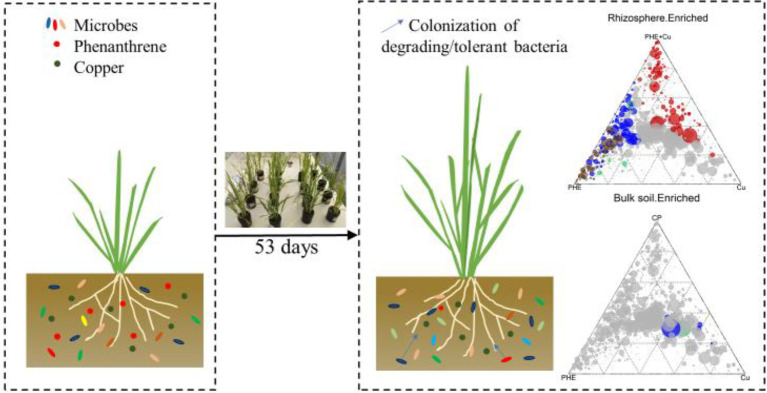
Combined organic and inorganic pollutants can greatly impact crops and microbes, but the interaction between coexisted pollutants and their effects on root-associated microbes under flooding conditions remains poorly understood. In this study, greenhouse experiments were conducted to investigate the individual and combined effects of phenanthrene (PHE) and copper (Cu) on rice uptake and root-associated microbial coping strategies. The results showed that more than 90% of phenanthrene was degraded, while the existence of Cu significantly reduced the dissipation of PHE in the rhizosphere, and the coexistence of phenanthrene and copper promoted their respective accumulation in plant roots. Copper played a dominant role in the interaction between these two chemicals. Microbes that can tolerate heavy metals and degrade PAHs, e.g., Herbaspirillum, Sphingobacteriales, and Saccharimonadales, were enriched in the contaminated soils. Additionally, microbes associated with redox processes reacted differently under polluted treatments. Fe reducers increased in Cu-treated soils, while sulfate reducers and methanogens were considerably inhibited under polluted treatments. In total, our results uncover the combined effect of heavy metals and polycyclic aromatic hydrocarbons on the assemblage of root-associated microbial communities in anaerobic environments and provide useful information for the selection of effective root-associated microbiomes to improve the resistance of common crops in contaminated sites.
Keywords: combined pollution; flooding condition; heavy metal; polycyclic aromatic hydrocarbon; root-associated microbiome.
Copyright © 2022 Li, Xu, Su, Zhang, Niu and Xu.
Conflict of interest statement
MX was employed by Shandong Academy of Environmental Sciences Co., Ltd. The remaining authors declare that the research was conducted in the absence of any commercial or financial relationships that could be construed as a potential conflict of interest.
Figures


References
-
- Babu T. S., Marder J. B., Tripuranthakam S., Dixon D. G., Greenberg B. M. (2001). Synergistic effects of a photooxidized polycyclic aromatic hydrocarbon and copper on photosynthesis and plant growth: evidence that in vivo formation of reactive oxygen species is a mechanism of copper toxicity. Environ. Toxicol. Chem. 20, 1351–1358. doi: 10.1002/etc.5620200626, PMID: - DOI - PubMed
-
- Cao L., Shen G., Lu Y. (2007). Combined effects of heavy metal and polycyclic aromatic hydrocarbon on soil microorganism communities. Environ. Geol. 54, 1531–1536. doi: 10.1007/s00254-007-0934-0 - DOI
LinkOut - more resources
Full Text Sources
