


Template guided cervical pedicle screw instrumentation
- PMID: 35602175
- PMCID: PMC9118173
- DOI: 10.1016/j.xnsj.2022.100120
Template guided cervical pedicle screw instrumentation
Abstract
Background: Pedicle screw instrumentation of the cervical spine, although technically challenging due to the potential risk of serious neurovascular injuries, is biomechanically favorable for stabilization purposes. Patient-specific templates are increasingly used in the thoracolumbar spine with excellent accuracy. The aim of this study was to evaluate the accuracy of cervical pedicle screw placement with patient-specific templates in a clinical setting and to report the European experience so far.
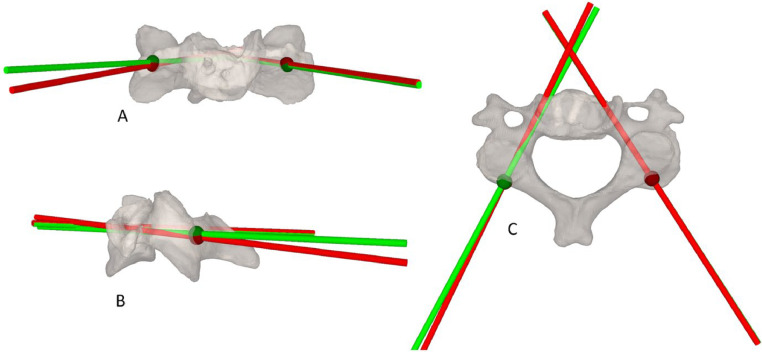
Methods: Multicentric, retrospectively obtained data of twelve patients who underwent dorsal instrumentation of the cervical spine with 3D-printed patient-specific templates were analyzed. Postoperative computed tomography (CT) scans were used to evaluate pedicle perforation and screw deviations between the planned and actual screw position. Furthermore, surgical time, radiation exposure, blood loss and immediate postoperative complications were analyzed.
Results: A total of 86 screws were inserted, of which 82 (95.3%) were fully contained inside the pedicle. All perforations (four screws, 4.7%) were within the safe zone of 2 mm and did not result in any neurovascular complications. Overall, median deviation from planned entry point (Euclidean distance) was 1.2 mm (0.1 - 11 mm), median deviation from the planned trajectory (Euler angle) was 4.4° (0.2-71.5°), median axial and sagittal trajectory deviation from the planned trajectory were 2.5° (0 - 57.5°) and 3.3° (0 - 54.9°), respectively. Median operative time was 168 minutes (111 - 564 minutes), median blood loss was 300 ml (150 - 1300 ml) and median intraoperative fluoroscopic dose was 321.2 mGycm2 (102.4 - 825.0 mGycm2). Overall complications were one adjacent segment kyphosis, one transient C5 palsy and one wound healing disorder.
Conclusion: Patient-specific 3D-printed templates provide a highly accurate option for placing cervical pedicle screws for dorsal instrumentation of the cervical spine.
Keywords: Cervical spine; Patient-specific template; Pedicle screw; Pedicle screw accuracy; Pedicle screw instrumentation; Three-dimensional model.
© 2022 The Author(s). Published by Elsevier Ltd on behalf of North American Spine Society.
Conflict of interest statement
None.
Figures


References
LinkOut - more resources
Full Text Sources
Miscellaneous
