Review
. 2022 May 4:13:884648.
doi: 10.3389/fimmu.2022.884648. eCollection 2022.

Cytokine-Induced Memory-Like NK Cells: From the Basics to Clinical Applications

Affiliations
Review

Cytokine-Induced Memory-Like NK Cells: From the Basics to Clinical Applications

Iñigo Terrén et al. Front Immunol. .

Abstract

Natural killer (NK) cells are lymphocytes with a key role in the defense against viral infections and tumor cells. Although NK cells are classified as innate lymphoid cells (ILCs), under certain circumstances they exhibit adaptive and memory-like features. The latter may be achieved, among others, by a brief stimulation with interleukin (IL)-12, IL-15 and IL-18. These cytokine-induced memory-like (CIML) NK cells resemble the trained immunity observed in myeloid cells. CIML NK cells undergo transcriptional, epigenetic and metabolic reprogramming that, along with changes in the expression of cell surface receptors and components of cytotoxic granules, are responsible for their enhanced effector functions after a resting period. In addition, these memory-like NK cells persist for a long time, which make them a good candidate for cancer immunotherapy. Currently, several clinical trials are testing CIML NK cells infusions to treat tumors, mostly hematological malignancies. In relapse/refractory acute myeloid leukemia (AML), the adoptive transfer of CIML NK cells is safe and complete clinical remissions have been observed. In our review, we sought to summarize the current knowledge about the generation and molecular basis of NK cell memory-like responses and the up-to-date results from clinical trials with CIML NK cells.

Keywords: AML - acute myeloid leukemia; NK cells; adaptive NK cells; adoptive cell therapy (ACT); cancer immunotherapy; cytokine-induced memory-like NK cells; memory-like; trained immunity.


Conflict of interest statement

The authors declare that the research was conducted in the absence of any commercial or financial relationships that could be construed as a potential conflict of interest.

Figures
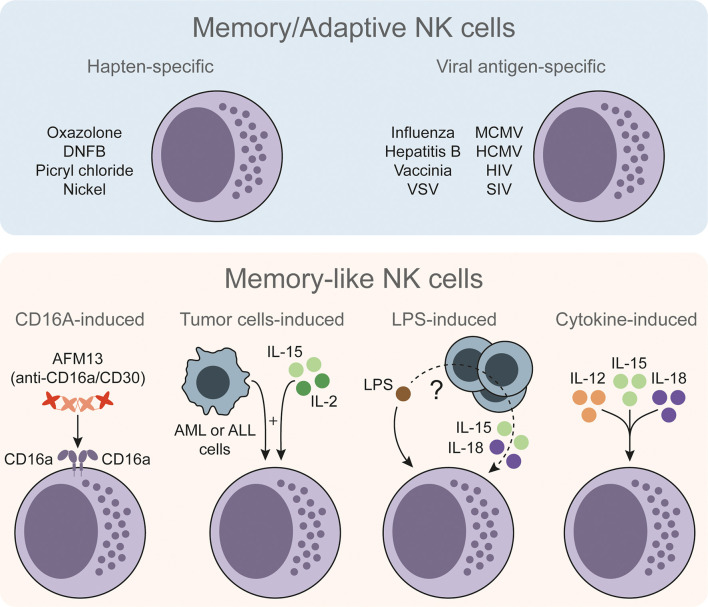
Figure 1
Figure 1
The diversity of memory/adaptive and memory-like NK cells. Memory/adaptive NK cells with antigen-specific responses have been described in different models such as contact hypersensitivity, viral infections or vaccinations. Memory-like NK cells show an increased but less specific response upon restimulation. These memory-like NK cells could be trained through CD16a-induced stimulation or by stimulating NK cells ex vivo with certain tumor cells and low doses of IL-15 and IL-2. In an in vivo setting of LPS-induced endotoxemia, LPS can endow NK cells with memory-like properties through non-well defined mechanism. NK cells can be stimulated directly with LPS plus IL-15 and IL-18, and other cells (e.g. DCs) may contribute to the NK cell training process. NK cells can be also stimulated with IL-12, IL-15 and IL-18 to endow them with memory-like properties. NK, natural killer; DNFB, 2,4-dinitrofluorobenzene; VSV, vesicular stomatitis virus; MCMV, murine cytomegalovirus; HCMV, human cytomegalovirus; HIV, human immunodeficiency virus; SIV, simian immunodeficiency virus; AML, acute myeloid leukemia; ALL, acute lymphoblastic leukemia; IL, interleukin; LPS, lipopolysaccharide.

References

    1. Vivier E, Artis D, Colonna M, Diefenbach A, Di Santo JP, Eberl G, et al. Innate Lymphoid Cells: 10 Years on. Cell (2018) 174:1054–66. doi: 10.1016/j.cell.2018.07.017 - DOI - PubMed
    1. Chiossone L, Dumas P-Y, Vienne M, Vivier E. Natural Killer Cells and Other Innate Lymphoid Cells in Cancer. Nat Rev Immunol (2018) 18:671–88. doi: 10.1038/s41577-018-0061-z - DOI - PubMed
    1. Crinier A, Kerdiles Y, Vienne M, Cózar B, Vivier E, Berruyer C. Multidimensional Molecular Controls Defining NK/ILC1 Identity in Cancers. Semin Immunol (2021) 52:101424. doi: 10.1016/j.smim.2020.101424 - DOI - PubMed
    1. Veluchamy JP, Kok N, Van der Vliet HJ, Verheul HMW, de Gruijl TD, Spanholtz J. The Rise of Allogeneic Natural Killer Cells As a Platform for Cancer Immunotherapy: Recent Innovations and Future Developments. Front Immunol (2017) 8:631. doi: 10.3389/fimmu.2017.00631 - DOI - PMC - PubMed
    1. Sanchez CE, Dowlati EP, Geiger AE, Chaudhry K, Tovar MA, Bollard CM, et al. NK Cell Adoptive Immunotherapy of Cancer: Evaluating Recognition Strategies and Overcoming Limitations. Transplant Cell Ther (2021) 27:21–35. doi: 10.1016/j.bbmt.2020.09.030 - DOI - PMC - PubMed

Publication types
