. 2022 Apr 5:2:36.
doi: 10.1038/s43856-022-00091-x. eCollection 2022.

A rapid antibody screening haemagglutination test for predicting immunity to SARS-CoV-2 variants of concern

Collaborators, Affiliations

A rapid antibody screening haemagglutination test for predicting immunity to SARS-CoV-2 variants of concern

Nina Urke Ertesvåg et al. Commun Med (Lond). .

Abstract

Background: Evaluation of susceptibility to emerging SARS-CoV-2 variants of concern (VOC) requires rapid screening tests for neutralising antibodies which provide protection.

Methods: Firstly, we developed a receptor-binding domain-specific haemagglutination test (HAT) to Wuhan and VOC (alpha, beta, gamma and delta) and compared to pseudotype, microneutralisation and virus neutralisation assays in 835 convalescent sera. Secondly, we investigated the antibody response using the HAT after two doses of mRNA (BNT162b2) vaccination. Sera were collected at baseline, three weeks after the first and second vaccinations from older (80-99 years, n = 89) and younger adults (23-77 years, n = 310) and compared to convalescent sera from naturally infected individuals (1-89 years, n = 307).

Results: Here we show that HAT antibodies highly correlated with neutralising antibodies (R = 0.72-0.88) in convalescent sera. Home-dwelling older individuals have significantly lower antibodies to the Wuhan strain after one and two doses of BNT162b2 vaccine than younger adult vaccinees and naturally infected individuals. Moverover, a second vaccine dose boosts and broadens the antibody repertoire to VOC in naïve, not previously infected older and younger adults. Most (72-76%) older adults respond after two vaccinations to alpha and delta, but only 58-62% to beta and gamma, compared to 96-97% of younger vaccinees and 68-76% of infected individuals. Previously infected older individuals have, similarly to younger adults, high antibody titres after one vaccination.

Conclusions: Overall, HAT provides a surrogate marker for neutralising antibodies, which can be used as a simple inexpensive, rapid test. HAT can be rapidly adaptable to emerging VOC for large-scale evaluation of potentially decreasing vaccine effectiveness.

Keywords: Predictive markers; RNA vaccines; Viral infection.


Conflict of interest statement

Competing interestsThe authors declare no competing interests.

Figures

Fig. 1
Fig. 1. The correlation between haemagglutination test and SARS-CoV-2 neutralising antibodies.
Correlation of endpoint haemagglutination test (HAT) titres with neutralising antibody titres. In a cohort of infected individuals from the first (Wuhan-like) and delta pandemic waves (diagnosis by PCR from nasopharyngeal swabs or serology in Bergen, Norway) (ab, dg), Wuhan-like neutralising antibodies were measured using the pseudotype (PN) neutralisation assay at 50% (PN50) (a) (R = 0.79, 95% confidence interval (CI): 0.73–0.83) and 80% (PN80) (d) (R = 0.78, 95% CI: 0.72–0.82) inhibition of pseudotype virus infectivity, the microneutralisation (MN) 50% inhibitory concentration (IC50) (b) (R = 0.82, 95% CI: 0.78–0.85) and virus neutralization (VN) 100% inhibition of cytopathic effect (e) (R = 0.74, 95% CI: 0.68–0.80) assays. Delta-like neutralising antibodies were measured in the PN assay at PN50 (f) (R = 0.82, 95% CI: 0.67–0.90) and VN 50% inhibitory concentration (g) (R = 0.72, 95% CI: 0.51–0.85). Convalescent sera from 420 infected individuals in UK for whom neutralising antibody and HAT titre were measured (c) (R = 0.88, 95% CI: 0.86–0.90). The correlation between the HAT and 50% inhibition of neutralising antibody titres for Wuhan-like, and B.1.1.7 and B.1.351 VOC antibody titres performed at Oxford, UK (h) (R = 0.87, 95% CI: 0.82–0.90). HAT titres were measured in a set of donors either infected or vaccinated with one or two doses of the Pfizer BNT162b2 mRNA vaccine who had neutralising antibody levels to the ancestral Wuhan, B.1.1.7, B.1.351 or B1.617.2 live viruses. Open symbols represent the positive anti SARS-CoV-2 WHO standard (20/130). The Spearman R correlations and significant values are shown. In the MN assay, virus infectivity was measured by detecting the amount of nucleoprotein and also spike after 22–24 h incubation in Vero cells. In Bergen (b, e) the Wuhan-like local D614G virus hCoV-19/Norway/Bergen-01/2020 (GISAID accession ID EPI_ISL_541970) was used in a certified Biosafety Level 3 Laboratory. The dotted lines show the lowest detectable titre in each assay, all negative values were assigned the number 5 for consistency, and the sample size can be derived from adding the blue numbers in the quadrants together.
Fig. 2
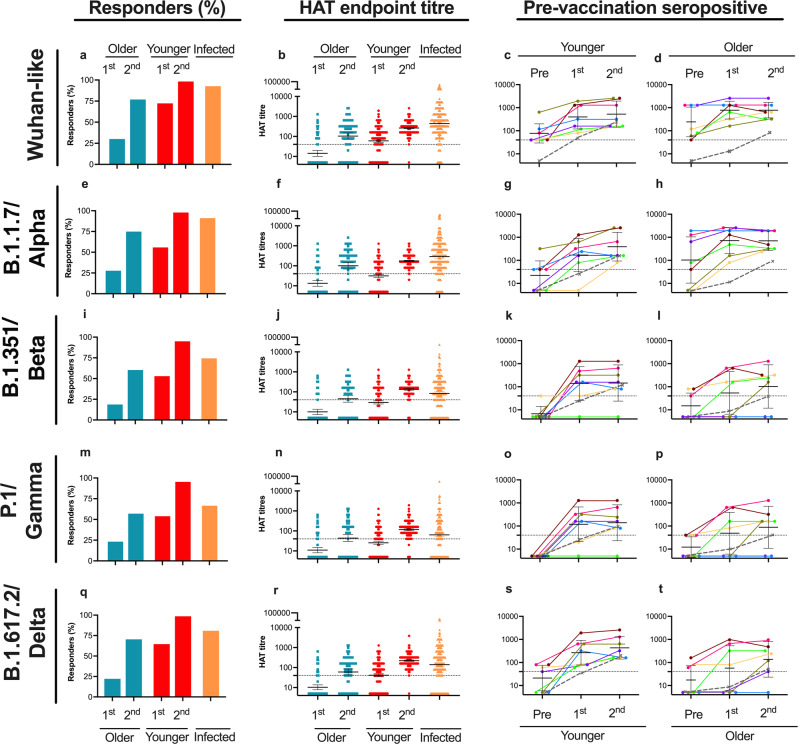
Fig. 2. Haemagglutination test antibodies to the ancestral Wuhan SARS-CoV-2 virus and variants of concern in older and younger adult vaccinees and after natural infection.
Haemagglutination test (HAT) antibodies to the SARS-CoV-2 virus receptor binding domains of homologous founder virus (ad: Wuhan-like) and variants of concern (eh B.1.1.7 alpha; il: B.1.351 beta; mp: P.1 gamma and qt: B.1.617.2 delta). Endpoint HAT titres are presented in (bd, fh, jl, np, rt). The percentage of responders with haemagglutination test titre ≥ 40 (a, e, i, m, q) and endpoint HAT titres (b, f, j, n, r) in seronegative older (n = 89) and seronegative adults (n = 309) post 1st dose (3 weeks) and post 2nd dose (6–8 weeks after 1st dose) mRNA BNT162b2 COVID-19 vaccination. In infected individuals, convalescent serum was collected 3–10 weeks after SARS-CoV-2 confirmed infection (infected, n = 307) with D614G virus during the first pandemic wave (ab, ef, ij, mn, qr). HAT endpoint titres to Wuhan-like and VOC in previously infected older individuals (n = 7) and adults (n = 7) who were vaccinated are shown in different colours, with the grey dashed line showing comparison of the geometric mean HAT titres for the corresponding seronegative (not previously infected) old (n = 89) and adult (n = 309) vaccinees (cd, gh, kl, op, st). For endpoint HAT titres (bd, fh, jl, np, rt), negative values were assigned a value of 5. The geometric mean titres (GMT) and error bars with 95% confidence intervals are shown in black and each symbol represents one subject (b, f, j, n, r).
Fig. 3
Fig. 3. Correlation of finger-prick and venous blood samples using the haemagglutination test on Wuhan and variants of concern.
Correlation of paired finger-prick and venous blood samples collected from vaccinated healthcare workers. HAT titres are shown by a symbol that can represent on or more blood samples. Correlations were analysed by linear regression shown in graphs and tables. a The point haemagglutination test (HAT) showing the correlation between finger-prick and venous whole blood samples (n = 78). Haemagglutination was scored as shown in the contingency table. “HAT+” samples with haemagglutination and “HAT−“ refers to no haemagglutination or endpoint titres <5. bf Endpoint HAT titres of paired finger-prick and venous blood samples. Diluted finger-prick or venous whole blood samples (1 in 40 in phosphate buffered saline (PBS)) were centrifuged, and the supernatant was titrated in the HAT assay using IH4-RBD-reagents and autologous red blood cells (RBC) (washed and diluted 1 in 40 in PBS). b Wuhan-like (n = 63), c B1.1.7/Alpha (n = 62), d B.1.351/Beta (n = 62), e P1/Gamma, (n = 54), and f B.1.617.2/Delta (n = 53).

References

    1. Khoury DS, et al. Neutralizing antibody levels are highly predictive of immune protection from symptomatic SARS-CoV-2 infection. Nat. Med. 2021;27:1205–1211. doi: 10.1038/s41591-021-01377-8. - DOI - PubMed
    1. Davies, N. G. et al. Estimated transmissibility and impact of SARS-CoV-2 lineage B.1.1.7 in England. Science372, 10.1126/science.abg3055 (2021). - PMC - PubMed
    1. Tegally H, et al. Detection of a SARS-CoV-2 variant of concern in South Africa. Nature. 2021;592:438–443. doi: 10.1038/s41586-021-03402-9. - DOI - PubMed
    1. Faria NR, et al. Genomics and epidemiology of the P.1 SARS-CoV-2 lineage in Manaus, Brazil. Science. 2021;372:815–821. doi: 10.1126/science.abh2644. - DOI - PMC - PubMed
    1. Cherian, S. et al. SARS-CoV-2 Spike Mutations, L452R, T478K, E484Q and P681R, in the Second Wave of COVID-19 in Maharashtra, India. Microorganisms9, 10.3390/microorganisms9071542 (2021). - PMC - PubMed