Long-term relative survival in uveal melanoma: a systematic review and meta-analysis
- PMID: 35603296
- PMCID: PMC9053233
- DOI: 10.1038/s43856-022-00082-y
Long-term relative survival in uveal melanoma: a systematic review and meta-analysis
Abstract
Background: A large proportion of patients with uveal melanoma develop metastases and succumb to their disease. Reports on the size of this proportion vary considerably.
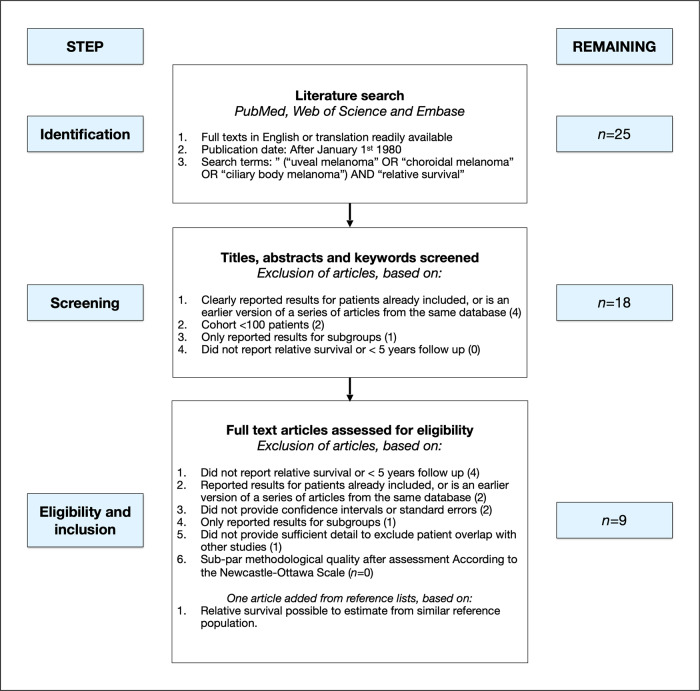
Methods: PubMed, Web of Science and Embase were searched for articles published after 1980. Studies with ≥100 patients reporting ≥five-year relative survival rates were included. Studies solely reporting Kaplan-Meier estimates and cumulative incidences were not considered, due to risk for competing risk bias and classification errors. A meta-analysis was performed using random-effects and weighted averages models, as well as a combined estimate based on curve fitting.
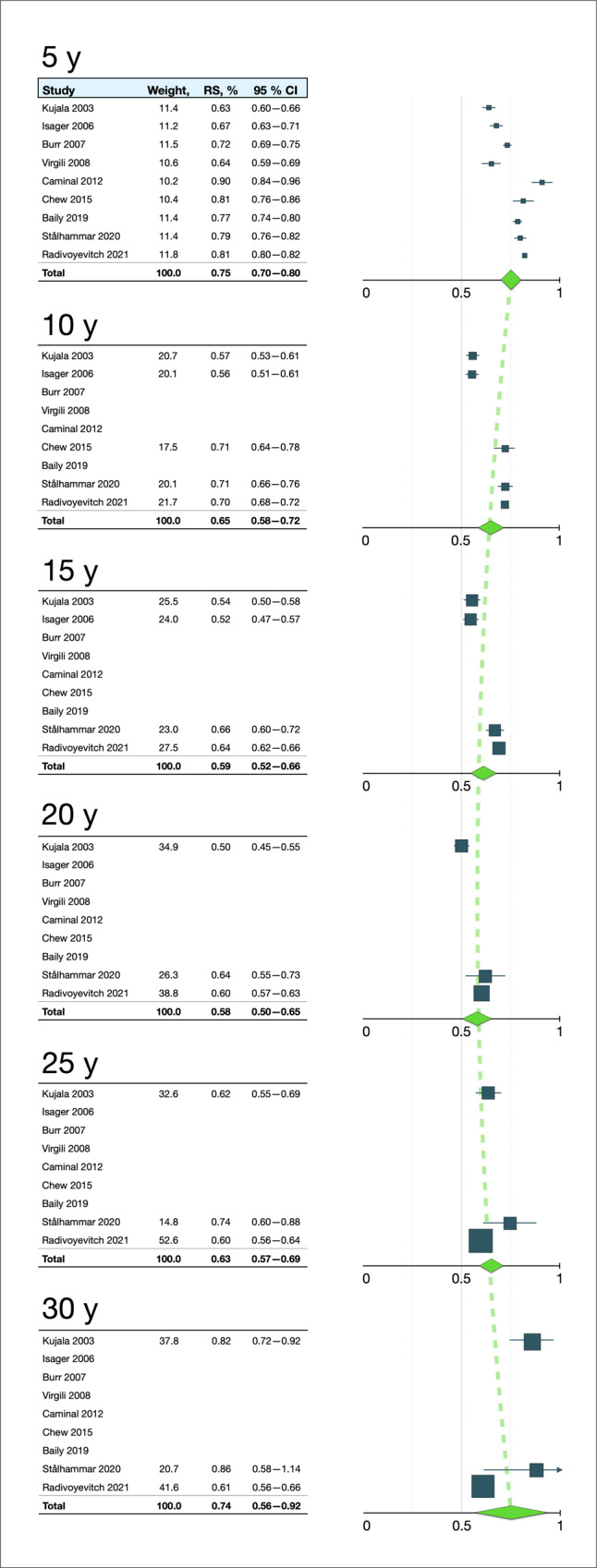
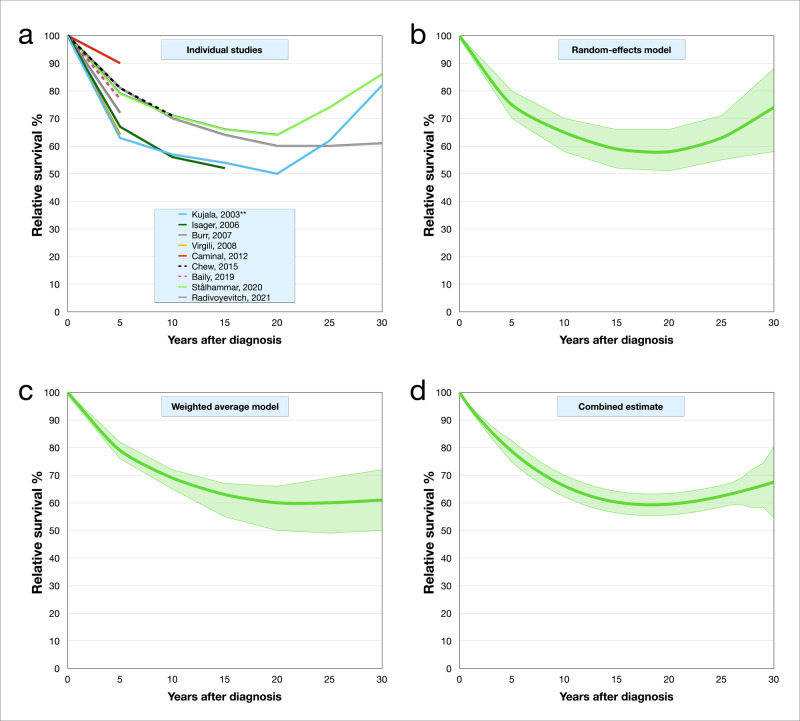
Results: Nine studies and a total of 18 495 patients are included. Overall, the risk of selective reporting bias is low. Relative survival rates vary across the population of studies (I2 48 to 97% and Q p < 0.00001 to 0.15), likely due to differences in baseline characteristics and the large number of patients included (τ2 < 0.02). The 30-year relative survival rates follow a cubic curve that is well fitted to data from the random-effects inverse-variance and weighted average models (R 2 = 0.95, p = 7.19E-7). The estimated five, ten, 15, 20, 25 and 30-year relative survival rates are 79, 66, 60, 60, 62 and 67%, respectively.
Conclusions: The findings suggest that about two in five of all patients with uveal melanoma ultimately succumb to their disease. This indicates a slightly better prognosis than what is often assumed, and that patients surviving 20 years or longer may have a survival advantage to individuals of the same sex and age from the general population.
Keywords: Cancer epidemiology; Eye cancer.
© The Author(s) 2022.
Conflict of interest statement
Competing interestsGustav Stålhammar has received honoraria (August 2021) from Santen S.A., Geneva, Switzerland for writing and reviewing content and serving on a virtual advisory board in the creation of an online Ophthalmology education platform. Christina Herrspiegel declares no competing interests.
Figures
References
-
- COMS. The COMS Randomized Trial of Iodine 125 Brachytherapy for Choroidal Melanoma: V. Twelve-year mortality rates and prognostic factors: COMS Report No. 28. Arch. Ophthalmol.124, 1684–1693 (2006). - PubMed
LinkOut - more resources
Full Text Sources