. 2022 Aug 1;189(4):2029-2043.
doi: 10.1093/plphys/kiac234.

Consecutive action of two BAHD acyltransferases promotes tetracoumaroyl spermine accumulation in chicory

Affiliations

Consecutive action of two BAHD acyltransferases promotes tetracoumaroyl spermine accumulation in chicory

Guillaume Bernard et al. Plant Physiol. .

Abstract

Fully substituted phenolamide accumulation in the pollen coat of Eudicotyledons is a conserved evolutionary chemical trait. Interestingly, spermidine derivatives are replaced by spermine derivatives as the main phenolamide accumulated in the Asteraceae family. Here, we show that the full substitution of spermine in chicory (Cichorium intybus) requires the successive action of two enzymes, that is spermidine hydroxycinnamoyl transferase-like proteins 1 and 2 (CiSHT1 and CiSHT2), two members of the BAHD enzyme family. Deletion of these genes in chicory using CRISPR/Cas9 gene editing technology evidenced that CiSHT2 catalyzes the first N-acylation steps, whereas CiSHT1 fulfills the substitution to give rise to tetracoumaroyl spermine. Additional experiments using Nicotiana benthamiana confirmed these findings. Expression of CiSHT2 alone promoted partially substituted spermine accumulation, and coexpression of CiSHT2 and CiSHT1 promoted synthesis and accumulation of the fully substituted spermine. Structural characterization of the main product of CiSHT2 using nuclear magnetic resonance revealed that CiSHT2 preferentially catalyzed N-acylation of secondary amines to form N5,N10-dicoumaroyl spermine, whereas CiSHT1 used this substrate to synthesize tetracoumaroyl spermine. We showed that spermine availability may be a key determinant toward preferential accumulation of spermine derivatives over spermidine derivatives in chicory. Our results reveal a subfunctionalization among the spermidine hydroxycinnamoyl transferase that was accompanied by a modification of free polyamine metabolism that has resulted in the accumulation of this new phenolamide in chicory and most probably in all Asteraceae. Finally, genetically engineered yeast (Saccharomyces cerevisiae) was shown to be a promising host platform to produce these compounds.


Figures

Figure 1
Figure 1
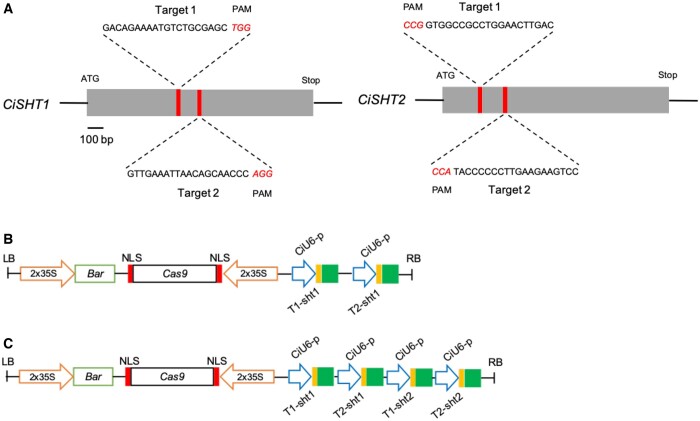
Schematic diagram of CiSHT1 and CiSHT2 gene structures and of vectors used to generate chicory mutants. A, Schematic diagram of CiSHT1 and CiSHT2 gene structures (gray rectangles) and target sequences (red lines). The translation initiation codon (ATG) and termination codon (stop) are shown. The target sequence is shown in capital letters, and the PAM sequence is marked in red. B and C, Schematic diagram of the pYLCRISPR-sgRNA1-sgRNA2-CiSHT1 and pYLCRISPR-sgRNA1-sgRNA2-SHT1/sgRNA1-sgRNA2-SHT2 vectors, respectively. Bar: Phosphinothricin acetyltransferase. 35S: cauliflower mosaic virus 35S promoter. NLS: nuclear localization sequence. CiU6-1P: C. intybus U6-1p promoter. LB: left border. RB: right border. T1 or T2 stands for target 1 or 2.
Figure 2
Figure 2
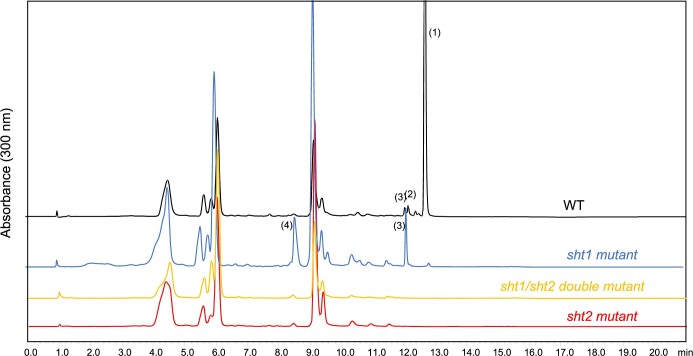
Stacked HPLC chromatograms of extracts obtained from flower buds at stages 13–15 isolated from WT, sht1 mutant, sht2 mutant or sht1/sht2 mutant. The identity of the numbered peaks was confirmed by mass spectrometry: (1) tetracoumaroyl spermine, (2) tricoumaroyl spermidine, (3) tricoumaroyl spermine, and (4) dicoumaroyl spermine.
Figure 3
Figure 3
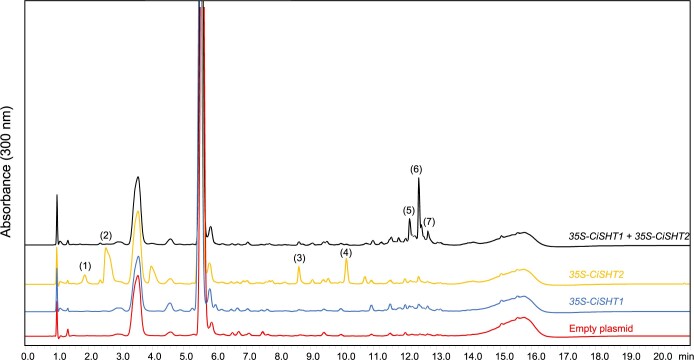
Stacked HPLC chromatograms of extracts obtained from agroinfiltrated N. benthamiana leaves. Plants were infiltrated with either the empty plasmid, CiSHT1 (35S-CiSHT1), CiSHT2 (35S-CISHT2), or CiSHT1 plus CiSHT2 (35S-CiSHT1+35S-CiSHT2). The identity of the numbered peaks was confirmed by mass spectrometry: (1) monocoumaroyl spermine, (2) monocoumaroyl spermidine, (3) dicoumaroyl spermine, (4) dicoumaroyl spermidine, (5) tricoumaroyl spermine, (6) tricoumaroyl spermidine, and (7) tetracoumaroyl spermine.
Figure 4
Figure 4
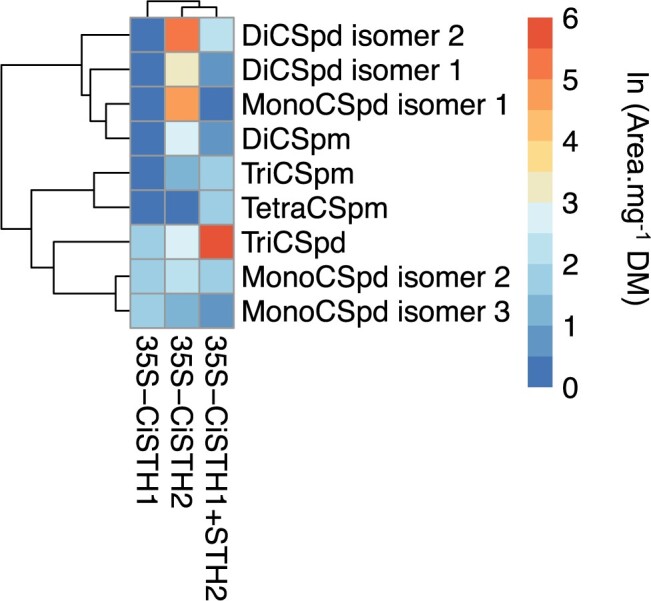
Heatmap of spermine and spermidine derived phenolamides in N. benthamiana agroinfiltrated with CiSHT1, CiSHT2, or CiSHT1 plus CiSHT2. Pick area means for each condition (eight plants) and for each metabolite are expressed per mg of dry material (DM). Natural logarithm of the means for each condition was used to conduct the heatmap hierarchical clustering with the Ward’s method. Colors in the heatmap are related to the sequential logarithmic scale presented in the right panel. DiCSpd, dicoumaroyl spermidine; MonoCSpd, monocoumaroyl spermidine; DiCSpm, dicoumaroyl spermine; TriCSpm, tricoumaroyl spermine; TetraCSpm, tetracoumaroyl spermine; TriCSpd, tricoumaroyl spermidine.
Figure 5
Figure 5
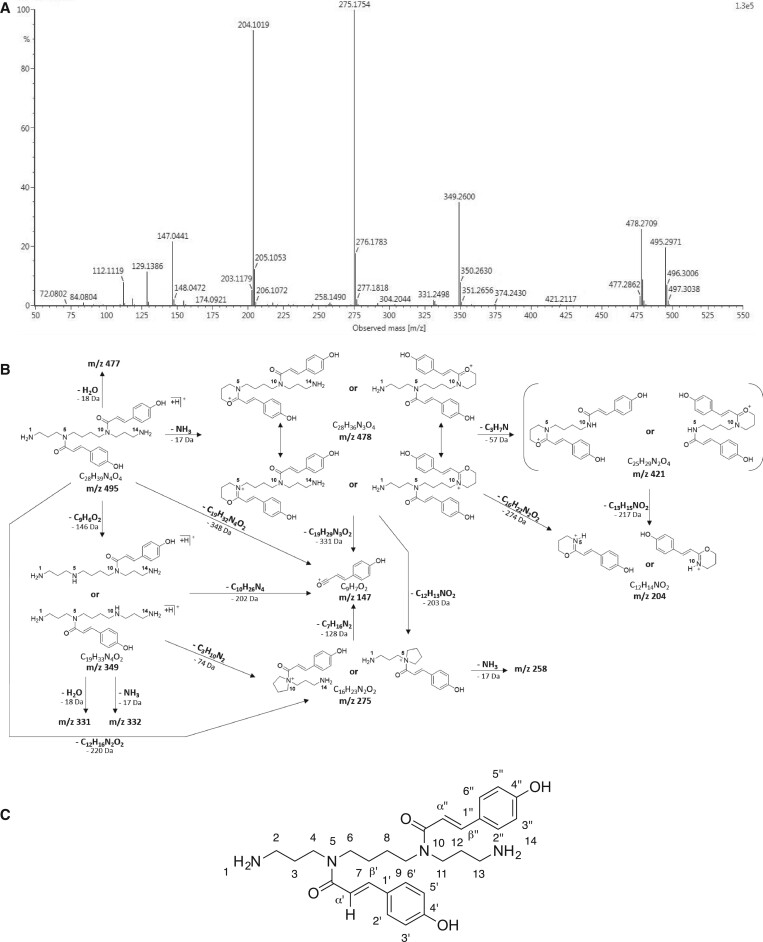
ESI-MS-HRMS spectra of purified N5,N10-dicoumaroyl spermine. A, Fragmentation of purified N5,N10- dicoumaroyl spermine. The position of the coumaroyl moieties was deduced from RMN data (see Table 1;Supplemental Figure S4). B, Fragmentation scheme of N5,N10-dicoumaroyl spermine. C, Chemical structure of N5, N10-dicoumaroyl spermine as deduced from NMR data.
Figure 6
Figure 6
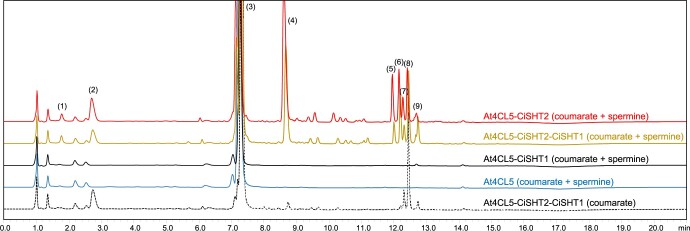
Stacked HPLC chromatograms of extracts from transgenic yeast expressing different combinations of genes. Yeasts were transformed with At4CL5 alone, with At4CL5 + CiSHT2 + CiSHT1, with At4CL5 + CiSHT1 or with At4CL5 + CiSHT2. The compounds added to the external medium are indicated in brackets. The identity of the numbered peaks was confirmed by mass spectrometry: (1) monocoumaroyl spermine, (2) monocoumaroyl spermidine, (3) coumarate, (4) dicoumaroyl spermine, (5) dihydrocoumaroyl dicoumaroyl spermine, (6) tricoumaroyl spermine, (7) dihydrocoumaroyl dicoumaroyl spermidine, (8) tricoumaroyl spermidine, and (9) tetracoumaroyl spermine. Tetracoumaroyl spermine coeluted with an unknown compound in our chromatographic conditions. Mass spectrometry analysis confirmed that tetracoumaroyl spermine was only present in yeast co-expressing both chicory genes (see Supplemental Figure S5).

References

    1. Ahmed E, Arshad M, Zakriyya Khan M, Shoaib Amjad M, Mehreen Sadaf H, Riaz I, Sidra Sabir P, Ahmad N, Sabaoon P, Ejaz Ahmed P, et al. (2017) Secondary metabolites and their multidimensional prospective in plant life. J Pharmacogn Phytochem 6: 205–214
    1. Bassard JE, Ullmann P, Bernier F, Werck-Reichhart D (2010) Phenolamides: bridging polyamines to the phenolic metabolism. Phytochemistry 71: 1808–1824 - PubMed
    1. Bernard G, Gagneul D, dos Santos HA, Etienne A, Hilbert JL, Rambaud C (2019) Efficient genome editing using CRISPR/Cas9 technology in chicory. Int J Mol Sci 20: 1155 - PMC - PubMed
    1. Bigler L, Schnider CF, Hu W, Hesse M (1996) Acid-catalyzed isomerization of N,N’-Bis[(E)-3-(4-hydroxyphenyl)prop-2-enoyl]spermidines by the zip reaction. Helv Chim Acta 79: 2152–2163
    1. Bogdanovic MD, Todorovic SI, Banjanac T, Dragiƒáeviƒá MB, Verstappen FWA, Bouwmeester HJ, Simonoviƒá AD, Bogdanović MD, Todorović SI, Banjanac T, et al. (2014) Production of guaianolides in Agrobacterium rhizogenes - transformed chicory regenerants flowering in vitro. Ind Crops Prod 60: 52–59

Publication types