. 2022 May 20:2:55.
doi: 10.1038/s43856-022-00115-6. eCollection 2022.

A prospective matched case-control study on the genomic epidemiology of colistin-resistant Enterobacterales from Dutch patients

Collaborators, Affiliations

A prospective matched case-control study on the genomic epidemiology of colistin-resistant Enterobacterales from Dutch patients

Karuna E W Vendrik et al. Commun Med (Lond). .

Abstract

Background: Colistin is a last-resort treatment option for infections with multidrug-resistant Gram-negative bacteria. However, colistin resistance is increasing.

Methods: A six-month prospective matched case-control study was performed in which 22 Dutch laboratories with 32 associated hospitals participated. Laboratories were invited to send a maximum of five colistin-resistant Escherichia coli or Klebsiella pneumoniae (COLR-EK) isolates and five colistin-susceptible isolates (COLS-EK) to the reference laboratory, matched for patient location, material of origin and bacterial species. Epidemiological/clinical data were collected and included in the analysis. Characteristics of COLR-EK/COLS-EK isolates were compared using logistic regression with correction for variables used for matching. Forty-six ColR-EK/ColS-EK pairs were analysed by next-generation sequencing (NGS) for whole-genome multi-locus sequence typing and identification of resistance genes, including mcr genes. To identify chromosomal mutations potentially leading to colistin resistance, NGS reads were mapped against gene sequences of pmrAB, phoPQ, mgrB and crrB.

Results: In total, 72 COLR-EK/COLS-EK pairs (75% E. coli and 25% K. pneumoniae) were included. Twenty-one percent of COLR-EK patients had received colistin, in contrast to 3% of COLS-EK patients (OR > 2.9). Of COLR-EK isolates, five contained mcr-1 and two mcr-9. One isolate lost mcr-9 after repeated sub-culturing, but retained colistin resistance. Among 46 sequenced COLR-EK isolates, genetic diversity was large and 19 (41.3%) isolates had chromosomal mutations potentially associated with colistin resistance.

Conclusions: Colistin resistance is present but uncommon in the Netherlands and caused by the mcr gene in a minority of COLR-EK isolates. There is a need for surveillance of colistin resistance using appropriate susceptibility testing methods.

Keywords: Antimicrobial resistance; Epidemiology; Infectious-disease epidemiology.


Conflict of interest statement

Competing interestsThe authors declare no competing interests.

Figures

Fig. 1
Fig. 1. Flow chart of received colistin-resistant and colistin-susceptible isolates.
Methods used to decide which isolates met study inclusion criteria are denoted in the green square. Reasons for rejection of isolates for inclusion in the study are denoted in the red squares. COLR-EK: colistin-resistant E. coli or K. pneumoniae, COLS-EK: colistin-susceptible E. coli or K. pneumoniae, MALDI-TOF: matrix-assisted laser desorption/ionisation time-of-flight analyser, MIC: minimum inhibitory concentration, PCR: polymerase chain reaction.
Fig. 2
Fig. 2. Minimum spanning tree of whole genome multilocus sequence typing results of 66 E. coli isolates.
Circles/squares/stars represent one isolate, which is connected to the closest relative. The circles represent colistin-susceptible isolates, the squares colistin-resistant isolates and the stars colistin-resistant isolates with mcr genes. The length of the lines in between the isolates is proportional to the allelic distance. Groups of isolates with the same classical MLST sequence type are indicated in the figure, e.g. ST131. The colours represent the different participating medical microbiology laboratories. A cluster was defined as ≥2 isolates with an allelic difference of ≤25. There were no clusters observed for E. coli. Source data: Supplementary Data files 2 and 3 and the Sequence Read Archive of the National Centre for Biotechnology Information (BioProject ID PRJNA754858).
Fig. 3
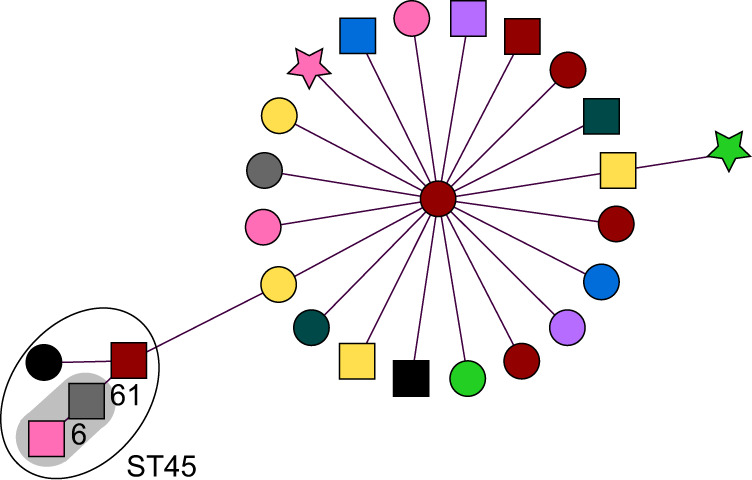
Fig. 3. Minimum spanning tree of whole genome multilocus sequence typing results of 26 K. pneumoniae isolates.
Circles/squares/stars represent one isolate, which is connected to the closest relative. The circles represent colistin-susceptible isolates, the squares colistin-resistant isolates and the stars colistin-resistant isolates with mcr genes. The length of the lines in between the isolates is proportional to the allelic distance. For clusters, the allelic differences between the isolates are denoted. Groups of isolates with the same classical MLST sequence type are indicated in the figure (ST45). The colours represent the different participating medical microbiology laboratories. A cluster is indicated by a grey halo and is defined as ≥2 isolates with an allelic difference of ≤20. Source data: Supplementary Data files 2 and 3 and the Sequence Read Archive of the National Centre for Biotechnology Information (BioProject ID PRJNA754858).
Fig. 4
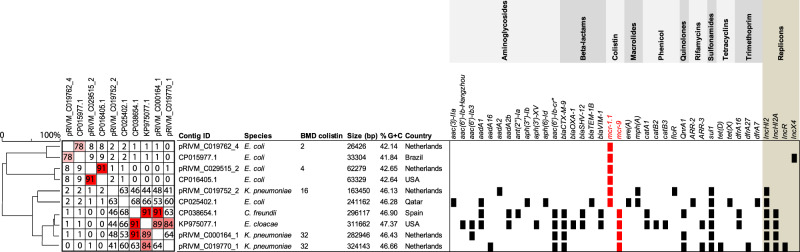
Fig. 4. Comparison of plasmids containing mcr genes.
Contig IDs that start with ‘pRIVM’ are from plasmids of isolates collected in the current study. The other isolates are the closest resembling plasmids from the NCBI database. Percentages identity are depicted in the square on the left. Source data: Supplementary Data file 4 and GenBank of the National Centre for Biotechnology Information (BioProject ID PRJNA754858). BMD: broth microdilution, bp: base pairs, USA: United States of America, % G + C: guanine-cytosine content.

References

    1. Munoz-Price LS, et al. Clinical epidemiology of the global expansion of Klebsiella pneumoniae carbapenemases. Lancet Infect. Dis. 2013;13:785–796. doi: 10.1016/S1473-3099(13)70190-7. - DOI - PMC - PubMed
    1. World Health Organization. Central Asian and Eastern European Surveillance of Antimicrobial Resistance. Annual Report 2017. https://www.euro.who.int/en/health-topics/disease-prevention/antimicrobi... (2018).
    1. European Centre for Disease Prevention and Control. Solna: Antimicrobial resistance in the EU/EEA (EARS-Net). Annual Epidemiological Report 2019. https://www.ecdc.europa.eu/sites/default/files/documents/surveillance-an... (2020).
    1. Catry B, et al. Use of colistin-containing products within the European Union and European Economic Area (EU/EEA): development of resistance in animals and possible impact on human and animal health. Int. J. Antimicrob. Agents. 2015;46:297–306. doi: 10.1016/j.ijantimicag.2015.06.005. - DOI - PubMed
    1. Kempf I, Jouy E, Chauvin C. Colistin use and colistin resistance in bacteria from animals. Int. J. Antimicrob. Agents. 2016;48:598–606. doi: 10.1016/j.ijantimicag.2016.09.016. - DOI - PubMed

LinkOut - more resources