. 2022 Sep;258(1):26-37.
doi: 10.1002/path.5969. Epub 2022 Jun 22.

Glomerular basement membrane deposition of collagen α1(III) in Alport glomeruli by mesangial filopodia injures podocytes via aberrant signaling through DDR1 and integrin α2β1

Affiliations

Glomerular basement membrane deposition of collagen α1(III) in Alport glomeruli by mesangial filopodia injures podocytes via aberrant signaling through DDR1 and integrin α2β1

Jacob Madison et al. J Pathol. 2022 Sep.

Abstract

In Alport mice, activation of the endothelin A receptor (ETA R) in mesangial cells results in sub-endothelial invasion of glomerular capillaries by mesangial filopodia. Filopodia deposit mesangial matrix in the glomerular basement membrane (GBM), including laminin 211 which activates NF-κB, resulting in induction of inflammatory cytokines. Herein we show that collagen α1(III) is also deposited in the GBM. Collagen α1(III) localized to the mesangium in wild-type mice and was found in both the mesangium and the GBM in Alport mice. We show that collagen α1(III) activates discoidin domain receptor family, member 1 (DDR1) receptors both in vitro and in vivo. To elucidate whether collagen α1(III) might cause podocyte injury, cultured murine Alport podocytes were overlaid with recombinant collagen α1(III), or not, for 24 h and RNA was analyzed by RNA sequencing (RNA-seq). These same cells were subjected to siRNA knockdown for integrin α2 or DDR1 and the RNA was analyzed by RNA-seq. Results were validated in vivo using RNA-seq from RNA isolated from wild-type and Alport mouse glomeruli. Numerous genes associated with podocyte injury were up- or down-regulated in both Alport glomeruli and cultured podocytes treated with collagen α1(III), 18 of which have been associated previously with podocyte injury or glomerulonephritis. The data indicate α2β1 integrin/DDR1 co-receptor signaling as the dominant regulatory mechanism. This may explain earlier studies where deletion of either DDR1 or α2β1 integrin in Alport mice ameliorates renal pathology. © 2022 Boys Town National Research Hospital. The Journal of Pathology published by John Wiley & Sons Ltd on behalf of The Pathological Society of Great Britain and Ireland.

Keywords: Alport syndrome; collagen α1(III); discoidin domain receptor 1; integrin α2β1; podocyte injury.


Figures

Figure 1
Figure 1
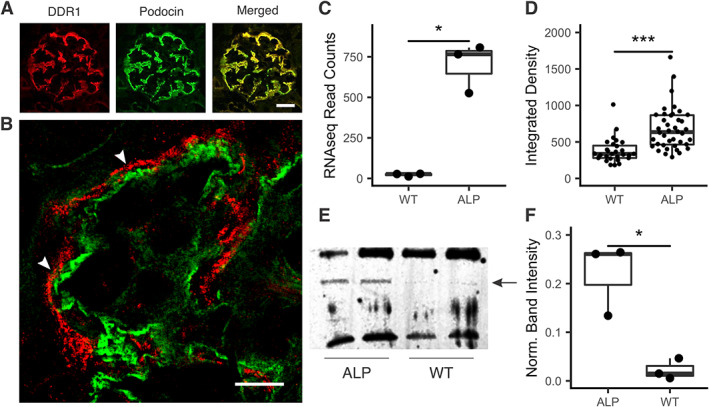
Collagen α1(III) is expressed in the glomerular basement membrane in Alport mice. (A) Dual immunofluorescence analysis was performed on kidney cryosections from 7‐week‐old wild‐type and Alport mice using antibodies for podocin (a slit diaphragm protein) and DDR1 (a collagen receptor). Clear co‐localization is apparent, placing DDR1 at the foot processes (bar = 15 μm). (B) Super‐resolution structured illumination microscopy (SR‐SIM) of dual immunofluorescence staining of a capillary loop from a 7‐week‐old Alport mouse stained with anti‐DDR1 antibodies (in red) and anti‐collagen α1(III) antibodies (in green). The adjacent localization (arrowheads) indicates basement membrane localization of collagen α1(III) (bar = 5 μm). (C) RNA‐seq results from wild‐type and Alport glomeruli show a marked (>20‐fold) increase in the expression of Col3a1 mRNA relative to wild‐type. These results were confirmed using real‐time RT‐PCR (data not shown) and microarray analysis [8]. (D) ImageJ analysis of the relative fluorescence for immunostains of wild‐type and Alport glomeruli (six independent glomeruli each) shows significant increases of fluorescence intensity in Alport mice. (E) Western blotting shows clear increases in the 139 kDa band corresponding to collagen α1(III). (F) Quantification of the relative band intensity for triplicate blots of wild‐type and Alport mouse glomeruli indicates significantly elevated abundance of collagen α1(III) in Alport glomeruli relative to wild‐type, consistent with the RNA‐seq findings. *p < 0.05, ***p < 0.001.
Figure 2
Figure 2
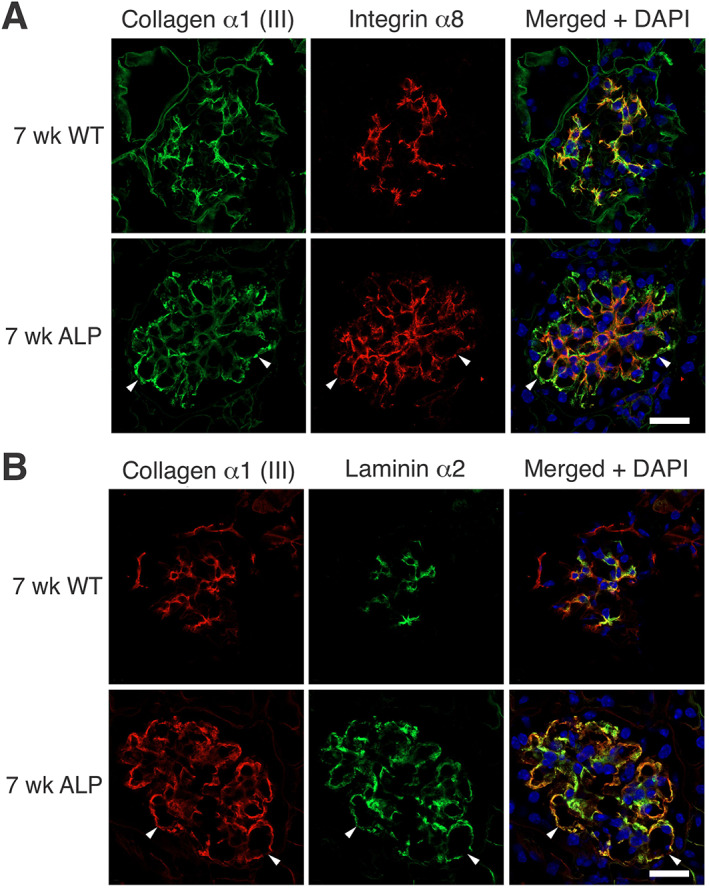
Collagen α1(III) co‐localization with glomerular mesangial matrix proteins. (A) Mesangial filopodia are evident in the areas of the GBM where collagen III is observed. Dual immunofluorescence analysis was performed on kidney cryosections from 7‐week‐old wild‐type and Alport mice using antibodies for integrin α8 (a mesangial integrin) and collagen III. Integrin α8 localizes to capillary loops where collagen α1(III) is present, consistent with a mesangial ECM protein. The dual fluorescence localizes collagen α1(III) to the GBM. Arrowheads denote areas in the GBM with clear co‐localization. Bar = 15 μm. (B) Laminin α2 and collagen α1(III) co‐localize in the GBM, consistent with their being secreted by mesangial filopodia. Dual immunofluorescence analysis was performed on kidney cryosections from 7‐week‐old wild‐type and Alport mice using antibodies for laminin α2 and collagen α1(III). Arrowheads denote areas in the GBM with clear co‐localization. Bar = 15 μm.
Figure 3
Figure 3
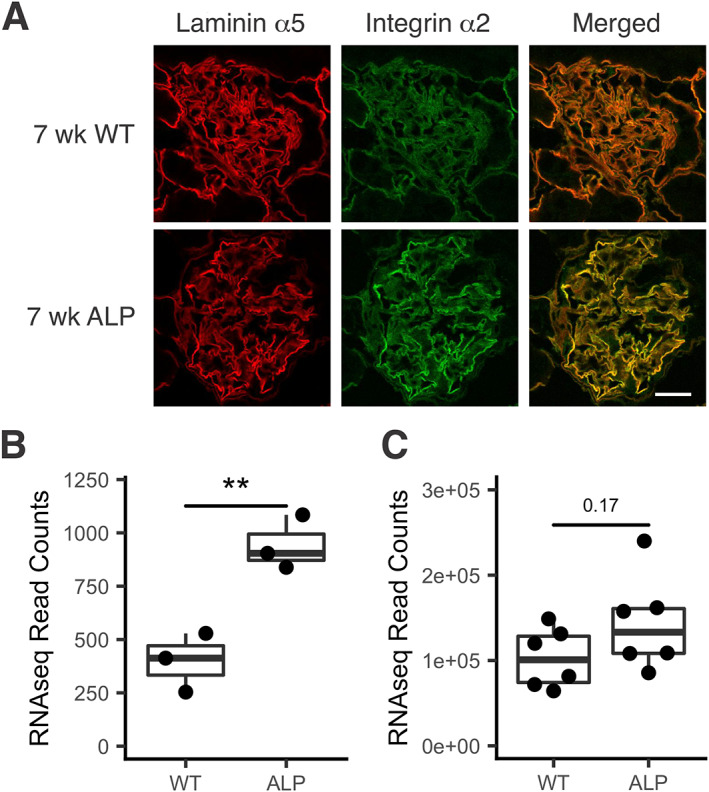
Integrin α2 co‐localizes with laminin α5 and is induced in Alport glomeruli relative to wild‐type. (A) Kidney cryosections from wild‐type and Alport mice were dual immunostained with antibodies specific for integrin α2 and laminin α5. Immunostaining indicates co‐localization with elevated levels of integrin α2 in Alport mice relative to wild‐type. Bar = 15 μm. (B) RNA‐seq of triplicate RNA samples from wild‐type and Alport glomeruli shows a significant increase of Itga2 in Alport glomeruli relative to wild‐type **p < 0.01. (C) ImageJ analysis of the relative fluorescence for immunostains of wild‐type and Alport glomeruli (six independent glomeruli each) shows an increase in Alport fluorescence intensity that trends towards significance.
Figure 4
Figure 4
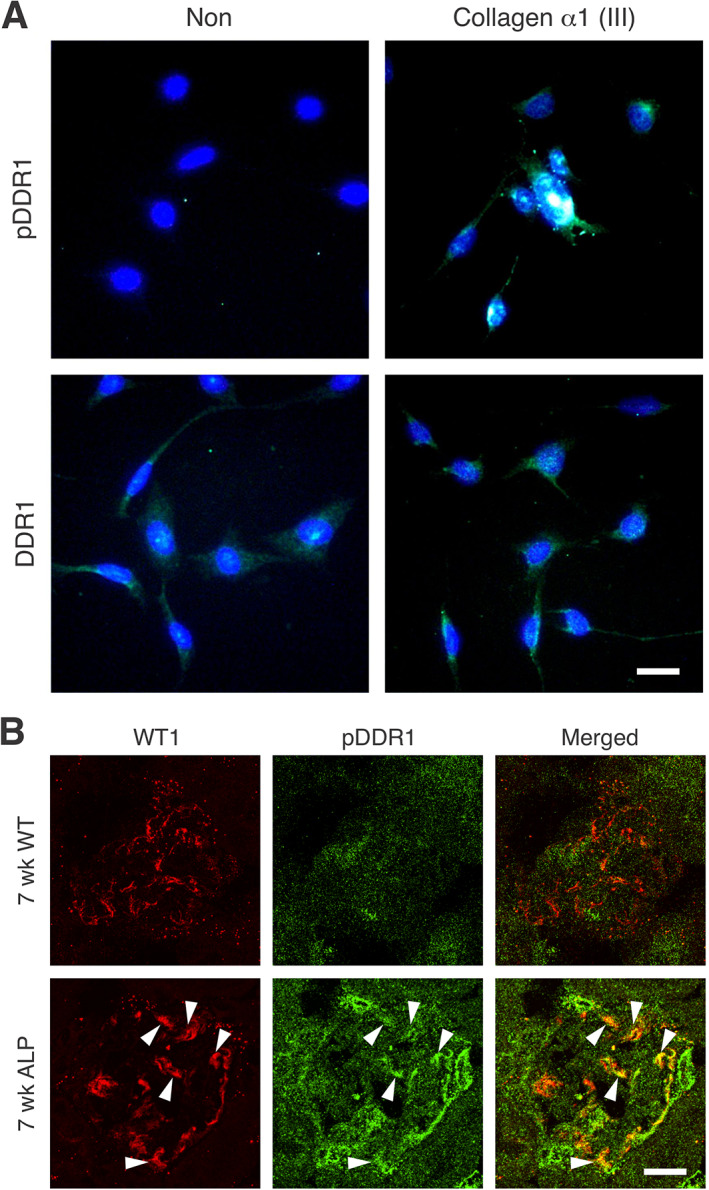
Collagen α1(III) activates DDR1 receptors both in vitro and in vivo. (A) Cells were treated or not with collagen III and after 12 h, stained with antibodies against either total DDR1 or phospho‐DDR1 (pDDR1) (bar = 5 μm). (B) Cryosections from 7‐week‐old wild‐type and Alport mice were dual immunostained with antibodies specific for pDDR1 or WT1 (a podocyte nuclear marker) (bar = 15 μm). Results indicate that collagen III activates DDR1 receptors both in vitro and in vivo in glomerular podocytes. Arrowheads denote areas of WT1 and pDDR1 co‐localization.
Figure 5
Figure 5
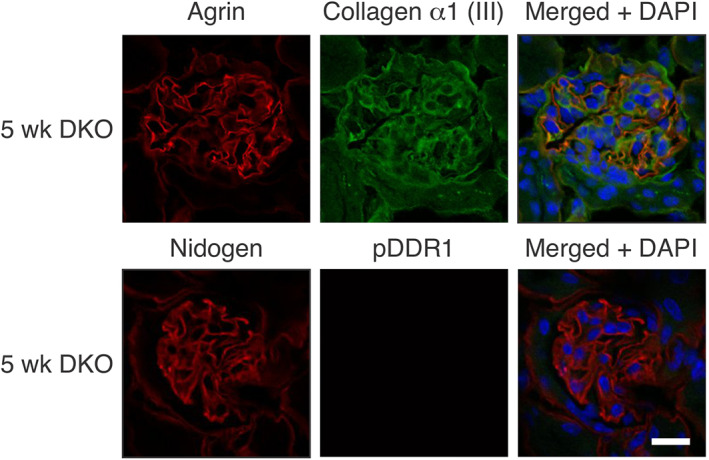
The collagen IV α1/α2 network in Alport GBM does not activate DDR1. Cryosections from 5‐week‐old integrin α1‐null Alport mice were stained with antibodies for the indicated proteins. Note the absence of collagen α1(III) in the GBM and the absence of pDDR1 nuclear immunostaining in the podocytes. This indicates that the collagen IV α1/α2 network does not activate DDR1. Bar = 15 μm.
Figure 6
Figure 6
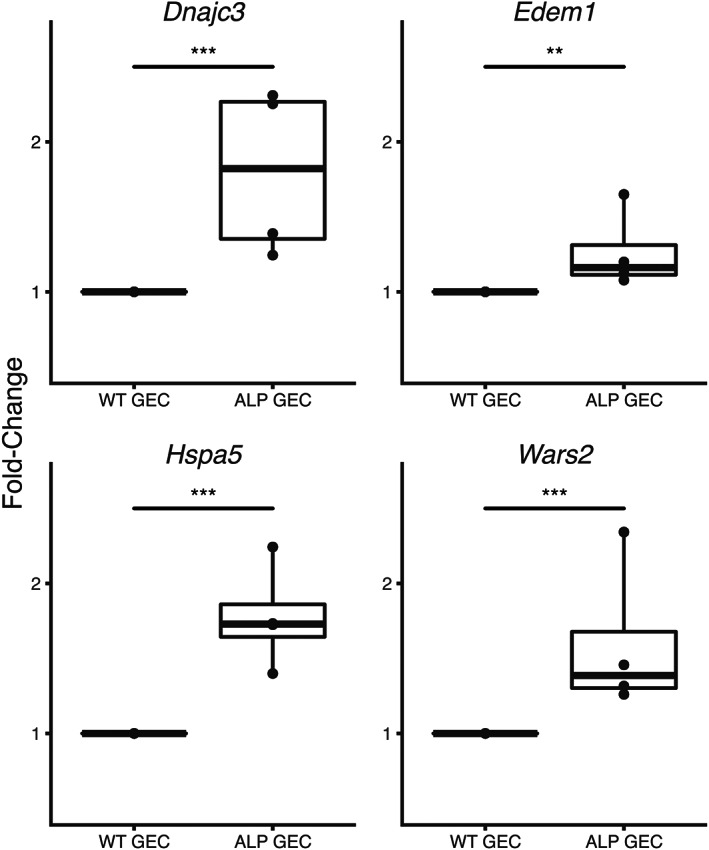
Genes associated with ER stress are induced in Alport podocytes relative to wild‐type podocytes. Cultured podocytes were differentiated for 14 days and the RNA was isolated and analyzed for the indicated transcripts by RT‐qPCR. The experiment was run in triplicate. **p < 0.01, ***p < 0.001.

References

    1. Mochizuki T, Lemmink HH, Mariyama M, et al. Identification of mutations in the α3(IV) and α4(IV) collagen genes in autosomal recessive Alport syndrome. Nat Genet 1994; 8: 77–82. - PubMed
    1. Lemmink HH, Mochizuki T, van den Heuvel LP, et al. Mutations in the type IV collagen alpha 3 (COL4A3) gene in autosomal recessive Alport syndrome. Hum Mol Genet 1994; 3: 1269–1273. - PubMed
    1. Barker DF, Hostikka SL, Zhou J, et al. Identification of mutations in the COL4A5 collagen gene in Alport syndrome. Science 1990; 248: 1224–1227. - PubMed
    1. Gunwar S, Ballester F, Noelken ME, et al. Glomerular basement membrane. Identification of a novel disulfide‐cross‐linked network of α3, α4, and α5 chains of type IV collagen and its implications for the pathogenesis of Alport syndrome. J Biol Chem 1998; 273: 8767–8775. - PubMed
    1. Meehan DT, Delimont D, Cheung L, et al. Biomechanical strain causes maladaptive gene regulation, contributing to Alport glomerular disease. Kidney Int 2009; 76: 968–976. - PMC - PubMed

Publication types