


Hepatitis C microelimination among people living with HIV in Taiwan
- PMID: 35608049
- PMCID: PMC9225706
- DOI: 10.1080/22221751.2022.2081620
Hepatitis C microelimination among people living with HIV in Taiwan
Abstract
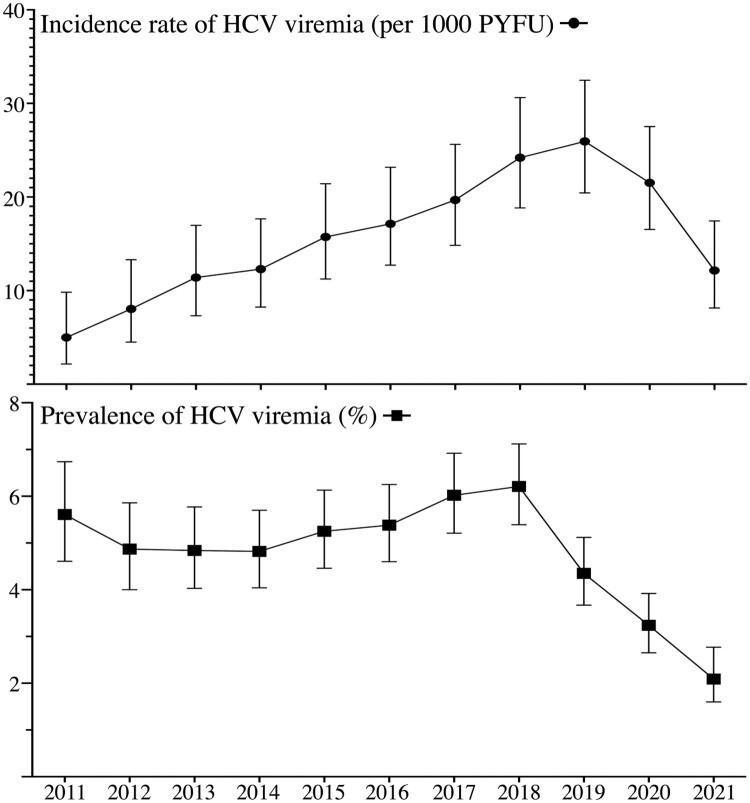
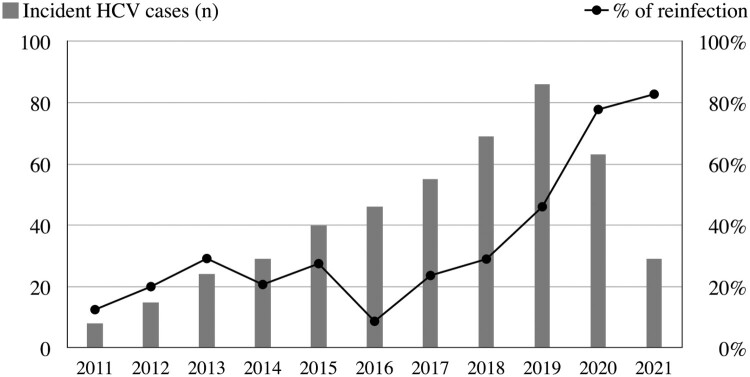
To reach the WHO target of hepatitis C virus (HCV) elimination by 2025, Taiwan started to implement free-of-charge direct-acting antiviral (DAA) treatment programme in 2017. Evaluating the progress of HCV microelimination among people living with HIV (PLWH) is a critical step to identify the barriers to HCV elimination. PLWH seeking care at a major hospital designated for HIV care in Taiwan between January 2011 and December 2021 were retrospectively included. For PLWH with HCV-seropositive or HCV seroconversion during the study period, serial HCV RNA testing was performed using archived samples to confirm the presence of HCV viremia and estimate the prevalence and incidence of HCV viremia. Overall, 4199 PLWH contributed to a total of 27,258.75 person-years of follow-up (PYFU). With the reimbursement of DAAs and improvement of access to treatments, the prevalence of HCV viremia has declined from its peak of 6.21% (95% CI, 5.39-7.12%) in 2018 to 2.09% (95% CI, 1.60-2.77%) in 2021 (decline by 66.4% [95% CI, 55.4-74.7%]); the incidence has declined from 25.94 per 1000 PYFU (95% CI, 20.44-32.47) in 2019 to 12.15% per 1000 PYFU (95% CI, 8.14-17.44) (decline by 53.2% [95% CI, 27.3-70.6%]). However, the proportion of HCV reinfections continued to increase and accounted for 82.8% of incident HCV infections in 2021. We observed significant declines of HCV viremia among PLWH with the expansion of the DAA treatment programme in Taiwan. Further improvement of the access to DAA retreatments is warranted to achieve the goal of HCV microelimination.
Keywords: Men who have sex with men; direct-acting antiviral; injection drug use; sexually transmitted disease; sustained virologic response.
Conflict of interest statement
C.C. Hung has received research support from Merck, Gilead Sciences, and ViiV and speaker honoraria from Gilead Sciences and ViiV, and served on advisory boards for Gilead Sciences and ViiV. H.Y. Sun has received research support from Gilead Sciences. Other authors have no competing interest to disclose.
Figures


References
-
- World Health Organization . Global health sector strategy on viral hepatitis, 2016–2021: towards ending viral hepatitis; [assessed 2022 Mar 23]. Available from: https://apps.who.int/iris/handle/10665/246177?locale-attribute=en&.
-
- Veldt BJ, Heathcote EJ, Wedemeyer H, et al. Sustained virologic response and clinical outcomes in patients with chronic hepatitis C and advanced fibrosis. Ann Intern Med. 2007;147:677–684. - PubMed
-
- Morgan RL, Baack B, Smith BD, et al. Eradication of hepatitis C virus infection and the development of hepatocellular carcinoma: a meta-analysis of observational studies. Ann Intern Med. 2013;158:329–337. - PubMed
-
- Kanwal F, Kramer J, Asch SM, et al. Risk of hepatocellular cancer in HCV patients treated with direct-acting antiviral agents. Gastroenterology. 2017;153:996–1005.e1. - PubMed
-
- Knop V, Hoppe D, Welzel T, et al. Regression of fibrosis and portal hypertension in HCV-associated cirrhosis and sustained virologic response after interferon-free antiviral therapy. J Viral Hepat. 2016;23:994–1002. - PubMed
MeSH terms
Substances
LinkOut - more resources
Full Text Sources
Medical
