. 2022 Oct 1;151(7):1127-1141.
doi: 10.1002/ijc.34136. Epub 2022 Jun 15.

Systematic analysis of Kaposi's sarcoma (KS)-associated herpesvirus genomes from a KS case-control study in Cameroon: Evidence of dual infections but no association between viral sequence variation and KS risk

Affiliations

Systematic analysis of Kaposi's sarcoma (KS)-associated herpesvirus genomes from a KS case-control study in Cameroon: Evidence of dual infections but no association between viral sequence variation and KS risk

Vickie A Marshall et al. Int J Cancer. .

Abstract

In sub-Saharan Africa, Kaposi's sarcoma-associated herpesvirus (KSHV) is endemic, and Kaposi's sarcoma (KS) is a significant public health problem. Until recently, KSHV genotype analysis was performed using variable gene regions, representing a small fraction of the genome, and thus the contribution of sequence variation to viral transmission or pathogenesis are understudied. We performed near full-length KSHV genome sequence analysis on samples from 43 individuals selected from a large Cameroonian KS case-control study. KSHV genomes were obtained from 21 KS patients and 22 control participants. Phylogenetic analysis of the K1 region indicated the majority of sequences were A5 or B1 subtypes and all three K15 alleles were represented. Unique polymorphisms in the KSHV genome were observed including large gene deletions. We found evidence of multiple distinct KSHV genotypes in three individuals. Additionally, our analyses indicate that recombination is prevalent suggesting that multiple KSHV infections may not be uncommon overall. Most importantly, a detailed analysis of KSHV genomes from KS patients and control participants did not find a correlation between viral sequence variations and disease. Our study is the first to systematically compare near full-length KSHV genome sequences between KS cases and controls in the same endemic region to identify possible sequence variations associated with disease risk.

Keywords: Cameroon; Kaposi's sarcoma; Kaposi's sarcoma-associated herpesvirus; human herpesvirus 8; next-generation sequencing; whole genome sequencing.


Conflict of interest statement

CONFLICT OF INTEREST

Dr. Neneh Salah is currently an employee of GSK and owns company shares. No other authors have COI to declare.

Figures
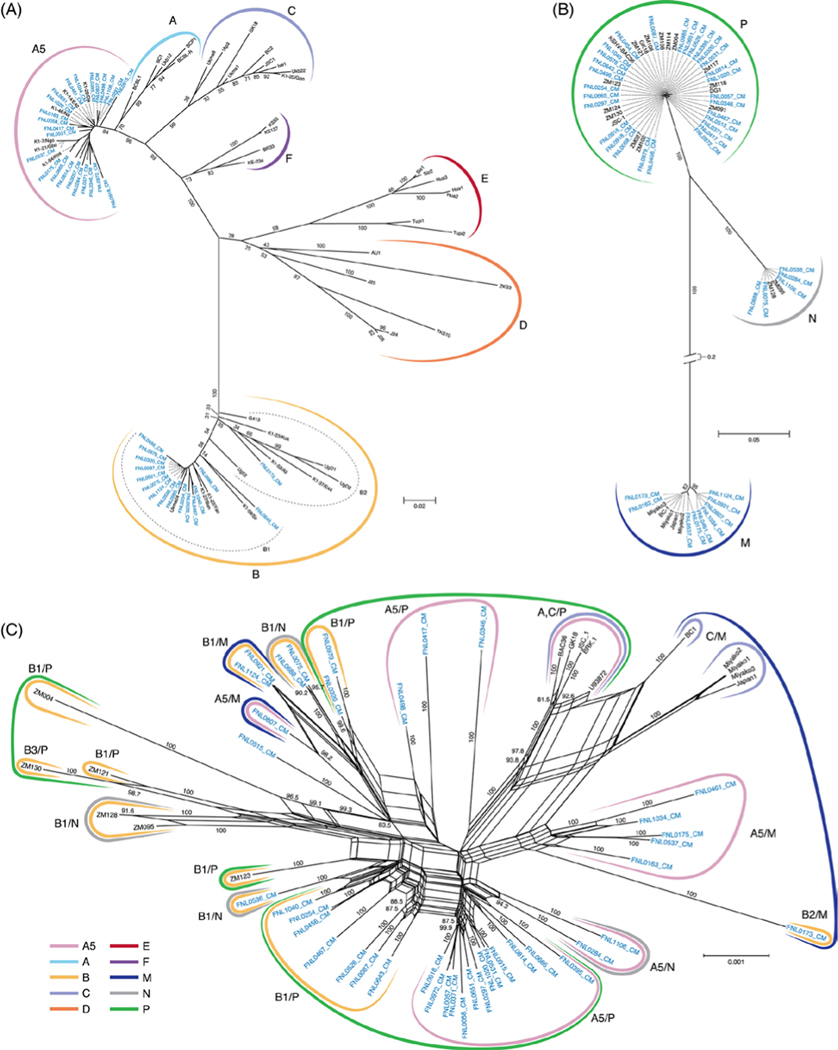
FIGURE 1
FIGURE 1
KSHV subtyping (current study participants in blue) with K1 and K15 subtypes indicated by color. (A) K1 neighbor-joining bootstrapped phylogenetic tree created in Mega 6. The analysis consisted of 40 Cameroon and 38 published amino acid sequences. All Cameroon samples were KSHV K1 subtypes A5 or B as indicated (B) K15 neighbor-joining bootstrapped phylogenetic tree constructed in Mega 6. The analysis included 65 nucleotide samples with 777 positions making up the final dataset. Most Cameroon samples were determined to be the predominant K15 P subtype, although less common M and N subtypes were also observed. (C) Whole-genome splits network of 40 study and 16 published sequences created using SplitsTree 4. A total of approximately 130 000 positions were included in the final data set with bootstrap values over 80 reported. Repeat regions were removed from the analysis. The KSHV full and partial genomes used for phylogenetic analyses included: GK18 (NC_009333), BC-1 (U75698.1), Japan/Miyako sequences (LC200587.1-LC200589.1), BCBL-1 (HQ404500.1), JSC-1 (MK143395.1), KSHV-BAC36 (HQ404500.1), BrK.219 (KF588566.1), BCBL-1 (MT936340.1), Zambian sequences ZM007-ZM130 (KT271453-KT271468), K1–7/Ngo (AF178779), K1–20/Gon (AF178789), K1–21/Gbo (AF178790), K1–22/Yan (AF178791), K1–23/Kok (AF178792), K1–27/Ban (AF178796), K1–31/Ren (AF178798), K1–54/Kos (AF171059), K1–59/Sir (AF178824), K1–34/E40 (AF178801), K1–28/Djk (AF178797), K1–46/Na (AF171058), K1–37/E44 (AF178804), K1–52/Ali (AF178818), Tupi 1 (AF220292.1), Tupi 2 (AF220293.1), Hua1 (AY329026.1), Hua2 (AY329027.1), Hua3 (AY329026.1), Sio1 (AY329025.1), Sio2 (AY329024.1), AU1 (AF151687.1), ZKS3 (AF133044.1), TKS10 (MK176598.1), J24 (AF278844.1), J25 (AF278845.1), J26 (AF278846.1), G413 (AF130262.1), KE-234 (FJ884616.1), BR33 (KT215106.1), KS137 (KP997134.1), KS55 (KP997076.1), UKma24 (AF130301.1), Iap3 (AF130271.1), BCBL-R (AF133038.1), BCP-1 (AY787132.1), Ukma1 (AF130300.1), Ukb22 (AF130298.1), Ive1 (AF130286.1), UgD1 (AF130292.1), UgD2 (AF130293.1), Ug52 (AF130290.1) and BC-2 (AF133042.1)
FIGURE 2
FIGURE 2
KSHV %ID by gene region: (A) Boxplots reflect the distribution of pairwise distances calculated for sample pairs in selected regions across the KSHV genome. Distances are based on a consensus alignment and includes current study sequences and the KSHV GK18 reference NC_009333.1. As expected, K1, ORF73 (repeat regions masked) and K15 are highly divergent regions. Variation outside these gene regions, in the central portion of the viral genome, ranged from 0.2% to 5% between the A5 and B subtypes represented in the current study. The zoomed inset (shaded) highlights the range from 94% to 100%, to provide clearer insight into less divergent gene regions. (B) Variations observed in the K4.2, ORF47 and K8 gene regions. Los Alamos Highlighter software was used to visualize mutations noted within the K4.2 (A), ORF47 (B) and K8 (C) gene regions. The plots show predicted amino acids changes as referenced in the figure legend, compared to the GK18 reference genome. Gaps in sequences are indicated by gray bars
FIGURE 3
FIGURE 3
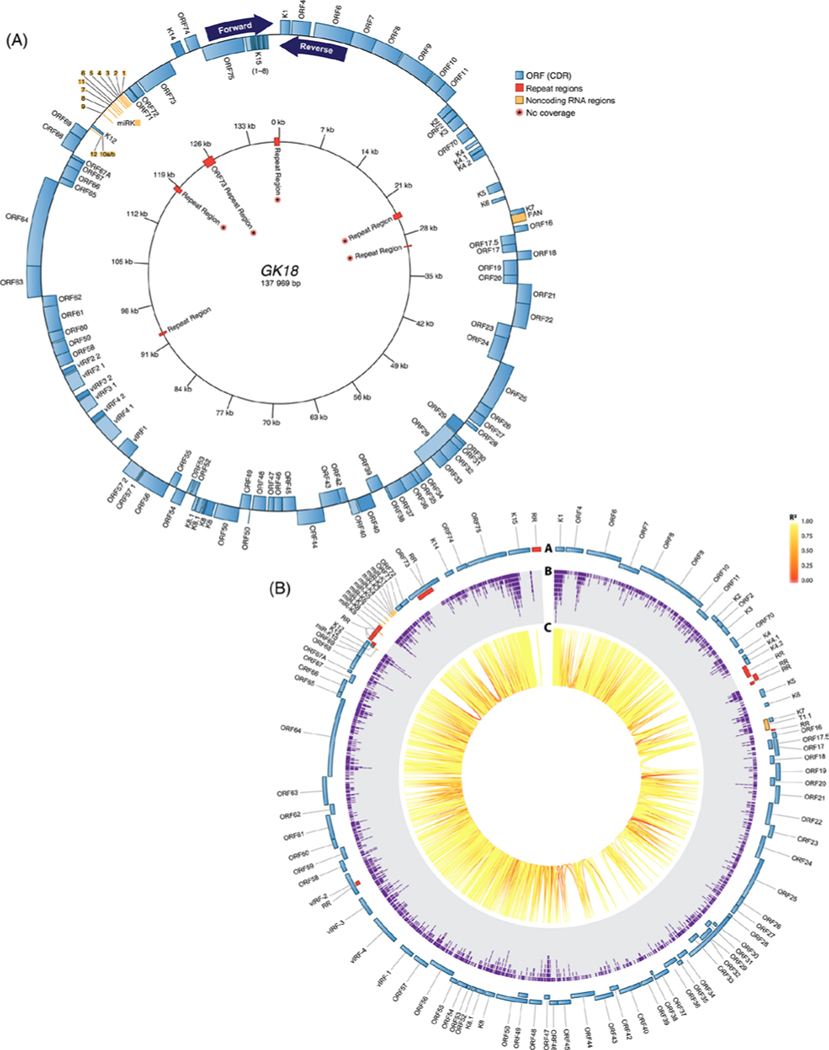
Reference KSHV genome ORF (CDR) (GenBank. NC_009333). (A) K1 and K15 are indicated at the top center of the outer circle with the orientation of individual genes reflected in the placement on the outside or inside of the outer circle as shown. Repetitive regions, not sequenced by NGS method, are indicated by the inner circle. (B) Detailed mapping of the positions of single nucleotide variations, insertions and deletions (B ring) as well as linkage disequilibrium analysis (C ring) in the KSHV sequences analyzed from HIV+ participants. Masked repeat regions indicated in red. Graphs created with Circosplot
FIGURE 4
FIGURE 4
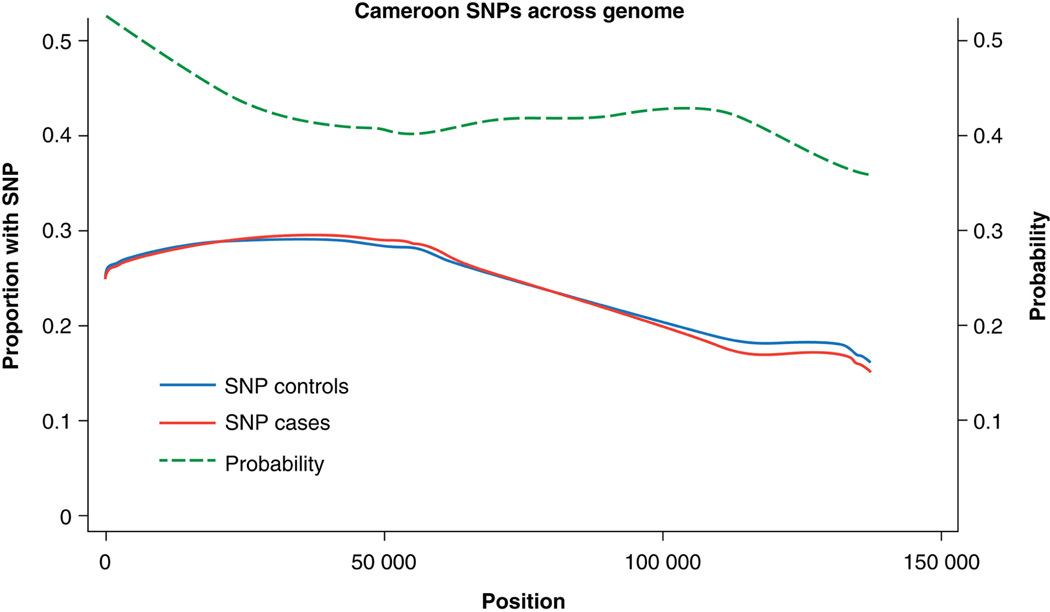
KSHV sequence comparisons between AIDS-KS cases and controls. Proportion (left y axis) of KS (red) and control (blue) whole KSHV genomes with variant sequence compared to the reference GK18 at any given nucleotide position (x axis). A parametric test for the equality of proportion yielded the probability shown by the green line (right y axis) and did not identify any SNVs occurring more frequently in KS as compared to control sequences
FIGURE 5
FIGURE 5
Mixed infection. KSHV sequence alignments are shown from the three identified dual infection samples. The alignments show a representative number of reads for the highly variable genes K1 (panels A and B) and K15 (panel C) using Geneious Prime software 2021.0.3. The shaded portion represents the A5 gene specific reads in the K1 gene alignments and the N subtype in the K15 alignment. For sample FNL0985, we were able to Sanger sequence confirm the major and minor KSHV strains in K15 gene, as well as two additional gene regions attempted, as shown in adjacent table. Sanger sequence primer designs used to distinguish dual infections are included in Table S1

Similar articles

Cited by

References

    1. Cornejo Castro EM, Marshall V, Lack J, et al. Dual infection and recombination of Kaposi sarcoma herpesvirus revealed by whole-genome sequence analysis of effusion samples. Virus Evol. 2020;6: veaa047. - PMC - PubMed
    1. Parkin DM, Hammerl L, Ferlay J, Kantelhardt EJ. Cancer in Africa 2018: the role of infections. Int J Cancer. 2020;146:2089–2103. - PubMed
    1. Sankaranarayanan R, Swaminathan R, World Health Organization, International Agency for Research on Cancer. Cancer Survival in Africa, Asia, the Caribbean and Central America. Lyon, France: International Agency for Research on Cancer, World Health Organization; 2011.
    1. Cesarman E, Damania B, Krown SE, Martin J, Bower M, Whitby D. Kaposi sarcoma. Nat Rev Dis Primers. 2019;5:9. - PMC - PubMed
    1. Chen WC, Singh E, Muchengeti M, et al. Johannesburg cancer study (JCS): contribution to knowledge and opportunities arising from 20 years of data collection in an African setting. Cancer Epidemiol. 2020; 65:101701. - PubMed

Publication types