Review
. 2022 Aug;31(4):e13616.
doi: 10.1111/jsr.13616. Epub 2022 May 24.

Obstructive sleep apnea: transition from pathophysiology to an integrative disease model

Affiliations
Review

Obstructive sleep apnea: transition from pathophysiology to an integrative disease model

Walter T McNicholas et al. J Sleep Res. 2022 Aug.

Abstract

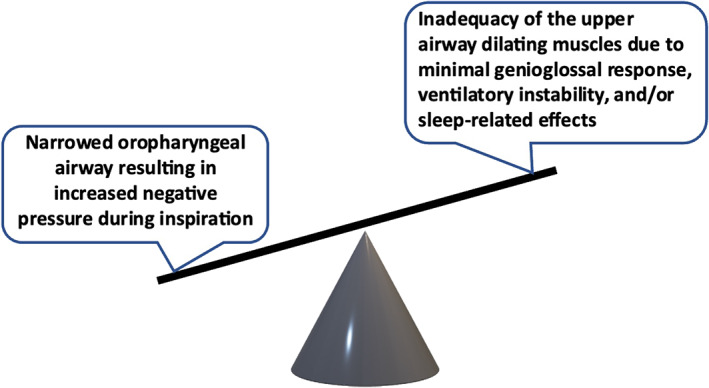
Obstructive sleep apnea (OSA) is characterised by recurring episodes of upper airway obstruction during sleep and the fundamental abnormality reflects the inability of the upper airway dilating muscles to withstand the negative forces generated within the upper airway during inspiration. Factors that result in narrowing of the oropharynx such as abnormal craniofacial anatomy, soft tissue accumulation in the neck, and rostral fluid shift in the recumbent position increase the collapsing forces within the airway. The counteracting forces of upper airway dilating muscles, especially the genioglossus, are negatively influenced by sleep onset, inadequacy of the genioglossus responsiveness, ventilatory instability, especially post arousal, and loop gain. OSA is frequently associated with comorbidities that include metabolic, cardiovascular, renal, pulmonary, and neuropsychiatric, and there is growing evidence of bidirectional relationships between OSA and comorbidity, especially for heart failure, metabolic syndrome, and stroke. A detailed understanding of the complex pathophysiology of OSA encourages the development of therapies targeted at pathophysiological endotypes and facilitates a move towards precision medicine as a potential alternative to continuous positive airway pressure therapy in selected patients.

Keywords: comorbidity; diagnosis; epidemiology; obstructive sleep apnea; pathophysiology; treatment.


Figures

FIGURE 1
FIGURE 1
Balance of forces affecting the patency of the upper airway. Factors resulting in increased negative intrapharyngeal pressure and factors that reduce dilating muscle contraction together promote airway collapse
FIGURE 2
FIGURE 2
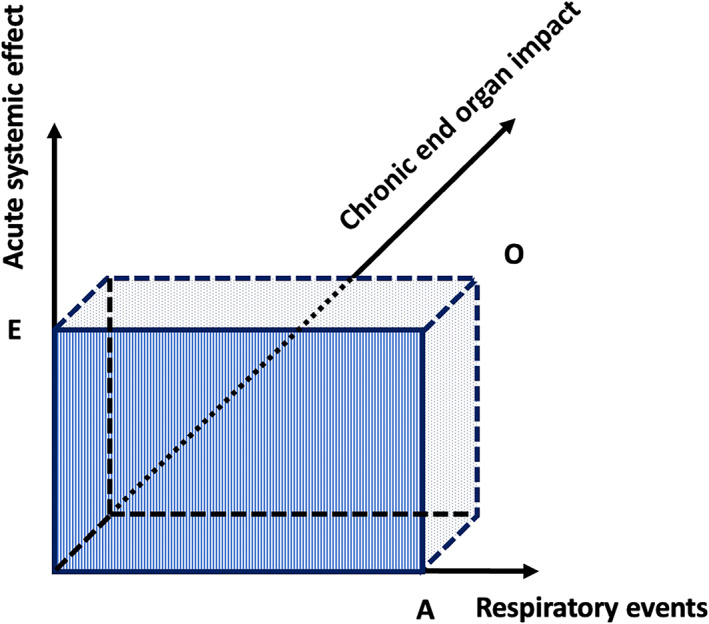
Three‐dimensional model of obstructive sleep apnea (OSA) disease severity. The x‐axis represents the amount of respiratory events (A) in an overnight sleep period. While this number is usually expressed as the apnea–hypopnea index in clinical studies, the absolute count of events is considered in this model. The y‐axis represents an acute systemic effect (E) induced by a respiratory event, e.g. a certain degree of hypoxaemia. The hatched area A*E represents the integration of all events with their associated systemic effects, being the nightly exposure to adverse effects of OSA. The nightly exposure inflicts repetitive strain to the end‐organ systems. The z‐axis represents a chronic end‐organ impact (O) of OSA, e.g. cognitive impairment, arterial hypertension, cardiovascular damage, insulin resistance, etc. Due to interindividual differences in susceptibility, the end‐organ impact may be variable among patients with OSA for similar levels of exposure. The dotted volume A*E*O represents the relation between the three dimensions. Based on postulated differences in susceptibility, the disease spectrum may vary from low exposure/high impact to high exposure/low impact. The dashed aspect of the boundaries indicates that the end‐organ impact of OSA is as yet difficult to assess. This is due to uncertainty regarding susceptibility on the one hand and to possible confounding effects of other disease processes on the other. Figure reproduced from (Randerath et al., 2018) with permission from the publisher
FIGURE 3
FIGURE 3
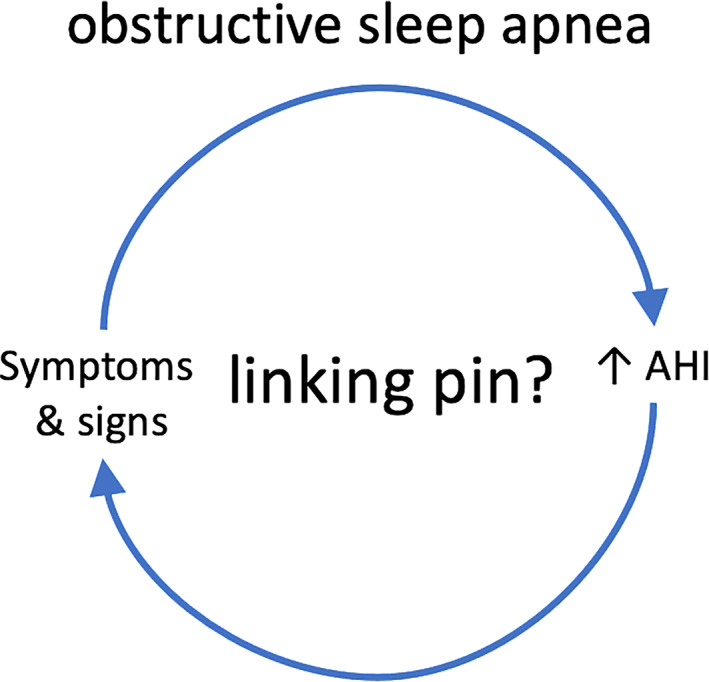
Reconsidering the conventional obstructive sleep apnea model. The assumption that an increased apnea–hypopnea index (AHI) is causally linked to symptoms and signs is an heuristic that has been introduced by the Stanford school in the 1970s. However, because both elements of this relationship are highly prevalent in the general population, the default hypothesis should rather be that the association is based on coincidence. Other factors have to be introduced into this model to enhance specificity, i.e., to increase the degree of certainty regarding causality
FIGURE 4
FIGURE 4
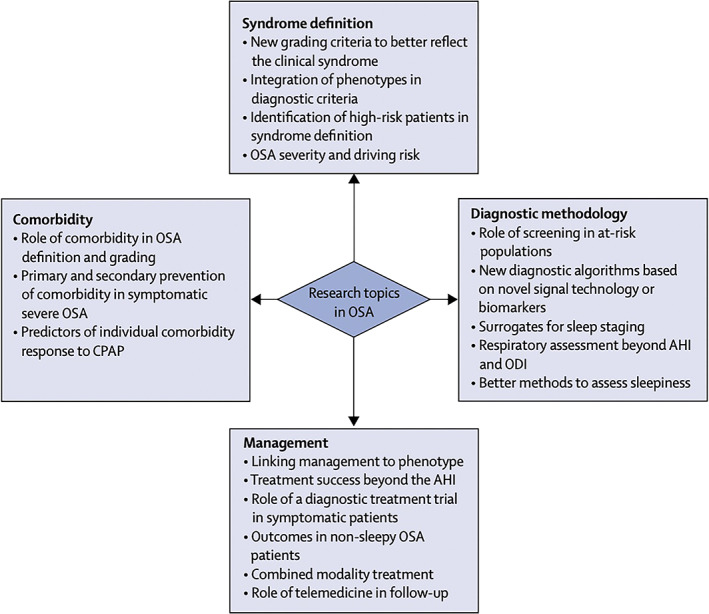
Proposed topics for future research in obstructive sleep apnoea (OSA). Research topics in OSA should be elaborated in four major domains: syndrome definition, diagnostic methodology, management, and clarifying the role of comorbidity. Figure reproduced from (McNicholas et al., 2018) with permission from the publisher. AHI, apnea–hypopnea index. CPAP, continuous positive airway pressure; ODI, oxygen desaturation index

References

    1. AASM (2014). Obstructive sleep apnea, adult. In Sateia M. (Ed.), The international classification of sleep disorders (3rd ed., pp. 53–62). American Academy of Sleep Medicine.
    1. Abbasi, J. (2017). In‐home, over‐the‐counter Sleep apnea sensor on the horizon. Jama‐Journal of the American Medical Association, 317(22), 2271. 10.1001/jama.2017.6928 - DOI - PubMed
    1. Abuyassin, B. , Sharma, K. , Ayas, N. T. , & Laher, I. (2015). Obstructive Sleep apnea and kidney disease: A potential bidirectional relationship? Journal of Clinical Sleep Medicine, 11(8), 915–924. 10.5664/jcsm.4946 - DOI - PMC - PubMed
    1. Abuzaid, A. S. , Al Ashry, H. S. , Elbadawi, A. , Ld, H. , Saad, M. , Elgendy, I. Y. , Elgendy, A. , Mahmoud, A. N. , Mentias, A. , Baraka, A. , & Lal, C. (2017). Meta‐analysis of cardiovascular outcomes with continuous positive airway pressure therapy in patients with obstructive Sleep apnea. The American Journal of Cardiology, 120(4), 693–699. 10.1016/j.amjcard.2017.05.042 - DOI - PubMed
    1. Ahmed, S. B. , Ronksley, P. E. , Hemmelgarn, B. R. , Tsai, W. H. , Manns, B. J. , Tonelli, M. , Klarenbach, S. W. , Chin, R. , Clement, F. M. , & Hanly, P. J. (2011). Nocturnal hypoxia and loss of kidney function. PLoS One, 6(4), e19029. 10.1371/journal.pone.0019029 - DOI - PMC - PubMed