


Prevalence and prospective evaluation of cognitive dysfunctions after SARS due to SARS-CoV-2 virus. The COgnitiVID study
- PMID: 35610098
- PMCID: PMC9123423
- DOI: 10.1016/j.neurol.2022.03.014
Prevalence and prospective evaluation of cognitive dysfunctions after SARS due to SARS-CoV-2 virus. The COgnitiVID study
Abstract
Objective: COVID-19 due to SARS-CoV-2 virus is a new cause of severe acute respiratory syndrome (SARS). Little is known about the short-term cognitive prognosis for these patients. We prospectively evaluated basic cognitive functions shortly after care in the intensive care unit (ICU) and three months later in post-ICU COVID-19 patients.
Material and methods: We performed a prospective single-center study in our institution in Paris. Patients with SARS-CoV-2 SARS were prospectively recruited via our ICU. Patients were evaluated using standardized cognitive tests at baseline and at three months' follow-up. Our primary endpoint was the evolution of the following five global tests: MMSE, FAB, oral naming test, Dubois five words test and MADRS.
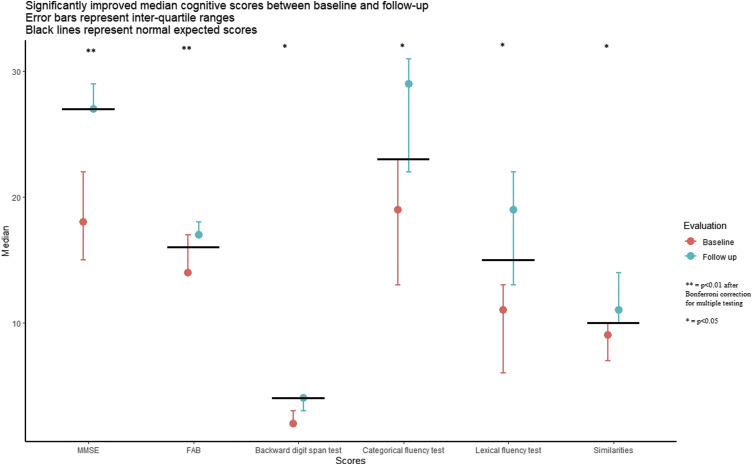
Results: We explored 13 patients at baseline and follow-up. All patients had cognitive impairment at baseline but they all improved at three months, significantly on two of the five global tests after Bonferroni correction for multiple testing: MMSE (median 18 (IQR [15-22]) and 27 (IQR [27-29]) respectively, P=0.002) and FAB test (median 14 (IQR [14-17]) and 17 (IQR [17,18]) respectively, P=0.002).
Conclusions: We report here the first longitudinal data on short-term cognitive impairment after intensive care in COVID-19 patients. We found acute and short-term cognitive impairment but significant improvement at three months. This pattern does not seem to differ from other causes of post-intensive care syndrome.
Keywords: COVID-19; Cognitive disorder; Critical care syndrome; Executive function; SARS-CoV-2.
Copyright © 2022 Elsevier Masson SAS. All rights reserved.
Figures
References
MeSH terms
LinkOut - more resources
Full Text Sources
Medical
Miscellaneous
