


Navigating uncertainty alone: A grounded theory analysis of women's psycho-social experiences of pregnancy and childbirth during the COVID-19 pandemic in London
- PMID: 35610170
- PMCID: PMC9110569
- DOI: 10.1016/j.wombi.2022.05.002
Navigating uncertainty alone: A grounded theory analysis of women's psycho-social experiences of pregnancy and childbirth during the COVID-19 pandemic in London
Abstract
Problem: Maternity care underwent substantial reconfiguration in the United Kingdom during the COVID-19 pandemic.
Background: COVID-19 posed an unprecedented public health crisis, risking population health and causing a significant health system shock.
Aim: To explore the psycho-social experiences of women who received maternity care and gave birth in South London during the first 'lockdown'.
Methods: We recruited women (N = 23) to semi-structured interviews, conducted virtually. Data were recorded, transcribed, and analysed by hand. A Classical Grounded Theory Analysis was followed including line-by-line coding, focused coding, development of super-categories followed by themes, and finally the generation of a theory.
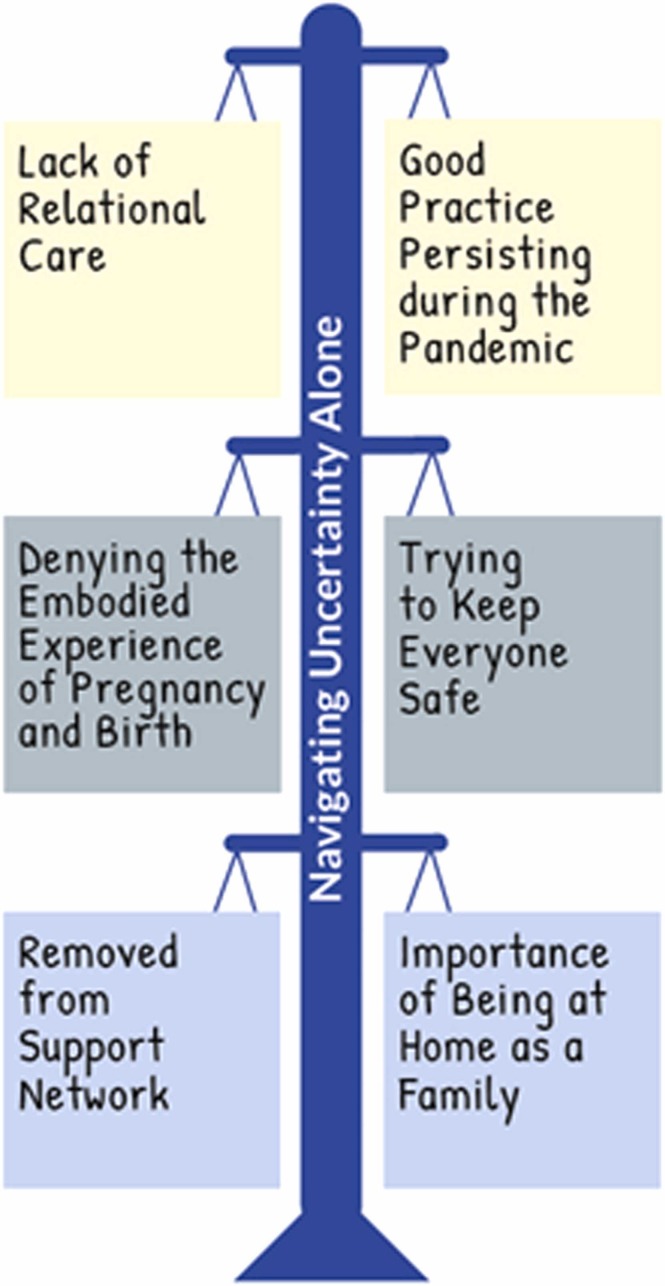
Findings: Iterative and inductive analysis generated six emergent themes, sorted into three dyadic pairs: 1 & 2: Lack of relational care vs. Good practice persisting during the pandemic; 3 & 4: Denying the embodied experience of pregnancy and birth vs. Trying to keep everyone safe; and 5 & 6: Removed from support network vs. Importance of being at home as a family. Together, these themes interact to form the theory: 'Navigating uncertainty alone'.
Discussion: Women's pregnancy and childbirth journeys during the pandemic were reported as having positive and negative experiences which would counteract one-another. Lack of relational care, denial of embodied experiences, and removal from support networks were counterbalanced by good practice which persisted, understanding staff were trying to keep everyone safe, and renewed importance in the family unit.
Conclusion: Pregnancy can be an uncertain time for women. This was compounded by having to navigate their maternity journey alone during the COVID-19 pandemic.
Keywords: COVID-19; Grounded theory; Maternity care; Pregnancy and childbirth; Qualitative methods; Women’s psycho-social experiences.
Copyright © 2023 The Authors. Published by Elsevier Ltd.. All rights reserved.
Conflict of interest statement
Declaration of Competing Interest The authors declare that they have no known competing financial interests or personal relationships that could have appeared to influence the work reported in this paper. CONFLICT OF INTEREST Sergio A. Silverio, Abigail Easter, Kaat De Backer, & Jane Sandall (King’s College London) are currently supported by the National Institute for Health Research Applied Research Collaboration South London [NIHR ARC South London] at King’s College Hospital NHS Foundation Trust. Kaat De Backer (King’s College London) is also currently supported by the National Institute for Health Research Applied Research Collaboration East of England [NIHR ARC East of England] at Cambridgeshire and Peterborough NHS Foundation Trust. Sergio A. Silverio is also in receipt of a personal Doctoral Fellowship awarded by the NIHR ARC South London Capacity Building Theme and Jane Sandall is also an NIHR Senior Investigator [Award Number: NIHR200306]. The views expressed are those of the authors and not necessarily those of the NIHR or the Department of Health and Social Care.
Figures
References
MeSH terms
LinkOut - more resources
Full Text Sources
Medical
