Review
. 2022 Jun 7;56(11):6813-6835.
doi: 10.1021/acs.est.2c01072. Epub 2022 May 25.

A Review of Road Traffic-Derived Non-Exhaust Particles: Emissions, Physicochemical Characteristics, Health Risks, and Mitigation Measures

Affiliations
Review

A Review of Road Traffic-Derived Non-Exhaust Particles: Emissions, Physicochemical Characteristics, Health Risks, and Mitigation Measures

Julia C Fussell et al. Environ Sci Technol. .

Abstract

Implementation of regulatory standards has reduced exhaust emissions of particulate matter from road traffic substantially in the developed world. However, nonexhaust particle emissions arising from the wear of brakes, tires, and the road surface, together with the resuspension of road dust, are unregulated and exceed exhaust emissions in many jurisdictions. While knowledge of the sources of nonexhaust particles is fairly good, source-specific measurements of airborne concentrations are few, and studies of the toxicology and epidemiology do not give a clear picture of the health risk posed. This paper reviews the current state of knowledge, with a strong focus on health-related research, highlighting areas where further research is an essential prerequisite for developing focused policy responses to nonexhaust particles.

Keywords: exposure assessment; health effects; mitigation; nonexhaust emissions; road traffic; toxicity.


Conflict of interest statement

The authors declare no competing financial interest.

Figures
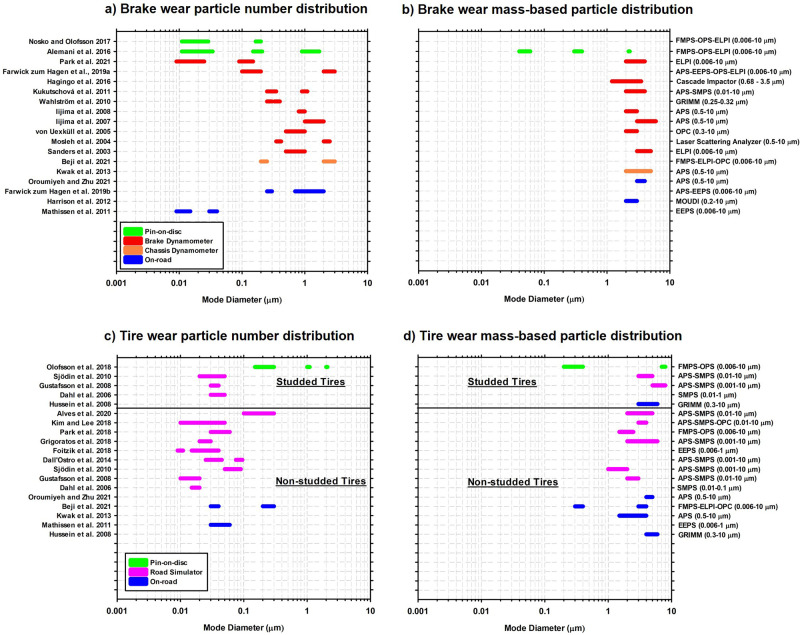
Figure 1
Figure 1
Overview of reported mode diameters of size distributions based on different measurement methods for (a) brake wear particle number distribution and (b) brake wear mass-based particle size distribution (c) tire wear particle number distribution, and (d) tire wear mass-based particle size distribution. Numbers in the parentheses show the detection size range of the measurement instruments: engine exhaust particle sizer (EEPS), aerodynamic particle sizer (APS), electrical low pressure impactor (ELPI), fast mobility particle sizer (FMPS), optical particle counter (OPC), laser scattering analyzer, optical particle sizer (OPS), scanning mobility particle sizer (SMPS).
Figure 2
Figure 2
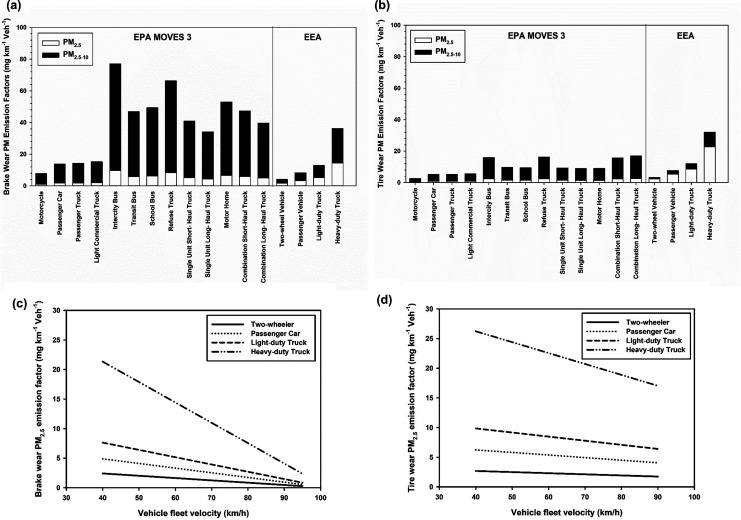
Effect of fleet velocity and weight on brake and tire wear PM emission factors (EFs) estimated by United States Environmental Protection Agency (USEPA) and European Monitoring and Evaluation Programme (EMEP)/European Environment Agency (EEA). Effect of weight on (a) brake and (b) tire wear PM EFs. Effect of vehicle velocity on PM2.5 EFs of (c) brake and (d) tire wear particles. EMEP/EEA brake wear PM EFs estimated for vehicle speed of 60 km/h EMEP/EEA heavy-duty truck brake wear PM EFs estimated for a half full truck with four axles.
Figure 3
Figure 3
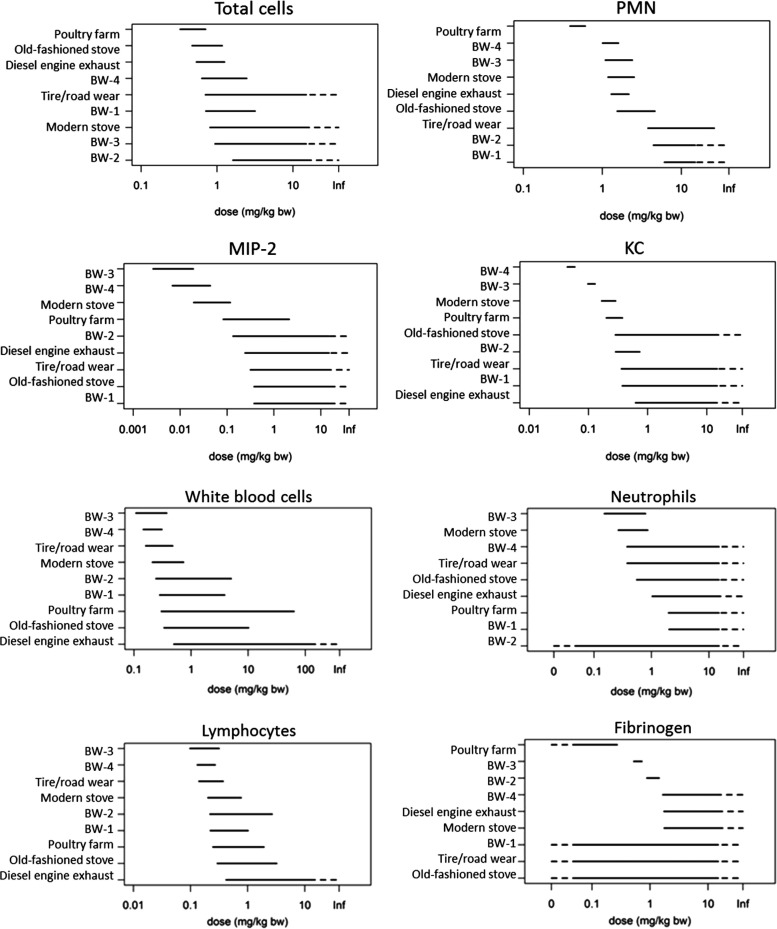
Relative toxicity of BWP compared to particulates from other sources following inhalation in mice. The further the line is to the left, the lower the dose at which it exerts an effect (i.e., the greater the toxicity) for that given parameter. In several assays, BWP had a greater effect than tire wear, DEP, and other PM. Equally, the relative toxicity varied considerably between the parameter being studied. Upper four panels are measures of pulmonary inflammation, lower four panels are markers of systemic inflammation. BW-1 = BW from low metallic pads but with some copper, BW-2 = BW from semimetallic pads with no copper, BW-3 = BW from organic brake pads, BW-4 = BW from organic and metallic hybrid pads, KC = keratinocyte-derived chemokine, MIP-2 = macrophage inflammatory protein, PMN = polymorphonuclear neutrophils. Gerlofs-Nijland, B. G. H. Bokkers, H. Sachse, J. J. E. Reijnders, M. Gustafsson, A. J. F. Boere, P. F. H. Fokkens, D. L. A. C. Leseman, K. Augsburg, and F. R. Cassee (2019) Inhalation toxicity profiles of particulate matter: a comparison between brake wear with other sources of emission, Inhalation Toxicology, 31:3, 89–98, 10.1080/08958378.2019.1606365 by Informa UK Limited, trading as Taylor & Francis.
Figure 4
Figure 4
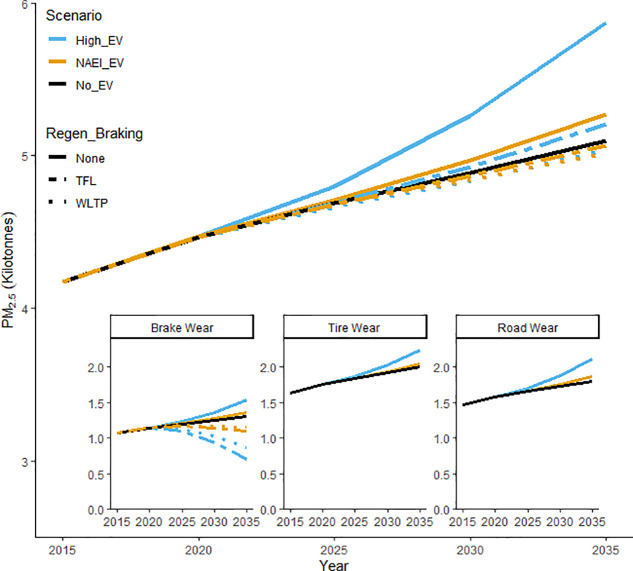
Projected PM2.5 brake, tire, and road wear emission estimates for passenger cars in the UK based on changes in DfT (2018) modeled traffic volume and battery electric vehicle uptake (vehicle mass, and regenerative braking). A vehicle mass EF regression approach was used to determine the impact of heavier EVs, while reductions from regenerative braking were calculated using brake force simulations for passenger vehicles under the TfL (dot dashed −65% reduction) and WLTP (small dots −88% reduction) drive cycles. Three scenarios have been considered: “NO_EV”: DfT reference (Scenario 1) traffic projections assuming no electrification of the vehicle fleet; “NAEI_EV”: DfT reference (Scenario 1) traffic projections + UK NAEI EV uptake; “High_EV”: DfT shift to zero emission vehicles (Scenario 7) + high uptake of EVs. DfT: Department for Transport; EF: emission factor; EV: electric vehicles; NAEI National Atmospheric Emissions Inventory; PM2.5: particulate matter less than 2.5 μm in diameter; TfL: Transport for London; WLTP: Worldwide Harmonized Light Vehicle Test Procedure

References

    1. Thurston G. D.; Kipen H.; Annesi-Maesano I.; Balmes J.; Brook R. D.; Cromar K.; De Matteis S.; Forastiere F.; Forsberg B.; Frampton M. W.; Grigg J.; Heederik D.; Kelly F. J.; Kuenzli N.; Laumbach R.; Peters A.; Rajagopalan S. T.; Rich D.; Ritz B.; Samet J. M.; Sandstrom T.; Sigsgaard T.; Sunyer J.; Brunekreef B. A joint ERS/ATS policy statement: what constitutes an adverse health effect of air pollution? An analytical framework. Eur. Respir. J. 2017, 49 (1), 1600419. 10.1183/13993003.00419-2016. - DOI - PMC - PubMed
    1. W. H. O. WHO global air quality guidelines: Particulate matter (PM2.5 and PM10), ozone, nitrogen dioxide, sulfur dioxide and carbon monoxide; World Health Organisation. License: CC BY-NC-SA 3.0 IGO: Geneva, 2021, 2021. - PubMed
    1. HEI Special Report 17: Traffic-related air pollution: a critical review of the literature on emissions, exposure and health effects https://www.healtheffects.org/publication/traffic-related-air-pollution-... (accessed 2019-3-4).
    1. Miller M. R.; Newby D. E.. Air pollution and cardiovascular disease: car sick. Cardiovasc. Res. 2019. 10.1093/cvr/cvz228 - DOI - PubMed
    1. Munoz X.; Barreiro E.; Bustamante V.; Lopez-Campos J. L.; Gonzalez-Barcala F. J.; Cruz M. J. Diesel exhausts particles: Their role in increasing the incidence of asthma. Reviewing the evidence of a causal link. Sci. Total Environ. 2019, 652, 1129–1138. 10.1016/j.scitotenv.2018.10.188. - DOI - PubMed

Publication types