


Is the modified Dunn's procedure superior to in situ fixation? A systematic review and meta-analysis of comparative studies for management of moderate and severe slipped capital femoral epiphysis
- PMID: 35615396
- PMCID: PMC9124911
- DOI: 10.1177/18632521221078864
Is the modified Dunn's procedure superior to in situ fixation? A systematic review and meta-analysis of comparative studies for management of moderate and severe slipped capital femoral epiphysis
Abstract
Purpose: The management of moderate and severe slipped capital femoral epiphysis is controversial. While in situ fixation is commonly used, the modified Dunn's procedure is increasingly popular within high-volume centers. We compared the clinical and radiological outcomes, as well as the rates of femoral head avascular necrosis or chondrolysis in patients managed with either modified Dunn's procedure or in situ fixation.
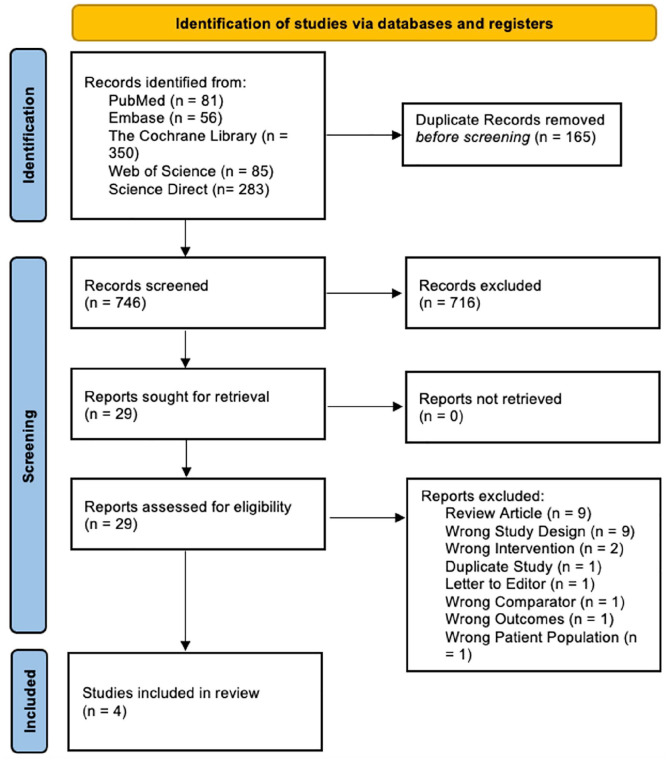
Methods: A systematic search of the PubMed, Embase, The Cochrane Library, Science Direct, and Web of Science was performed in August 2021. Studies comparing outcomes and complications of modified Dunn's procedure versus in situ fixation in patients with moderate or severe slipped capital femoral epiphysis were included.
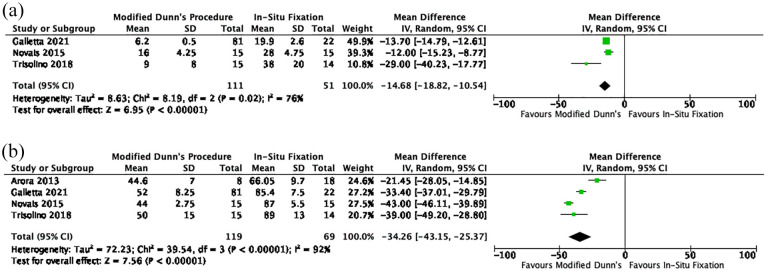
Results: A total of four studies were included in the final analysis. Modified Dunn's procedure did not result in improved clinical outcomes. However, radiological outcomes as measured using Southwick angles and Alpha angles were significantly improved in the modified Dunn's procedure group, with a mean difference of -14.68 (p < 0.00001) and -34.26 degrees (p < 0.00001), respectively, compared to in situ fixation. There was no difference in the odds of femoral head avascular necrosis or chondrolysis, with odds ratio of 0.99 (p = 0.97).
Conclusion: Within the limits of our study, modified Dunn's procedure did not improve clinical outcomes. There were significantly improved radiological outcomes without higher odds of femoral head avascular necrosis or chondrolysis. Further long-term studies are required to better guide management of moderate and severe slipped capital femoral epiphysis, especially in unstable slips. In the meantime, we recommend that the modified Dunn's procedure, if done, be restricted to high-volume centers with low complication rates.
Level of evidence: Level III-Systematic review of Level III studies.
Prospero registration no: CRD42021279503.
Keywords: Slipped capital femoral epiphysis; in situ fixation; meta-analysis; modified Dunn’s procedure; systematic review; treatment.
© The Author(s) 2022.
Conflict of interest statement
Declaration of conflicting interests: The author(s) declared no potential conflicts of interest with respect to the research, authorship, and/or publication of this article.
Figures


References
-
- Nguyen AR, Ling J, Gomes B, et al.. Slipped capital femoral epiphysis: rising rates with obesity and aboriginality in South Australia. J Bone Joint Surg Br 2011; 93(10): 1416–1423. - PubMed
-
- Murray AW, Wilson NI. Changing incidence of slipped capital femoral epiphysis: a relationship with obesity. J Bone Joint Surg Br 2008; 90(1): 92–94. - PubMed
-
- Lehmann CL, Arons RR, Loder RT, et al.. The epidemiology of slipped capital femoral epiphysis: an update. J Pediatr Orthop 2006; 26(3): 286–290. - PubMed
-
- Henrikson B. The incidence of slipped capital femoral epiphysis. Acta Orthop Scand 1969; 40(3): 365–372. - PubMed
-
- Stott S, Bidwell T. Epidemiology of slipped capital femoral epiphysis in a population with a high proportion of New Zealand Maori and Pacific children. N Z Med J 2003; 116(1184): U647. - PubMed
Publication types
LinkOut - more resources
Full Text Sources
Research Materials
