


Maintaining the thyroid gland in mutant thyroglobulin-induced hypothyroidism requires thyroid cell proliferation that must continue in adulthood
- PMID: 35618019
- PMCID: PMC9213252
- DOI: 10.1016/j.jbc.2022.102066
Maintaining the thyroid gland in mutant thyroglobulin-induced hypothyroidism requires thyroid cell proliferation that must continue in adulthood
Abstract
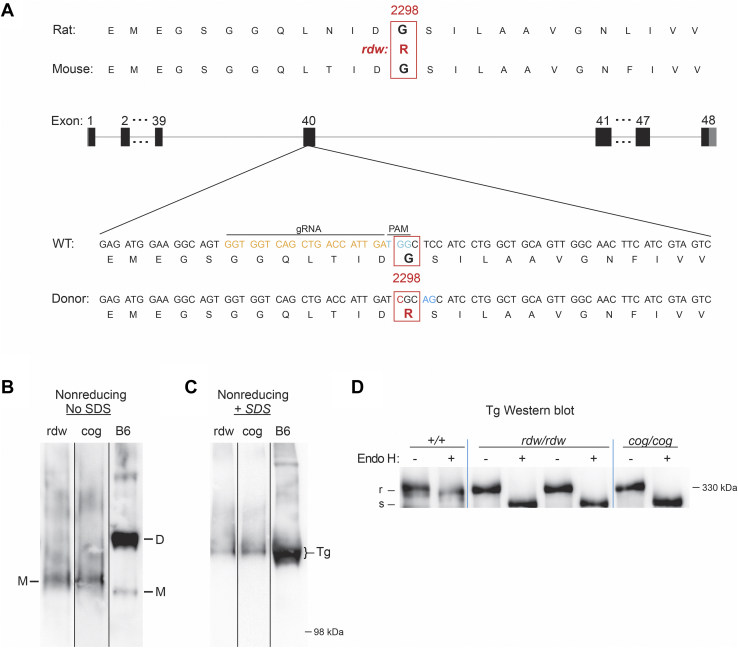
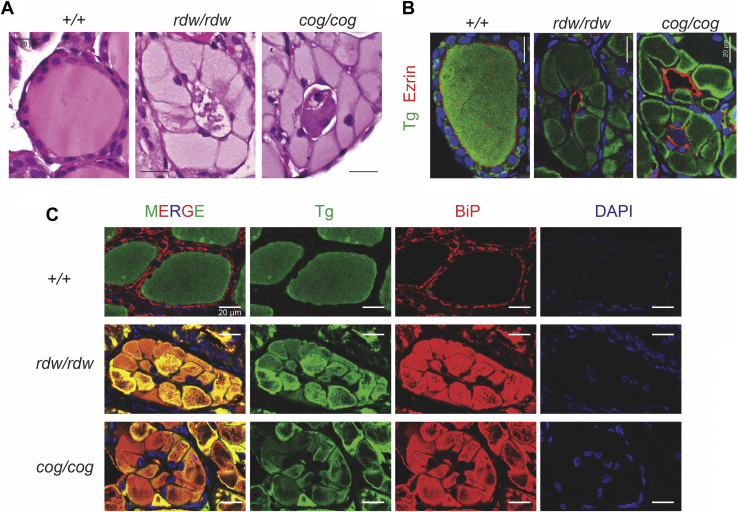
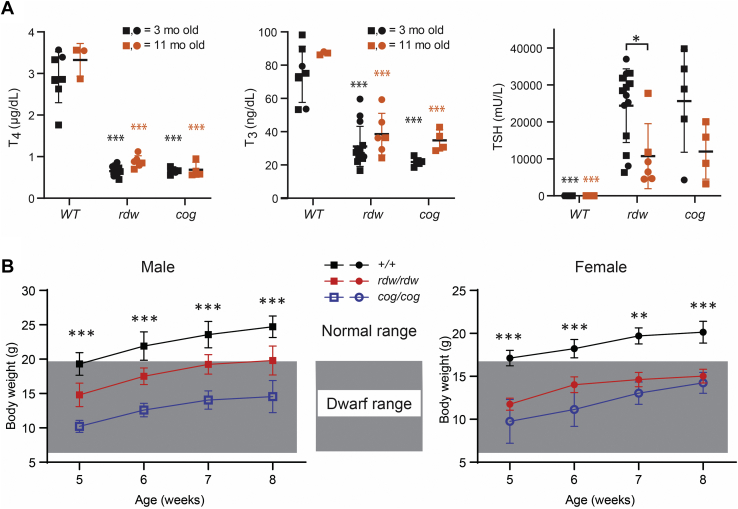
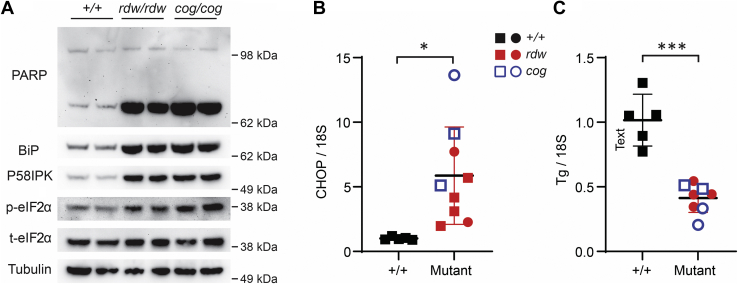
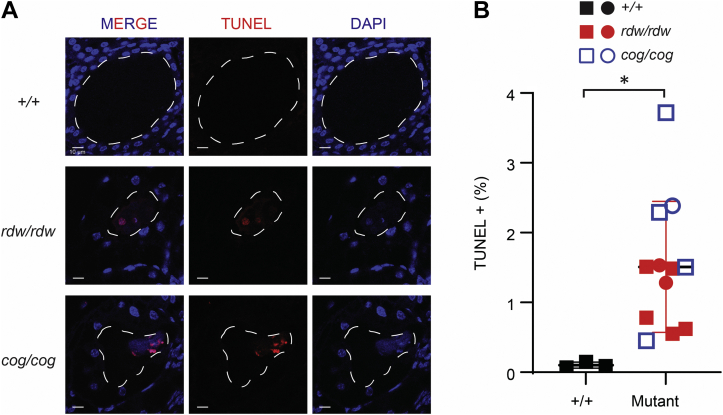
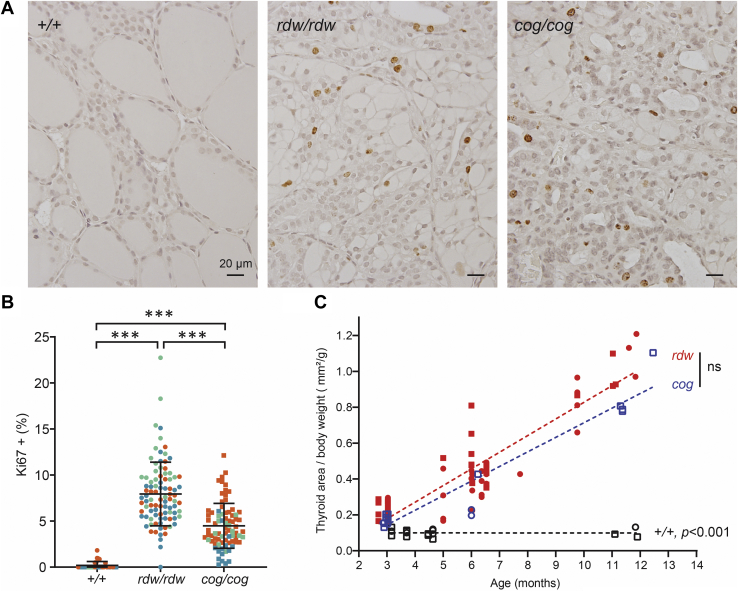
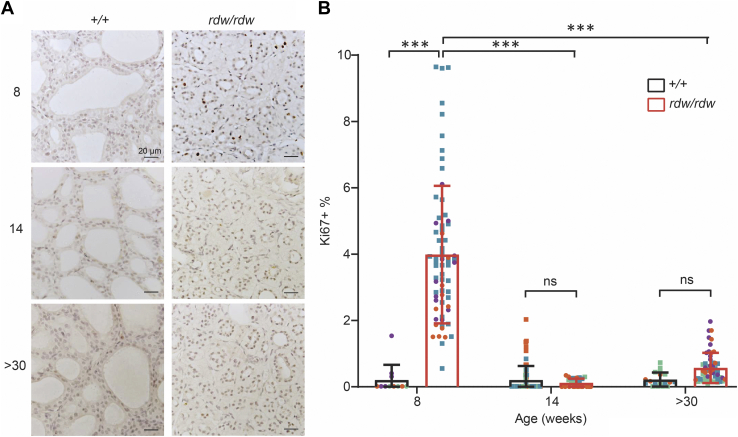
Congenital hypothyroidism with biallelic thyroglobulin (Tg protein, encoded by the TG gene) mutation is an endoplasmic reticulum (ER) storage disease. Many patients (and animal models) grow an enlarged thyroid (goiter), yet some do not. In adulthood, hypothyroid TGcog/cog mice (bearing a Tg-L2263P mutation) exhibit a large goiter, whereas adult WIC rats bearing the TGrdw/rdw mutation (Tg-G2298R) exhibit a hypoplastic thyroid. Homozygous TG mutation has been linked to thyroid cell death, and cytotoxicity of the Tg-G2298R protein was previously thought to explain the lack of goiter in WIC-TGrdw/rdw rats. However, recent studies revealed that TGcog/cog mice also exhibit widespread ER stress-mediated thyrocyte death, yet under continuous feedback stimulation, thyroid cells proliferate in excess of their demise. Here, to examine the relative proteotoxicity of the Tg-G2298R protein, we have used CRISPR-CRISPR-associated protein 9 technology to generate homozygous TGrdw/rdw knock-in mice in a strain background identical to that of TGcog/cog mice. TGrdw/rdw mice exhibit similar phenotypes of defective Tg protein folding, thyroid histological abnormalities, hypothyroidism, and growth retardation. TGrdw/rdw mice do not show evidence of greater ER stress response or stress-mediated cell death than TGcog/cog mice, and both mouse models exhibit sustained thyrocyte proliferation, with comparable goiter growth. In contrast, in WIC-TGrdw/rdw rats, as a function of aging, the thyrocyte proliferation rate declines precipitously. We conclude that the mutant Tg-G2298R protein is not intrinsically more proteotoxic than Tg-L2263P; rather, aging-dependent difference in maintenance of cell proliferation is the limiting factor, which accounts for the absence of goiter in adult WIC-TGrdw/rdw rats.
Keywords: ER stress; aging; cell death; protein misfolding; secretory pathway.
Copyright © 2022 The Authors. Published by Elsevier Inc. All rights reserved.
Conflict of interest statement
Conflict of interest The authors declare that they have no conflicts of interest with the contents of this article.
Figures
References
-
- Brix K., Qatato M., Szumska J., Venugopalan V., Rehders M. In: The Thyroid and its Diseases: A Comprehensive Guide for the Clinician. Luster M., Duntas L.H., Wartofsky L., editors. Springer International Publishing; Cham: 2019. “Thyroglobulin storage, processing and degradation for thyroid hormone liberation”; pp. 25–48.
-
- Carvalho D.P., Dupuy C. Thyroid hormone biosynthesis and release. Mol. Cell Endocrinol. 2017;458:6–15. - PubMed
-
- Dunn J.T., Dunn A.D. The importance of thyroglobulin structure for thyroid hormone biosynthesis. Biochimie. 1999;81:505–509. - PubMed
MeSH terms
Substances
Grants and funding
LinkOut - more resources
Full Text Sources
Medical
Molecular Biology Databases
Research Materials
Miscellaneous
