


Factors Influencing Palliative Care Access and Delivery for Great Plains American Indians
- PMID: 35618250
- PMCID: PMC10230738
- DOI: 10.1016/j.jpainsymman.2022.05.011
Factors Influencing Palliative Care Access and Delivery for Great Plains American Indians
Abstract
Context: Despite the known importance of culturally tailored palliative care (PC), American Indian people (AIs) in the Great Plains lack access to such services. While clinicians caring for AIs in the Great Plains have long acknowledged major barriers to serious illness care, there is a paucity of literature describing specific factors influencing PC access and delivery for AI patients living on reservation land.
Objectives: This study aimed to explore factors influencing PC access and delivery on reservation land in the Great Plains to inform the development culturally tailored PC services for AIs.
Methods: Three authors recorded and transcribed interviews with 21 specialty and 17 primary clinicians. A data analysis team of seven authors analyzed transcripts using conventional content analysis. The analysis team met over Zoom to engage in code negotiation, classify codes, and develop themes.
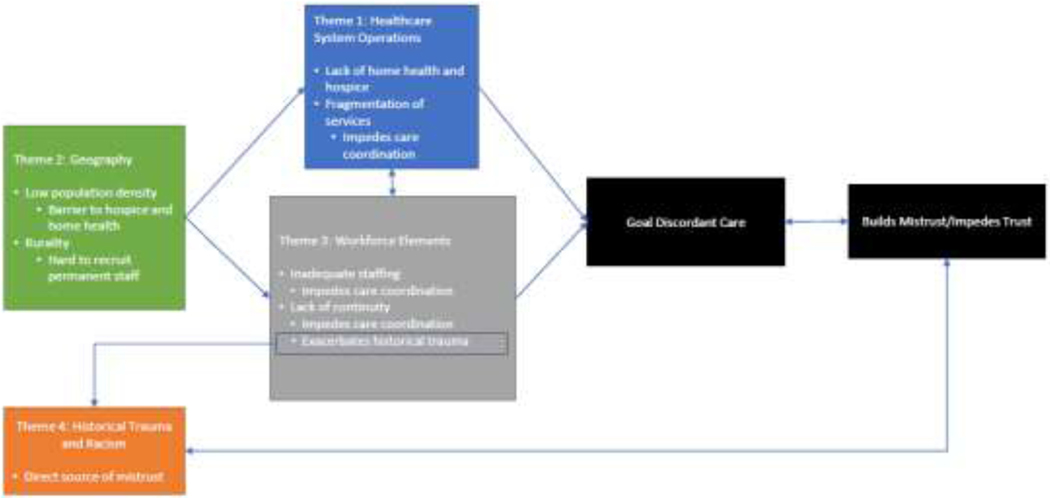
Results: Qualitative analysis of interview data revealed four themes encompassing factors influencing palliative care delivery and access for Great Plains American Indians: health care system operations (e.g., hospice and home health availability, fragmented services), geography (e.g., weather, travel distances), workforce elements (e.g., care continuity, inadequate staffing, cultural familiarity), and historical trauma and racism.
Conclusion: Our findings emphasize the importance of addressing the time and cost of travel for seriously ill patients, increasing home health and hospice availability on reservations, and improving trust in the medical system. Strengthening the AI medical workforce, increasing funding for the Indian Health Service, and transitioning the governance of reservation health care to Tribal entities may improve the trustworthiness of the medical system.
Keywords: Alaska Native; American Indian; barriers; facilitators; hospice; palliative care; qualitative research.
Copyright © 2022 American Academy of Hospice and Palliative Medicine. Published by Elsevier Inc. All rights reserved.
Figures
Similar articles
-
Great Plains American Indians' Perspectives on Patient and Family Needs Throughout the Cancer Journey.Oncol Nurs Forum. 2023 Apr 21;50(3):279-289. doi: 10.1188/23.ONF.279-289. Oncol Nurs Forum. 2023. PMID: 37155972 Free PMC article.
-
"Are They Just Experimenting With All of Us?" Cultural Considerations for Clinicians Caring for Seriously Ill Great Plains American Indians.Am J Hosp Palliat Care. 2025 Mar 14:10499091251327404. doi: 10.1177/10499091251327404. Online ahead of print. Am J Hosp Palliat Care. 2025. PMID: 40083214
-
Palliative care in the Pueblo of Zuni.J Palliat Med. 2004 Feb;7(1):135-43. doi: 10.1089/109662104322737403. J Palliat Med. 2004. PMID: 15000797
-
Palliative Care for American Indians and Alaska Natives: A Review of the Literature.J Palliat Med. 2016 Dec;19(12):1331-1340. doi: 10.1089/jpm.2016.0201. Epub 2016 Nov 9. J Palliat Med. 2016. PMID: 27828727 Review.
-
Examining Barriers and Facilitators to Palliative Care Access in Rural Areas: A Scoping Review.Am J Hosp Palliat Care. 2022 Jan;39(1):123-130. doi: 10.1177/10499091211011145. Epub 2021 Apr 28. Am J Hosp Palliat Care. 2022. PMID: 33906486
Cited by
-
Increasing Lung Cancer Screening for High-Risk Smokers in a Frontier Population.J Cancer Educ. 2024 Feb;39(1):27-32. doi: 10.1007/s13187-023-02369-7. Epub 2023 Sep 9. J Cancer Educ. 2024. PMID: 37688691
-
Naming racism as a root cause of inequities in palliative care research: a scoping review.BMC Palliat Care. 2024 Jun 10;23(1):143. doi: 10.1186/s12904-024-01465-9. BMC Palliat Care. 2024. PMID: 38858646 Free PMC article.
-
Great Plains American Indians' Perspectives on Patient and Family Needs Throughout the Cancer Journey.Oncol Nurs Forum. 2023 Apr 21;50(3):279-289. doi: 10.1188/23.ONF.279-289. Oncol Nurs Forum. 2023. PMID: 37155972 Free PMC article.
-
Racism in Pediatric Serious Illness and Palliative Care: A Scoping Review of Qualitative Research.J Pain Symptom Manage. 2025 Jan;69(1):44-52. doi: 10.1016/j.jpainsymman.2024.09.021. Epub 2024 Oct 1. J Pain Symptom Manage. 2025. PMID: 39362386
-
Results of a Culturally Tailored Advance Care Planning Intervention for American Indian Peoples: A Quasi-Experimental Waitlist-Controlled Trial.Innov Aging. 2025 May 6;9(6):igaf041. doi: 10.1093/geroni/igaf041. eCollection 2025. Innov Aging. 2025. PMID: 40520470 Free PMC article.
References
-
- Temel JS, Greer JA, Muzikansky A, et al. Early palliative care for patients with metastatic non–small-cell lung cancer. New England Journal of Medicine 2010;363:733–742. - PubMed
-
- El-Jawahri A, Greer JA, Temel JS. Does palliative care improve outcomes for patients with incurable illness? A review of the evidence. Database of Abstracts of Reviews of Effects (DARE): Quality-assessed Reviews [Internet] 2011. - PubMed
-
- Gade G, Venohr I, Conner D, et al. Impact of an inpatient palliative care team: a randomized control trial. J Palliat Med 2008;11:180–90. - PubMed
Publication types
MeSH terms
Grants and funding
LinkOut - more resources
Full Text Sources
Medical
Miscellaneous
