


Cross-sectional study of COVID-19 knowledge, beliefs and prevention behaviours among adults in Senegal
- PMID: 35618332
- PMCID: PMC9136694
- DOI: 10.1136/bmjopen-2021-057914
Cross-sectional study of COVID-19 knowledge, beliefs and prevention behaviours among adults in Senegal
Abstract
Objectives: The aim of the study was to explore COVID-19 beliefs and prevention behaviours in a francophone West African nation, Senegal.
Design: This was a cross-sectional analysis of survey data collected via a multimodal observational study.
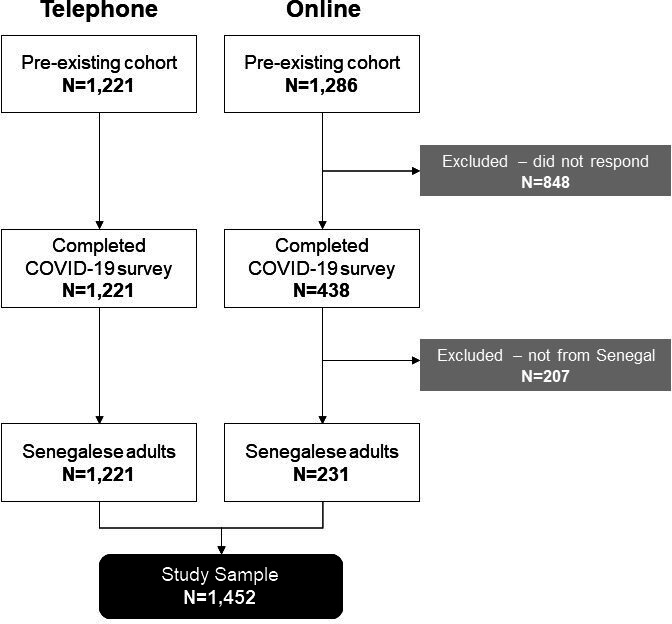
Participants: Senegalese adults aged 18 years or older (n=1452).
Primary and secondary outcome measures: Primary outcome measures were COVID-19 prevention behaviours. Secondary outcome measures included COVID-19 knowledge and beliefs. Univariate, bivariate and multivariate statistics were generated to describe the sample and explore potential correlations.
Setting: Participants from Senegal were recruited online and telephonically between June and August 2020.
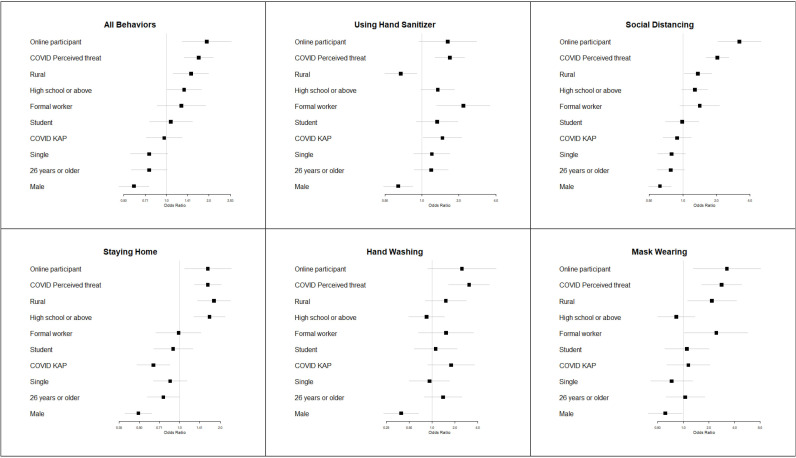
Results: Mask wearing, hand washing and use of hand sanitiser were most frequently reported. Social distancing and staying at home were also reported although to a lower degree. Knowledge and perceived risk of COVID-19 were very high in general, but risk was a stronger and more influential predictor of COVID-19 prevention behaviours. Men, compared with women, had lower odds (adjusted OR (aOR)=0.59, 95% CI 0.46 to 0.75, p<0.001) of reporting prevention behaviours. Rural residents (vs urban; aOR=1.49, 95% CI 1.12 to 1.98, p=0.001) and participants with at least a high school education (vs less than high school education; aOR=1.33, 95% CI 1.01 to 1.76, p=0.006) were more likely to report COVID-19 prevention behaviours.
Conclusions: In Senegal, we observed high compliance with recommended COVID-19 prevention behaviours among our sample of respondents, in particular for masking and personal hygiene practice. We also identified a range of psychosocial and demographic predictors for COVID-19 prevention behaviours such as knowledge and perceived risk. Stakeholders and decision makers in Senegal and across Africa can use place-based evidence like ours to address COVID-19 risk factors and intervene effectively with policies and programming. Use of both phone and online surveys enhances representation and study generalisability and should be considered in future research with hard-to-reach populations.
Keywords: COVID-19; public health.
© Author(s) (or their employer(s)) 2022. Re-use permitted under CC BY. Published by BMJ.
Conflict of interest statement
Competing interests: None declared.
Figures
References
Publication types
MeSH terms
LinkOut - more resources
Full Text Sources
Medical
