


Reducing Metabolic Dysregulation in Obese Latina and/or Hispanic Breast Cancer Survivors Using Physical Activity (ROSA) Trial: A Study Protocol
- PMID: 35619910
- PMCID: PMC9128380
- DOI: 10.3389/fonc.2022.864844
Reducing Metabolic Dysregulation in Obese Latina and/or Hispanic Breast Cancer Survivors Using Physical Activity (ROSA) Trial: A Study Protocol
Abstract
Background: Latina and Hispanic breast cancer survivors (LHBCS) are at increased risk for long-term complications and poorer metabolic health, including metabolic dysregulation (MetD) before and following breast cancer diagnosis. MetD can increase risk of cancer recurrence, death, and comorbid conditions by increasing inflammation and cancer cell proliferation. While exercise improves physical fitness and metabolic outcomes in breast cancer survivors, there is a lack of studies including underrepresented and disadvantaged minority groups such as LHBCS.
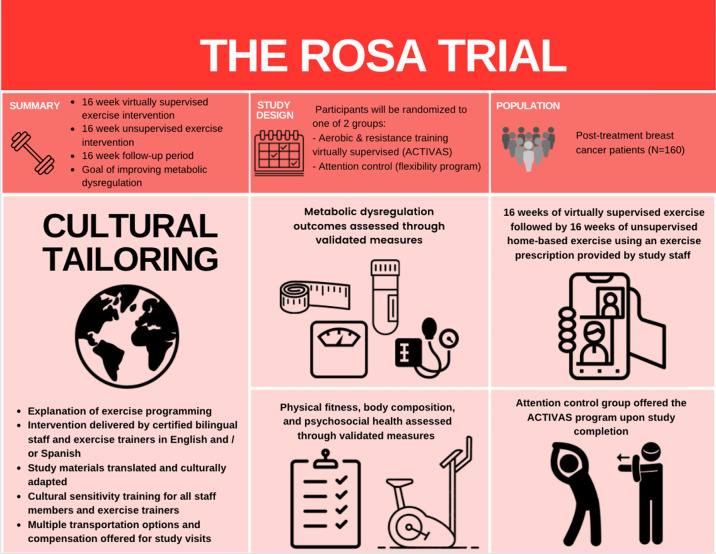
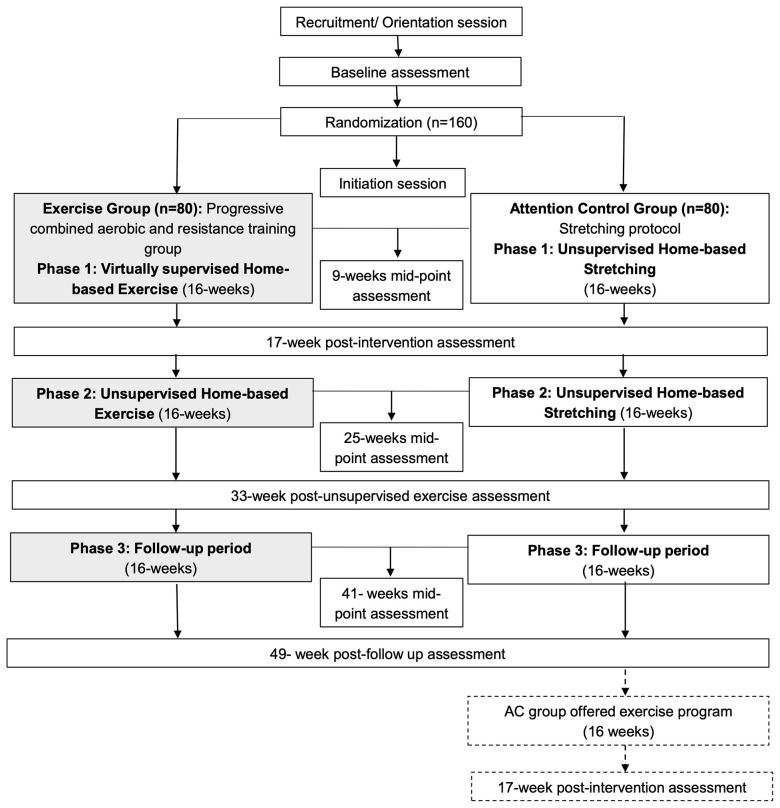
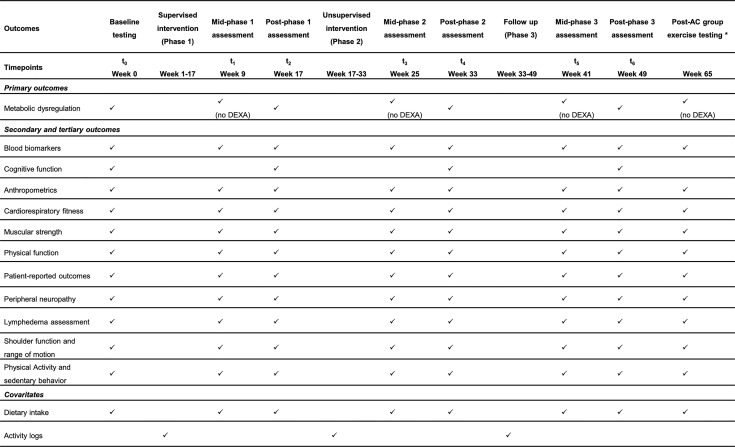
Methods: Our 12-month randomized (exercise or attention control) controlled trial (the ROSA trial) aims to utilize a progressive combined aerobic and resistance exercise program to improve MetD, insulin resistance, and visceral adiposity among obese LHBCS. We aim to recruit 160 women with Stage I-III breast cancer who are sedentary, centrally obese, and have completed treatment (e.g., surgery, radiation, chemotherapy) prior to enrollment. Participants randomized to the exercise group receive 16-weeks of virtually supervised aerobic and resistance training, followed by 16-weeks of unsupervised home-based aerobic and resistance exercise, and 16-weeks of follow-up. The attention control group receive a 12-month home-based stretching program. Primary and secondary outcomes are measured every 4-weeks during study visits.
Discussion: The ROSA trial is the first exercise oncology trial targeting high-risk sedentary, obese LHBCS to improve MetD-related outcomes. Results of this trial will help illuminate how exercise impacts health-related outcomes, survivorship, and recurrence, and inform future exercise oncology guidelines to reduce health disparities among minority cancer survivors.
Keywords: adiposity; aerobic exercise; cancer minorities; insulin resistance; resistance exercise.
Copyright © 2022 Gonzalo-Encabo, Wilson, Kang, Norris, Uno, Christopher, Chow, Sami, Fox, Ligibel and Dieli-Conwright.
Conflict of interest statement
Author FF was employed by the company Gerson Lehrman Group, LLC. The remaining authors declare that the research was conducted in the absence of any commercial or financial relationships that could be construed as a potential conflict of interest.
Figures
References
-
- U.S. Census Bureau . Race and Ethnicity in the United States: 2010 Census and 2020 Census census.gov: United States Census Bureau (2021). Available at: https://www.census.gov/library/visualizations/interactive/race-and-ethni....
-
- Lopez MH, Krogstad JM, Passel JS. Who Is Hispanic? pewresearch.org: Washington, DC, United States: Pew Research Center; (2021). Available at: https://www.pewresearch.org/fact-tank/2021/09/23/who-is-hispanic.
-
- U.S. Census Bureau . Hispanic Population to Reach 111 Million by 2060. census.gov: Washington, DC, United States: United States Census Bureau; (2018). Available at: https://www.census.gov/library/visualizations/2018/comm/hispanic-project....
-
- Vespa J, Medina L, Armstrong DM. Demographic Turning Points for the United States: Population Projections for 2020 to 2060. census.gov: Washington, DC, United States: United States Census Bureau; (2018). Available at: https://www.census.gov/content/dam/Census/library/publications/2020/demo....
-
- American Cancer Society . Cancer Facts & Figures for Hispanics/Latinos 2018-2020. cancer.org: Atlanta, Georgia, United States: American Cancer Society; (2018). Available at: https://www.cancer.org/content/dam/cancer-org/research/cancer-facts-and-....
LinkOut - more resources
Full Text Sources
