


Simulation training in endoscopic skull base surgery: A scoping review
- PMID: 35619934
- PMCID: PMC9126166
- DOI: 10.1002/wjo2.11
Simulation training in endoscopic skull base surgery: A scoping review
Abstract
Objective: Proficiency in endoscopic endonasal skull base surgery requires both substantial baseline training and progressive lifelong learning. Endoscopic simulation models continue to evolve in an effort to optimize trainee education and preoperative preparation and improve surgical outcomes. The current scoping review systematically reviews all available literature and synthesizes the current paradigms of simulation models for endoscopic skull base surgery training and skill enhancement.
Methods: In accordance with Preferred Reporting Items for Systemic Review and Meta-Analyses guidelines, we systematically searched PubMed, Embase, CINAHL, and Cochrane databases. Studies were categorized according to the type of simulation models investigated.
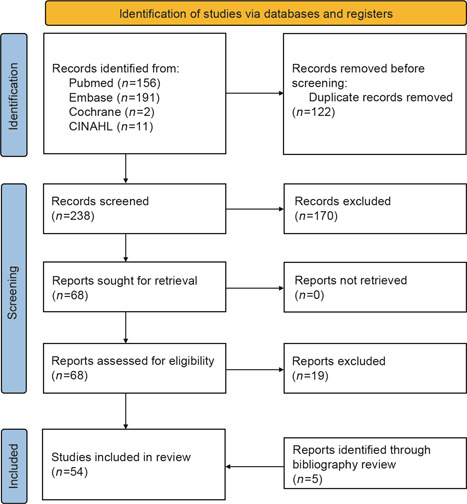
Results: We identified 238 unique references, with 55 studies ultimately meeting inclusion criteria. Of these, 19 studies described cadaveric dissection models, 17 discussed three-dimensional (3D) printed models, 14 examined virtual surgical planning and augmented reality-based models, and five 5 articles described task trainers.
Conclusions: There are a wide variety of simulation models for endoscopic skull base surgery, including high-fidelity cadaveric, virtual reality, and 3D-printed models. These models are an asset for trainee development and preoperative surgical preparation.
Keywords: resident education; skull base surgery; surgical simulation training; virtual reality; virtual surgical planning.
© 2022 The Authors. World Journal of Otorhinolaryngology ‐ Head and Neck Surgery published by John Wiley & Sons, Ltd on behalf of Chinese Medical Association.
Conflict of interest statement
The authors declare that there is no conflict of interests.
Figures
References
-
- Cohen ER, Feinglass J, Barsuk JH, et al. Cost savings from reduced catheter‐related bloodstream infection after simulation‐based education for residents in a medical intensive care unit. Simul Healthc. 2010;5:98‐102. - PubMed
-
- Barsuk JH, Cohen ER, Williams MV, et al. Simulation‐based mastery learning for thoracentesis skills improves patient outcomes: a randomized trial. Acad Med. 2018;93:729‐735. - PubMed
-
- Gardner PA, Snyderman CH, Wang EW, Fernandez‐Miranda JC. Complications of endoscopic endonasal skull base surgery. J Neurosurg. 2018;87:207‐212. 10.1016/B978-0-323-50961-9.00036-0 - DOI
Publication types
LinkOut - more resources
Full Text Sources