


Global Prevalence and Causes of Visual Impairment and Blindness in Children: A Systematic Review and Meta-Analysis
- PMID: 35620376
- PMCID: PMC9128433
- DOI: 10.4103/joco.joco_135_21
Global Prevalence and Causes of Visual Impairment and Blindness in Children: A Systematic Review and Meta-Analysis
Abstract
Purpose: To determine the global prevalence and common causes of visual impairment (VI) and blindness in children.
Methods: In this meta-analysis, a structured search strategy was applied to search electronic databases including PubMed, Scopus, and Web of Science, as well as the list of references in the selected articles to identify all population-based cross-sectional studies that concerned the prevalence of VI and blindness in populations under 20 years of age up to January 2018, regardless of the publication date and language, gender, region of residence, or race. VI was reported based on presenting visual acuity (PVA), uncorrected visual acuity (UCVA), and best corrected visual acuity (BCVA) of equal to 20/60 or worse in the better eye. Blindness was reported as visual acuity worse than 20/400 in the better eye.
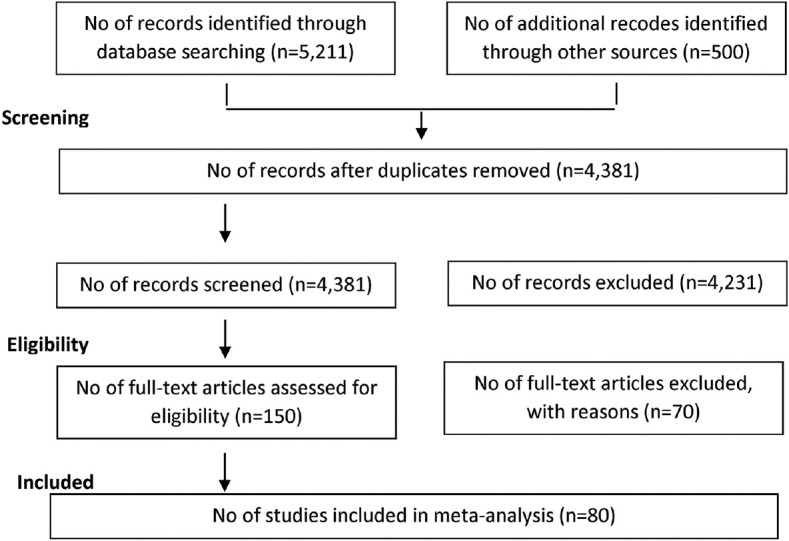
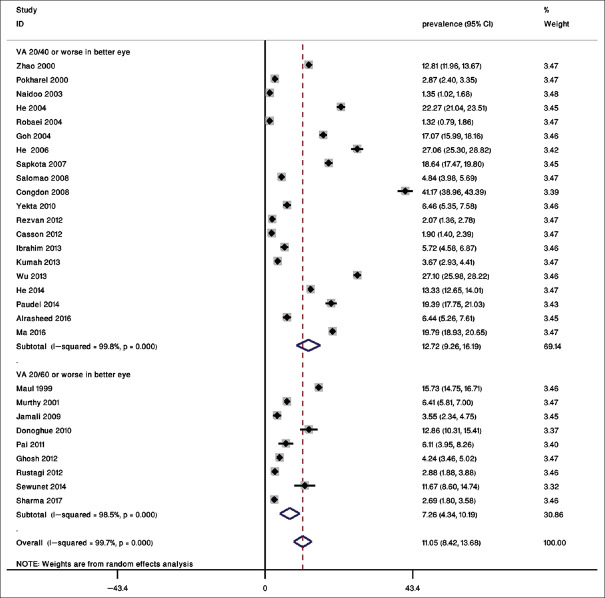
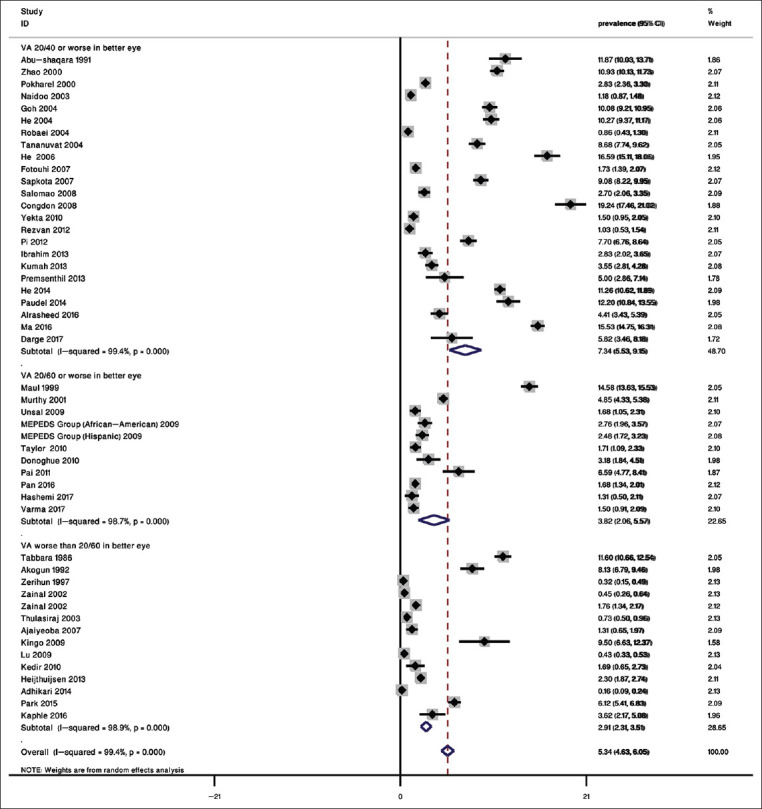
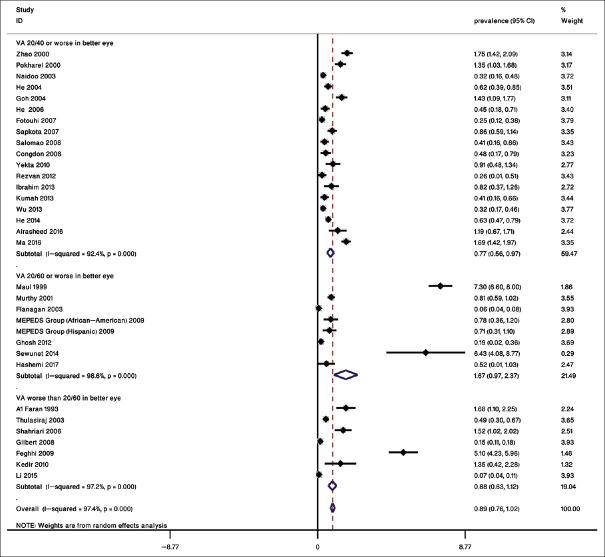
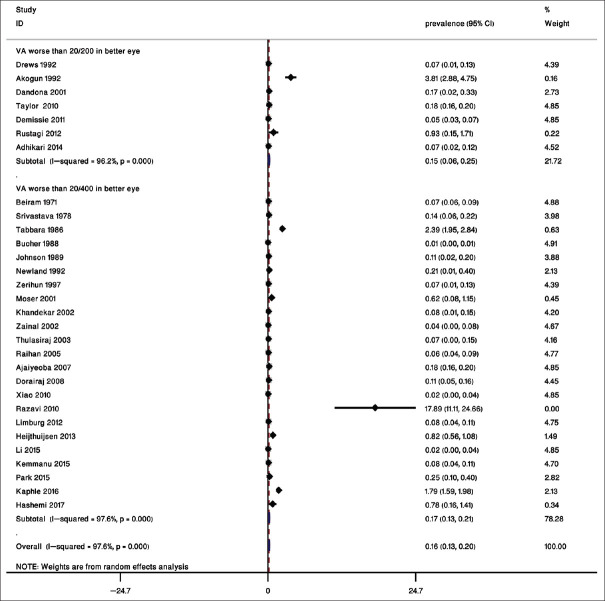
Results: In the present study, 5711 articles were identified, and the final analyses were done on 80 articles including 769,720 people from twenty-eight different countries. The prevalence of VI based on UCVA was 7.26% (95% confidence interval [CI]: 4.34%-10.19%), PVA was 3.82% (95% CI: 2.06%-5.57%), BCVA was 1.67% (95% CI 0.97%-2.37%), and blindness was 0.17% (95% CI: 0.13%-0.21%). Refractive errors were the most common cause of VI in the subjects of selected articles (77.20% [95% CI: 73.40%-81.00%]). The prevalence of amblyopia was 7.60% (95% CI: 05.60%-09.10%) and congenital cataract was 0.60% (95% CI: 0.3%-0.9%).
Conclusion: Despite differences in the definition of VI and blindness, based on PVA, 3.82%, and based on BCVA, 1.67% of the examined samples suffer from VI.
Keywords: Blindness; Children; Low vision; Visual impairment.
Copyright: © 2022 Journal of Current Ophthalmology.
Conflict of interest statement
There are no conflicts of interest.
Figures
References
-
- Solebo AL, Teoh L, Rahi J. Epidemiology of blindness in children. Arch Dis Child. 2017;102:853–7. - PubMed
-
- World Health Organization. (1997) Strategies for the prevention of blindness in national programmers: a primary health care approach. 2nd ed. [Last accessed on 2022 Mar 27]. https://apps.who.int/iris/handle/10665/41887.
-
- Blindness and Visual Impairment; 2017. [Last accessed on 2017 Mar 05]. Available from: http://www.who.int/news-room/fact-sheets/detail/blindness-and-visual-imp... .
-
- Courtright P, Hutchinson AK, Lewallen S. Visual impairment in children in middle- and lower-income countries. Arch Dis Child. 2011;96:1129–34. - PubMed
Publication types
LinkOut - more resources
Full Text Sources
Miscellaneous