


Dengue vectors in Africa: A review
- PMID: 35620619
- PMCID: PMC9126922
- DOI: 10.1016/j.heliyon.2022.e09459
Dengue vectors in Africa: A review
Abstract
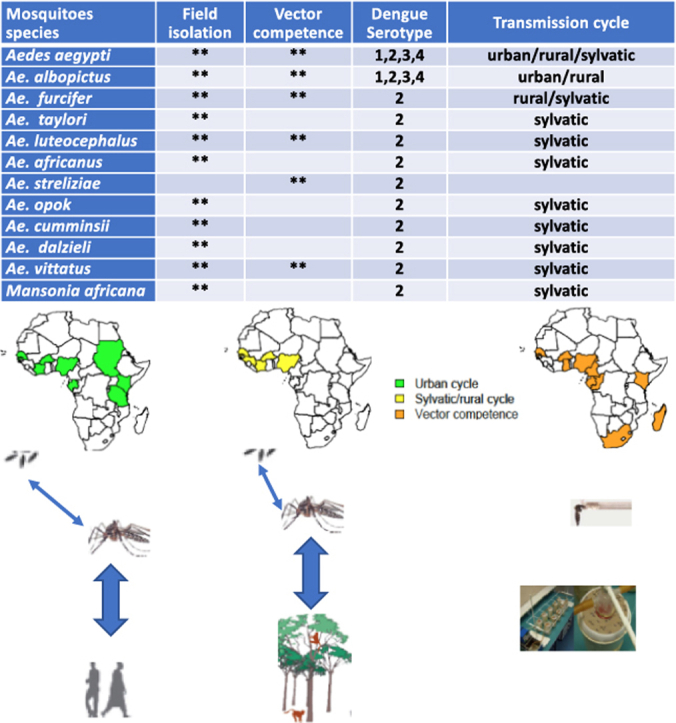
Dengue fever is a mosquito-borne-disease of growing public health importance in Africa. The continuous increase of number and frequency of outbreaks of dengue fever, especially in urban area in Africa underline the need to review the current data available on vectors involved in dengue virus transmission in Africa. Here, we summarized the available data on vectors involved in the transmission of dengue virus in the sylvatic and urban environments, vertical transmission, vector competence studies, and vector control strategies used in Africa. The virus was isolated mainly from Aedes furcifer, Ae. luteocephalus, and Ae. taylori in the sylvatic environment and from Ae. aegypti and Ae. albopictus in the urban areas. Prospective and urgently needed studies on vectors biology, behavior, and alternative control strategies are suggested.
Keywords: Africa; Dengue; Mosquito vectors; Sylvatic; Urban.
© 2022 The Author(s).
Conflict of interest statement
The authors declare no conflict of interest.
Figures
References
-
- SHARP Tyler M. Unveiling the burden of dengue in Africa [Internet] https://blogs.cdc.gov/publichealthmatters/2015/07/unveiling-the-burden-o... blogs.cdc.gov/publichealthmatters. [cited 2021 May 5]. Available from:
-
- Cornet M. 39–47. World Health Organization; Geneva: 1993. (Dengue in Africa. Epidemiology of Dengue and Dengue Hemorrhagic Fever Monograph on Dengue/dengue Hemorrhagic Fever).
-
- Saleh A.S., Hassan A., Scott R.M., Mellick P.W., Oldfield E.C., Podgore J.K. Dengue in north-East Africa. Lancet. 1985;2:211–212. - PubMed
LinkOut - more resources
Full Text Sources
