


Age-dependent risk for thromboembolism in atrial fibrillation: The Fushimi AF registry
- PMID: 35620660
- PMCID: PMC9127591
- DOI: 10.1016/j.ijcha.2022.101055
Age-dependent risk for thromboembolism in atrial fibrillation: The Fushimi AF registry
Abstract
Background: The risk for thromboembolism depending on the different age subgroups in patients with atrial fibrillation (AF) has not been fully elucidated.
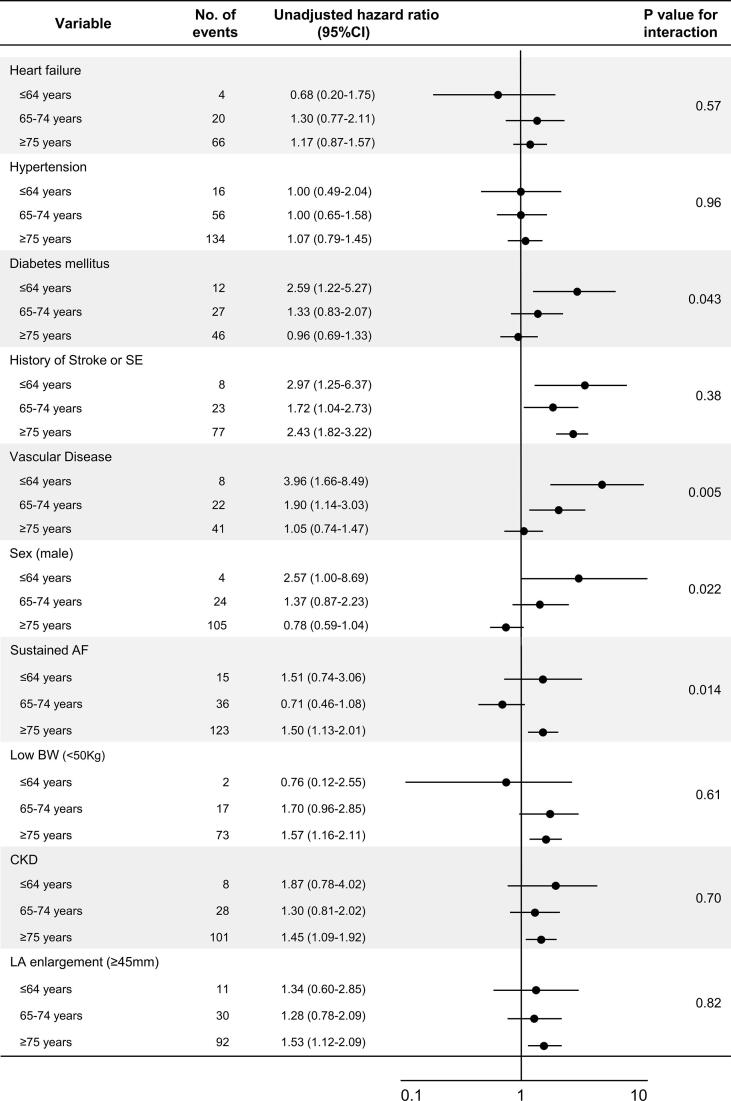
Methods: The Fushimi AF Registry is a community-based prospective survey of patients with AF in Fushimi-ku, Kyoto. Follow-up data were available for 4,466 patients by the end of 2019. Clinical determinants and the description of variables which interact and lead to the incidence of thromboembolism (the composite of ischemic stroke and systemic embolism [SE]) were identified in overall population and in age subgroups (≤64, 65-74, and ≥ 75 years).
Results: A total of 314 patients developed thromboembolism during the median follow-up of 1,610 days (1.56 per 100 person-years). The independent determinants were age advance (per 10 years, hazard ratio [HR]: 1.51, 95% confidence interval [CI]: 1.22-1.86, P < 0.001), low body weight (HR: 1.91, 95% CI: 1.35-2.70, P < 0.001), history of stroke or SE (HR: 2.06, 95% CI: 1.54-2.76, P < 0.001), chronic kidney disease (HR: 1.34, 95% CI: 1.01-1.78, P = 0.043), and left atrial enlargement (HR: 1.57, 95% CI: 1.18-2.10, P = 0.0021). With regard to the age subgroup analysis, diabetes mellitus (P = 0.043), vascular disease (P = 0.005), male sex (P = 0.022), and sustained AF (P = 0.014) indicated significantly relevant interactions between the age subgroups and thromboembolism.
Conclusion: The risk and the impact of baseline characteristics on thromboembolism in patients with AF varied depending on the age subgroups.
Keywords: Age subgroups; Atrial fibrillation; Thromboembolism.
© 2022 The Author(s).
Conflict of interest statement
Dr Akao received lecture fees from Pfizer, Bristol-Myers Squibb, Boehringer Ingelheim, Bayer Healthcare, and Daiichi Sankyo. All other authors have reported that they have no relationships relevant to the content of this paper to disclose.
Figures


References
-
- Lip G.Y.H., Frison L., Halperin J.L., Lane D.A. Identifying patients at high risk for stroke despite anticoagulation: a comparison of contemporary stroke risk stratification schemes in an anticoagulated atrial fibrillation cohort. Stroke. 2010;41(12):2731–2738. doi: 10.1161/STROKEAHA.110.590257. - DOI - PubMed
-
- Chao T.-F., Wang K.-L., Liu C.-J., Lin Y.-J., Chang S.-L., Lo L.-W., Hu Y.-F., Tuan T.-C., Chung F.-P., Liao J.-N., Chen T.-J., Chiang C.-E., Lip G.Y.H., Chen S.-A. Age threshold for increased stroke risk among patients with atrial fibrillation: A nationwide cohort study from Taiwan. J. Am. Coll. Cardiol. 2015;66(12):1339–1347. doi: 10.1016/j.jacc.2015.07.026. - DOI - PubMed
-
- Akao M., Chun Y.-H., Wada H., Esato M., Hashimoto T., Abe M., Hasegawa K., Tsuji H., Furuke K. Current status of clinical background of patients with atrial fibrillation in a community-based survey: The Fushimi AF Registry. J. Cardiol. 2013;61(4):260–266. doi: 10.1016/j.jjcc.2012.12.002. - DOI - PubMed
LinkOut - more resources
Full Text Sources
