


Global, regional, and national burden of cancers attributable to tobacco smoking in 204 countries and territories, 1990-2019
- PMID: 35621231
- PMCID: PMC9249976
- DOI: 10.1002/cam4.4647
Global, regional, and national burden of cancers attributable to tobacco smoking in 204 countries and territories, 1990-2019
Abstract
Background: Cancers are leading causes of mortality and morbidity, with smoking being recognized as a significant risk factor for many types of cancer. We aimed to report the cancer burden attributable to tobacco smoking by sex, age, socio-demographic index (SDI), and cancer type in 204 countries and territories from 1990 to 2019.
Methods: The burden of cancers attributable to smoking was reported between 1990 and 2019, based upon the Comparative Risk Assessment approach used in the Global Burden of Disease (GBD) study 2019.
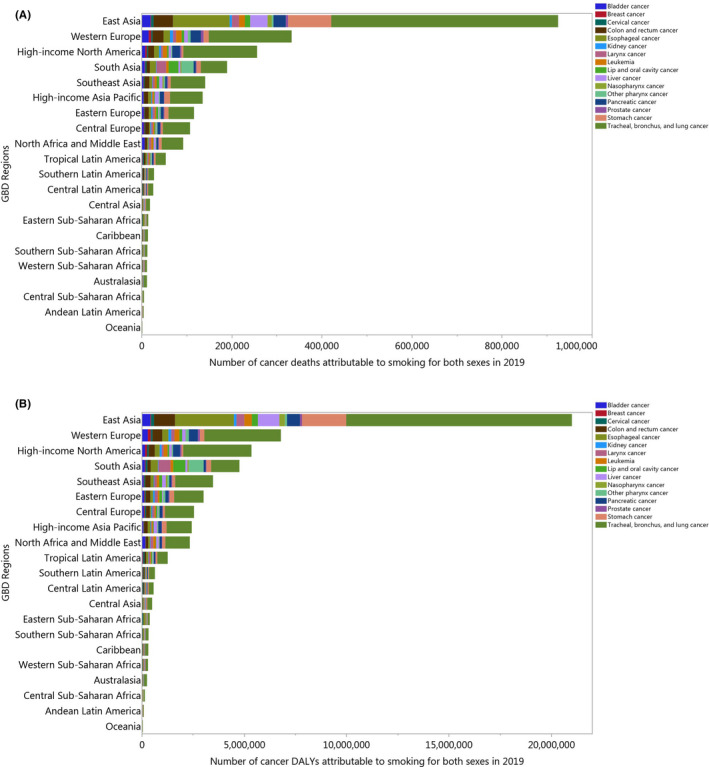
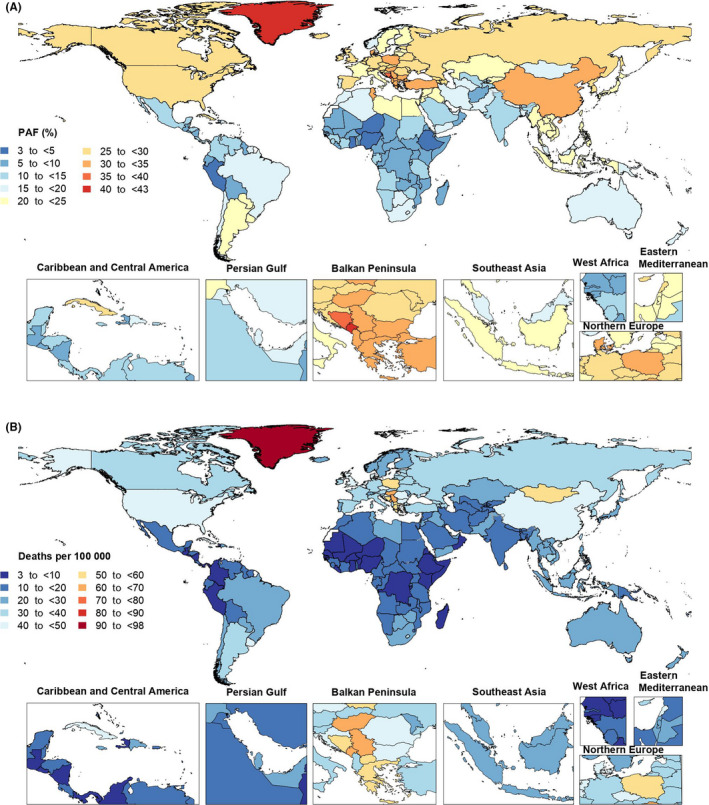
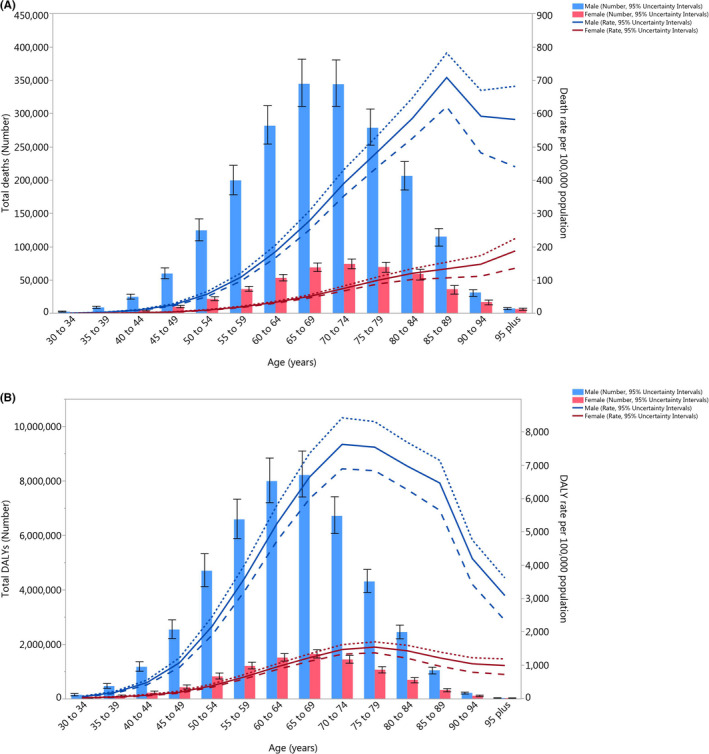
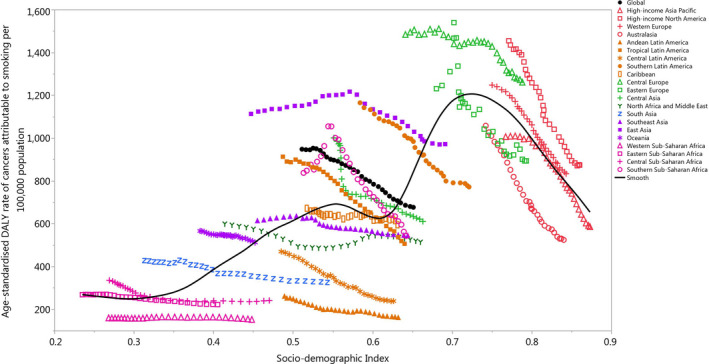
Results: Globally, in 2019 there were an estimated 2.5 million cancer-related deaths (95% UI: 2.3 to 2.7) and 56.4 million DALYs (51.3 to 61.7) attributable to smoking. The global age-standardized death and DALY rates of cancers attributable to smoking per 100,000 decreased by 23.0% (-29.5 to -15.8) and 28.6% (-35.1 to -21.5), respectively, over the period 1990-2019. Central Europe (50.4 [44.4 to 57.6]) and Western Sub-Saharan Africa (6.7 [5.7 to 8.0]) had the highest and lowest age-standardized death rates, respectively, for cancers attributable to smoking. In 2019, the age-standardized DALY rate of cancers attributable to smoking was highest in Greenland (2224.0 [1804.5 to 2678.8]) and lowest in Ethiopia (72.2 [51.2 to 98.0]). Also in 2019, the global number of DALYs was highest in the 65-69 age group and there was a positive association between SDI and the age-standardized DALY rate.
Conclusions: The results of this study clearly illustrate that renewed efforts are required to increase utilization of evidence-based smoking cessation support in order to reduce the burden of smoking-related diseases.
Keywords: cancer; death; disability-adjusted life year; global burden of disease; smoking.
© 2022 The Authors. Cancer Medicine published by John Wiley & Sons Ltd.
Conflict of interest statement
None declared.
Figures
References
-
- Institute for Health Metrics and Evaluation (IHME) . GBD results tool. University of Washington. 2021. Accessed June 4, 2021. http://ghdx.healthdata.org/gbd‐results‐tool
-
- (WHO) WHO . Cancer. 2021. Accessed June 4, 2021. https://www.who.int/news‐room/fact‐sheets/detail/cancer
-
- Carson KV, Usmani ZA, Robertson TA, Mysore S, Brinn MP. Smoking cessation interventions for lung cancer patients. Lung Cancer Management. 2013;2(1):61‐74. doi:10.2217/lmt.12.55 - DOI
Publication types
MeSH terms
Grants and funding
LinkOut - more resources
Full Text Sources
Medical
