Review
. 2022 May 5;9(5):200.
doi: 10.3390/bioengineering9050200.

Gold Nanorod-Assisted Photothermal Therapy and Improvement Strategies

Affiliations
Review

Gold Nanorod-Assisted Photothermal Therapy and Improvement Strategies

Mitchell Lee Taylor et al. Bioengineering (Basel). .

Abstract

Noble metal nanoparticles have been sought after in cancer nanomedicine during the past two decades, owing to the unique localized surface plasmon resonance that induces strong absorption and scattering properties of the nanoparticles. A popular application of noble metal nanoparticles is photothermal therapy, which destroys cancer cells by heat generated by laser irradiation of the nanoparticles. Gold nanorods have stood out as one of the major types of noble metal nanoparticles for photothermal therapy due to the facile tuning of their optical properties in the tissue penetrative near infrared region, strong photothermal conversion efficiency, and long blood circulation half-life after surface modification with stealthy polymers. In this review, we will summarize the optical properties of gold nanorods and their applications in photothermal therapy. We will also discuss the recent strategies to improve gold nanorod-assisted photothermal therapy through combination with chemotherapy and photodynamic therapy.

Keywords: cancer; gold nanorod; photothermal therapy; surface plasmon resonance.


Conflict of interest statement

The authors declare no conflict of interest.

Figures
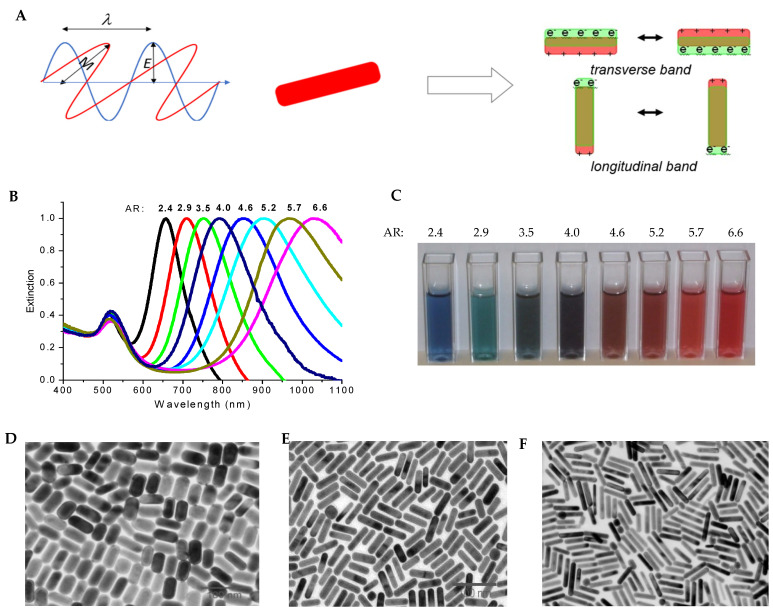
Figure 1
Figure 1
Optical Properties of AuNRs. (A) Schematic of the coherent and collective electron oscillations along the long and short axes of AuNRs resulting in longitudinal and transverse LSPR bands, respectively. Blue line is electric field and red line is magnetic field. (B) Dependence of LSPR of AuNRs on the aspect ratio (AR). Increasing AR leads to red shift of the longitudinal LSPR. (C) Photographic picture of the solution of AuNRs with different ARs. (DF) TEM images of AuNRs with aspect ratio of 2.9 (C), 4.0 (D), and 4.6 (E).
Figure 2
Figure 2
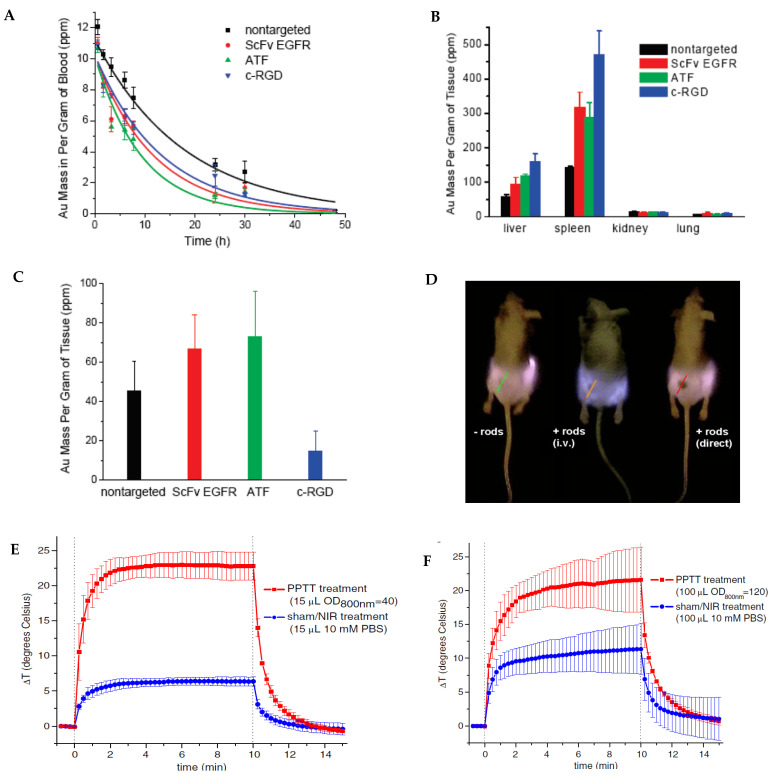
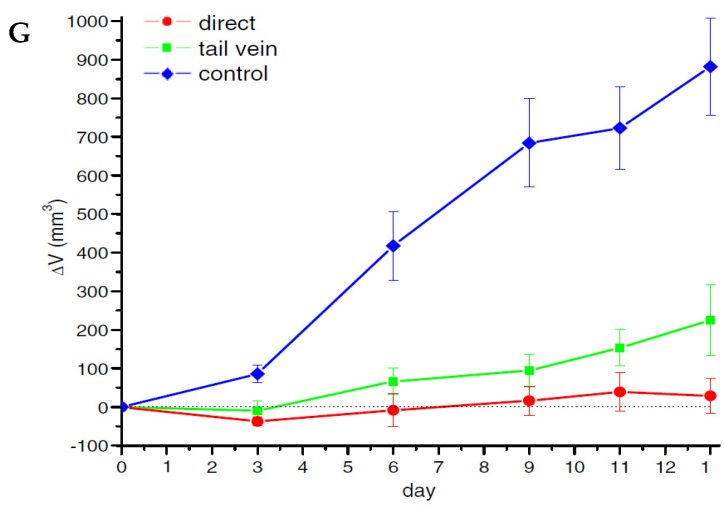
PPTT using passive targeting AuNRs. (A) Blood circulation for targeted and nontargeted AuNRs in healthy mice models. (B) Organ uptake of targeted and nontargeted AuNRs in healthy mice models at 24 h postinjection in A549 xenografted mice models. (C) Tumor uptake of targeted and nontargeted AuNRs at 24 h postinjection in A549 lung cancer xenografted mice models. AuNRs were quantified by ICP-MS in (AC). (D) NIR transmission image of HSC-3 head and neck xenografted mice showing AuNRs in tumor for the intravenously and intratumoral administrated mice. (E,F) Thermal transient measurement of HSC-3 tumor interstitial during direct (E) and intravenous (F) NIR PPTT in comparison to sham/NIR treatment without PEGylated AuNRs. (G) Average change in tumor volume for HSC-3 xenografted mice following NIR PPTT by control (blue), intravenous (blue), and direct (red) injection of PEGylated AuNRs. (AC) Reprinted/adapted with permission from Ref. [61]. Copyright © 2010, American Chemical Society. (DG) Reprinted/adapted from Ref. [63]. Copyright © 2008, Elsevier.
Figure 2
Figure 2
PPTT using passive targeting AuNRs. (A) Blood circulation for targeted and nontargeted AuNRs in healthy mice models. (B) Organ uptake of targeted and nontargeted AuNRs in healthy mice models at 24 h postinjection in A549 xenografted mice models. (C) Tumor uptake of targeted and nontargeted AuNRs at 24 h postinjection in A549 lung cancer xenografted mice models. AuNRs were quantified by ICP-MS in (AC). (D) NIR transmission image of HSC-3 head and neck xenografted mice showing AuNRs in tumor for the intravenously and intratumoral administrated mice. (E,F) Thermal transient measurement of HSC-3 tumor interstitial during direct (E) and intravenous (F) NIR PPTT in comparison to sham/NIR treatment without PEGylated AuNRs. (G) Average change in tumor volume for HSC-3 xenografted mice following NIR PPTT by control (blue), intravenous (blue), and direct (red) injection of PEGylated AuNRs. (AC) Reprinted/adapted with permission from Ref. [61]. Copyright © 2010, American Chemical Society. (DG) Reprinted/adapted from Ref. [63]. Copyright © 2008, Elsevier.
Figure 3
Figure 3
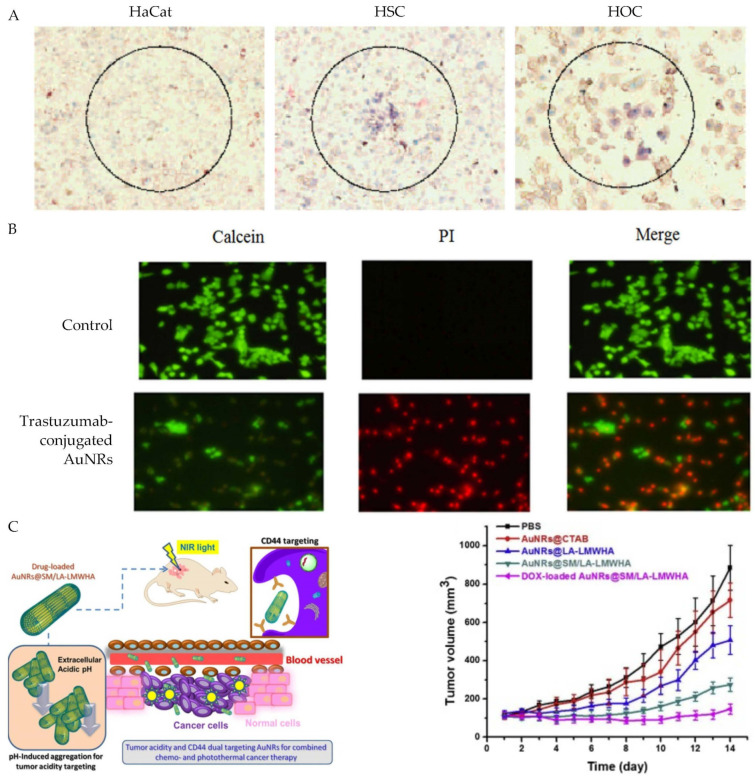
PPTT using ligand-conjugated AuNRs. (A) Selective PPTT of HSC (middle) and HOC (right) head and neck cancer cells over HaCat healthy cells (left) using anti-EGFR conjugated AuNRs. Reprinted/adapted with permission from Ref. [82]. Copyright © 2010, American Chemical Society. (B) PPTT of BT474 breast cancer cells with trastuzumab-conjugated AuNRs. Reprinted/adapted with permission from Ref. [85]. Copyright © 2017, Kang, X.; Guo, X.; An, W.; Niu, X.; Li, S.; Liu, Z.; Yang, Y.; Wang, N.; Jiang, Q.; Yan, C.; et al. (C) PPTT of MDA-MB-231 xenograft tumors with tumor acidity and CD44 dual targeting hyaluronic acid-coated AuNRs. (Left) Schematic of the targeting mechanism. (Right) Tumor volume at different days of post-treatment with 808 nm NIR laser and the hyaluronic acid-coated AuNRs. Reprinted/adapted with permission from Ref. [87]. Copyright © 2019, Elsevier.
Figure 4
Figure 4
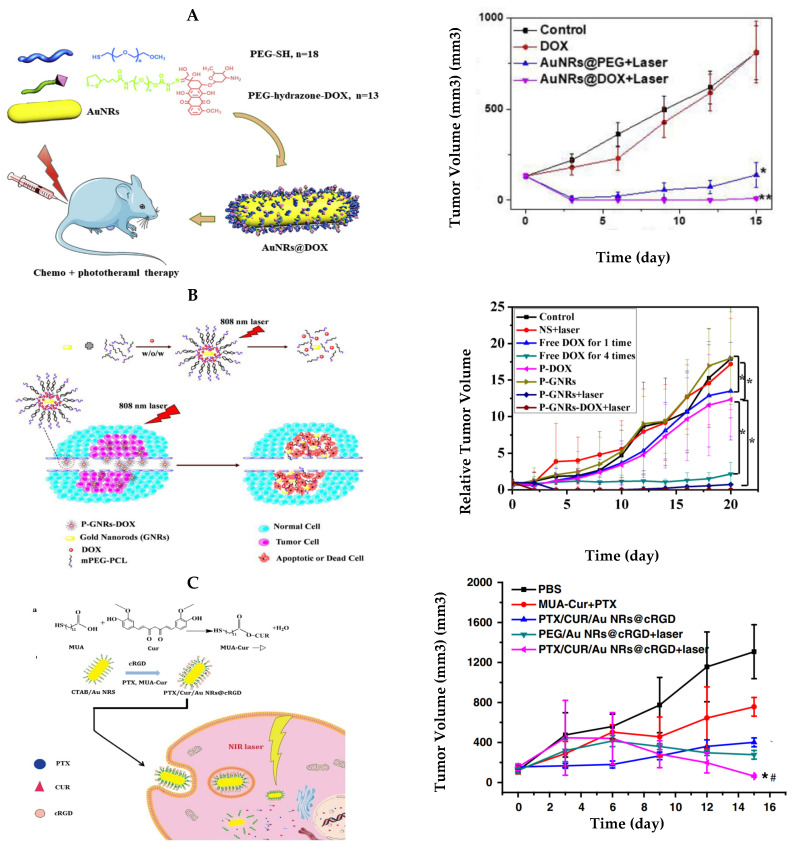
PPTT + chemotherapy using AuNRs. (A) Dox-conjugated pH-responsive AuNRs for PPTT + chemotherapy. Left: Schematic of the synthesis of the AuNR conjugates and its application for combined PPTT and chemotherapy. Right: Average HepG2 tumor volume of the mice at different days after different treatments. Cited from Ref. [104]. * indicates significant difference at p < 0.05 and ** indicates significant difference at p < 0.01. Copyright@2018, Chen, J.; Li, X.; Zhao, X.; Wu, Q.; Zhu, H.; Mao, Z.; Gao, C. (B) Dox-conjugated light-sensitive AuNRs for PPTT + chemotherapy. Left: Schematic of the preparation of P-GNRs-Dox and light sensitive drug release mechanism. Right: Relative C26 tumor volume of the mice at different days after different treatments. * indicates significant difference at p < 0.05. Cited from Ref. [108]. Copyright @2015, Liao, J.; Li, W.; Peng, J.; Enzu, Q.; Li, H.; Wei, Y.; Zhang, X.; Qian, Z. (C) Paclitaxel (PTX)/CUR/AuNRs@c-RGD complex for PPTT + chemotherapy. Left: Schematic of the preparation and application of the complex for PPTT + chemotherapy. PTX is released by hydrophobic interaction and CUR is released by enzymatic hydrolysis. Right: Average A549 tumor volume of the mice at different days after different treatments. Cited from Ref. [113]. * indicates significant difference at p < 0.05. * p < 0.05 vs. PTX/CUR/AuNRs@CRGD and # p < 0.05 vs. PEG/AuNRs@cRGD+laser. Copyright@2019, Zhu, F.; Tan, G.; Zhong, Y.; Jiang, Y.; Cai, L.; Yu, Z.; Liu, S.; Ren, F.
Figure 5
Figure 5
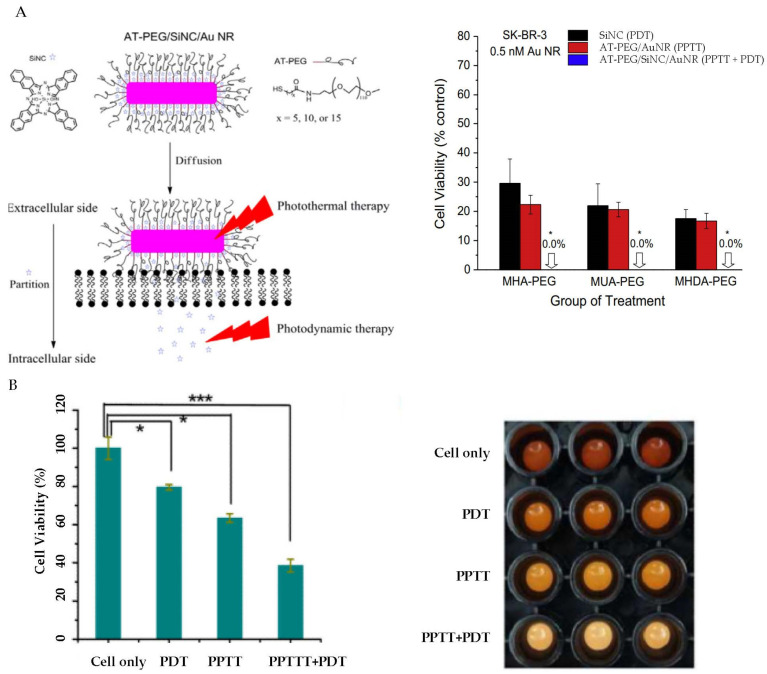
PPTT + PDT using AuNRs. (A) AT-PEG/SiNC/AuNRs for PPTT + PDT. Left: Schematic of the structure of AT-PEG/SiNC/AuNRs and mechanism of PPTT + PDT. Right: Comparison of SK-BR-3 cell viability data under different treatments. Reprinted/adapted from Ref. [139]. * indicates significant difference at p < 0.05. Copyright@2016, Elsevier. (B) Ce6-ASP-T32- NRs for PPTT + PDT. Comparison of CCRF-CEM cell viability data (left) and imaging under different treatments. * and *** indicates significant difference at p < 0.05 and p < 0.0001, respectively. Reprinted with permission from Ref. [142], Copyright © 2012, American Chemical Society.

References

    1. Sung H., Ferlay J., Siegel R.L., Laversanne M., Soerjomataram I., Jemal A., Bray F. Global Cancer Statistics 2020: GLOBOCAN Estimates of Incidence and Mortality Worldwide for 36 Cancers in 185 Countries. CA A Cancer J. Clin. 2021;71:209–249. doi: 10.3322/caac.21660. - DOI - PubMed
    1. Shao K., Singha S., Clemente-Casares X., Tsai S., Th Y., Santamaria P. Nanoparticle-Based Immunotherapy for Cancer. ACS Nano. 2015;9:16–30. doi: 10.1021/nn5062029. - DOI - PubMed
    1. Li Z., Chen Y., Yang Y., Yu Y., Zhang Y., Zhu D., Yu X., Ouyang X., Xie Z., Zhao Y., et al. Recent Advances in Nanomaterials-Based Chemo-Photothermal Combination Therapy for Improving Cancer Treatment. Front. Bioeng. Biotechnol. 2019;7:293. doi: 10.3389/fbioe.2019.00293. - DOI - PMC - PubMed
    1. Vines J.B., Yoon J.-H., Ryu N.-E., Lim D.-J., Park H. Gold Nanoparticles for Photothermal Cancer Therapy. Front. Chem. 2019;7:167. doi: 10.3389/fchem.2019.00167. - DOI - PMC - PubMed
    1. Cobley C.M., Au L., Chen J., Xia Y. Targeting Gold Nanocages to Cancer Cells for Photothermal Destruction and Drug Delivery. Expert Opin. Drug Deliv. 2010;7:577–587. doi: 10.1517/17425240903571614. - DOI - PMC - PubMed

LinkOut - more resources