. 2022 May 27;5(1):24.
doi: 10.1186/s42155-022-00303-4.

Embolisation of an aneurysmal high-flow renal arteriovenous fistula in a paediatric patient: simultaneous arterial and venous approach

Affiliations

Embolisation of an aneurysmal high-flow renal arteriovenous fistula in a paediatric patient: simultaneous arterial and venous approach

Kin Fen Kevin Fung et al. CVIR Endovasc. .

Abstract

Background: A large aneurysmal renal arteriovenous fistula (AVF) can cause hypokalaemic hypertension due to activation of renin-aldosterone system due to steal effect from renal parenchyma. In comparison to nephrectomy, endovascular embolisation of renal AVF is minimally invasive and can be nephron sparing, thus preserving renal function. However, such embolisation is technically challenging and can be associated with high risk of embolic migration.

Case presentation: We present a case of successful embolisation of a large aneurysmal renal AVF in a 11-year-old girl. The AVF was initially treated with coil embolization via transarterial route, resulting in partial migration of coil into inferior vena cava. After removal of the migrated coil via transvenous snaring, coils were deployed simultaneously via transarterial and transvenous routes to prevent migration. AVF flow dampened but residual flow persisted at 1 month follow up. A second embolization session with additional coil deployment and N-butyl cyanoacrylate (NBCA) injection resulted in successful occlusion of the AVF. At 3 months follow up, the girl's blood pressure and serum potassium level have normalized without need of antihypertensive agent or potassium supplements.

Conclusion: Endovascular embolisation can be an effective nephron sparing treatment for large aneurysmal renal AVF. This is particularly important in paediatric patients as most renal function can be preserved with their expected longer life span. Risk of coil migration can be controlled by simultaneous transarterial and transvenous deployment. Complete occlusion of AVF can be aided by additional use of NBCA.

Keywords: Coil; Embolic migration; Embolisation; N-butyl cyanoacrylate; Renal arteriovenous fistula.


Conflict of interest statement

The authors declare that they have no competing interests.

Figures
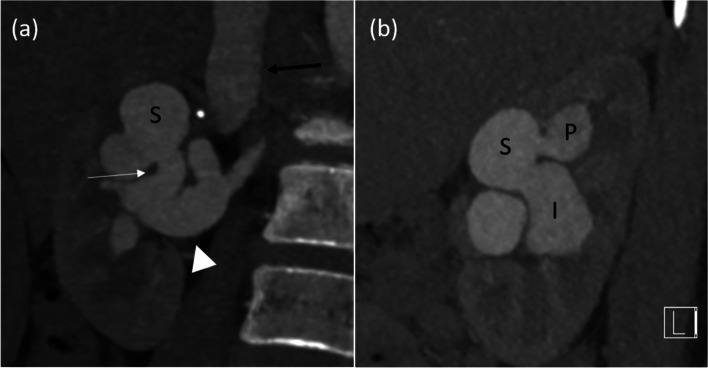
Fig. 1
Fig. 1
Selected maximum intensity projection arterial phase contrast enhanced CT images performed at diagnosis. a Coronal reformatted image showed an aneurysmal AVF at right renal hilum. The fistula (white arrow) connects an aneurysmally dilated anterior division of right renal artery (white arrowhead) with the superior venous varix (marked with “S”). Early opacification of IVC detected on arterial phase, indicating high flow shunting. b Sagittal reformatted image demonstrated the three interconnecting venous varices – superior (marked as “S”), inferior (marked as “I”) and posterior (marked as “P”)
Fig. 2
Fig. 2
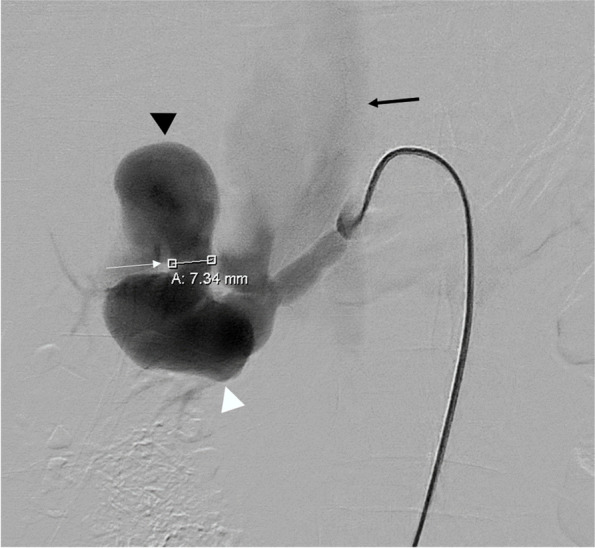
Selected image from DSA demonstrated a high flow aneurysmal AVF at right renal hilum. The fistula (white arrow) measures 7.34 mm and connects an aneurysmally dilated anterior division of right renal artery (white arrowhead) with the superior venous varix (black arrowhead). The IVC (black arrow) was dilated and opacified early, with impaired renal parenchymal staining, indicating rapid high flow arteriovenous shunting
Fig. 3
Fig. 3
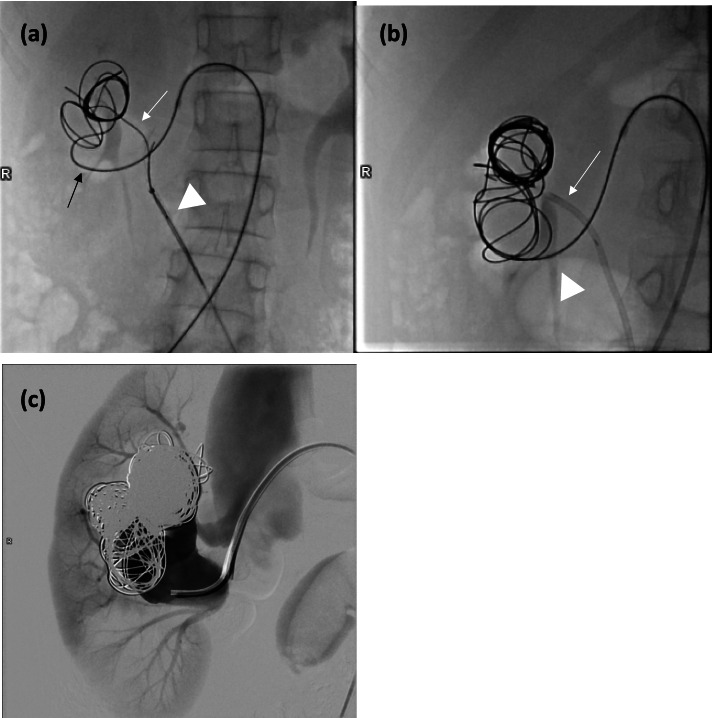
a During transarterial deployment of second 40 mm × 60 cm Ruby framing coil (black arrow), the first 40 mm × 60 cm Ruby framing coil (white arrow) unraveled and prolapsed into the IVC. It was then removed by a snaring catheter (white arrowhead) via transvenous route. b Two 40 mm × 60 cm Ruby framing coils were simultaneously deployed via transarterial and transvenous microcatheters to prevent coil migration (transarterial coil – white arrow; transvenus coil – white arrowhead). c Post-coiling angiogram showed improved parenchymal enhancement of right kidney but residual shunting into IVC along the AVF
Fig. 4
Fig. 4
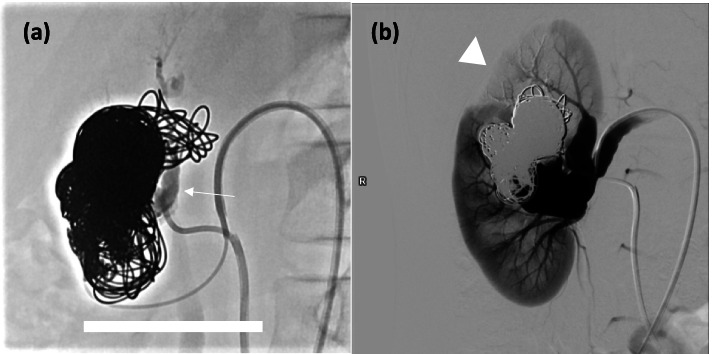
a The arterial supply of AVF was cannulated using a Swift-ninja mC and injection of 50% NBCA:lipiodol mixture was performed under fluoroscopic screening. The glue cast was indicated by white arrow. b Check angiogram showed complete occlusion of AVF with no residual shunting into IVC. Most of the renal parenchymal arterial branches were preserved. The anterosuperior segmental branch (arrowhead) was sacrificed as it shared a common origin with the arterial supply of AVF

References

    1. An HS, et al. Hypertension caused by renal arteriovenous fistula. Korean Circ J. 2009;39(12):548–550. doi: 10.4070/kcj.2009.39.12.548. - DOI - PMC - PubMed
    1. Campbell JE, et al. Use of an amplatzer vascular plug for transcatheter embolization of a renal arteriovenous fistula. Vascular. 2009;17(1):40–43. doi: 10.2310/6670.2008.00071. - DOI - PubMed
    1. Greben CR, et al. Double microcatheter single vascular access embolization technique for complex peripheral vascular pathology. Vasc Endovasc Surg. 2010;44(3):217–222. doi: 10.1177/1538574410361786. - DOI - PubMed
    1. Maruno M, et al. Renal Arteriovenous shunts: clinical features, imaging appearance, and Transcatheter embolization based on Angioarchitecture. Radiographics. 2016;36(2):580–595. doi: 10.1148/rg.2016150124. - DOI - PubMed
    1. Takeuchi Y, et al. Committee of Practice Guidelines of the Japanese Society of Interventional Radiology. Guidelines for the use of NBCA in vascular embolization devised by the Committee of Practice Guidelines of the Japanese Society of Interventional Radiology (CGJSIR), 2012 edition. Jpn J Radiol. 2014;32(8):500–517. doi: 10.1007/s11604-014-0328-7. - DOI - PubMed

LinkOut - more resources