


Non-contact Anterior Cruciate Ligament Injury Epidemiology in Team-Ball Sports: A Systematic Review with Meta-analysis by Sex, Age, Sport, Participation Level, and Exposure Type
- PMID: 35622227
- PMCID: PMC9136558
- DOI: 10.1007/s40279-022-01697-w
Non-contact Anterior Cruciate Ligament Injury Epidemiology in Team-Ball Sports: A Systematic Review with Meta-analysis by Sex, Age, Sport, Participation Level, and Exposure Type
Abstract
Background: Not all anterior cruciate ligament (ACL) injuries are preventable. While some ACL injuries are unavoidable such as those resulting from a tackle, others that occur in non-contact situations like twisting and turning in the absence of external contact might be more preventable. Because ACL injuries commonly occur in team ball-sports that involve jumping, landing and cutting manoeuvres, accurate information about the epidemiology of non-contact ACL injuries in these sports is needed to quantify their extent and burden to guide resource allocation for risk-reduction efforts.
Objective: To synthesize the evidence on the incidence and proportion of non-contact to total ACL injuries by sex, age, sport, participation level and exposure type in team ball-sports.
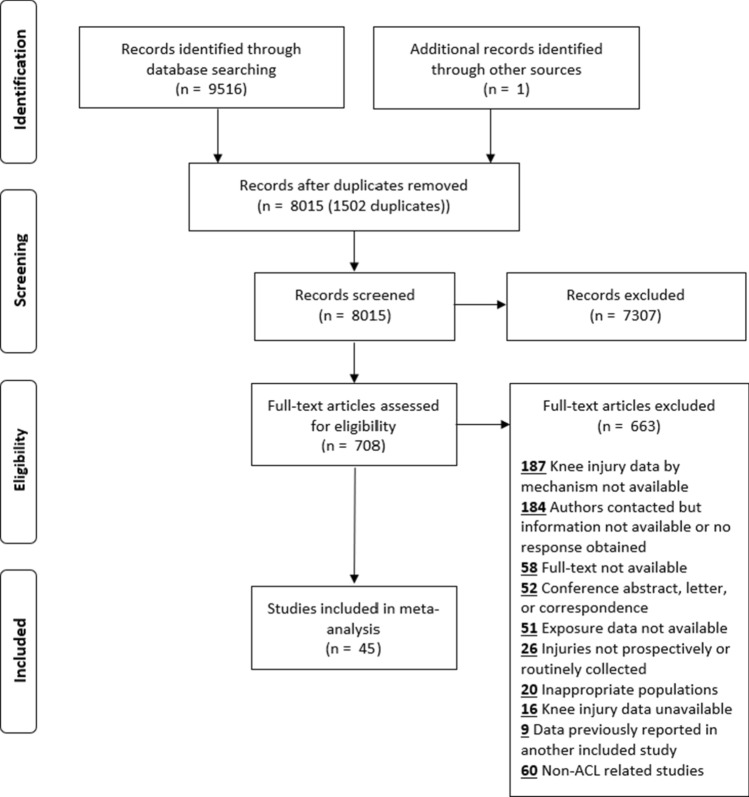
Methods: Six databases (MEDLINE, EMBASE, Web of Science, CINAHL, Scopus and SPORTDiscus) were searched from inception to July 2021. Cohort studies of team ball-sports reporting number of knee injuries as a function of exposure and injury mechanism were included.
Results: Forty-five studies covering 13 team ball-sports were included. The overall proportion of non-contact to total ACL injuries was 55% (95% CI 48-62, I2 = 82%; females: 63%, 95% CI 53-71, I2 = 84%; males: 50%, 95% CI 42-58, I2 = 86%). The overall incidence of non-contact ACL injuries was 0.07 per 1000 player-hours (95% CI 0.05-0.10, I2 = 77%), and 0.05 per 1000 player-exposures (95% CI 0.03-0.07, I2 = 97%). Injury incidence was higher in female athletes (0.14 per 1000 player-hours, 95% CI 0.10-0.19, I2 = 40%) than male athletes (0.05 per 1000 player-hours, 95% CI 0.03-0.07, I2 = 48%), and this difference was significant. Injury incidence during competition was higher (0.48 per 1000 player-hours, 95% CI 0.32-0.72, I2 = 77%; 0.32 per 1000 player-exposures, 95% CI 0.15-0.70, I2 = 96%) than during training (0.04 per 1000 player-hours, 95% CI 0.02-0.07, I2 = 63%; 0.02 per 1000 player-exposures, 95% CI 0.01-0.05, I2 = 86%) and these differences were significant. Heterogeneity across studies was generally high.
Conclusion: This study quantifies several key epidemiological findings for ACL injuries in team ball-sports. Non-contact ACL injuries represented over half of all ACL injuries sustained. The proportion of non-contact to total ACL injuries and injury incidence were higher in female than in male athletes. Injuries mostly occurred in competition settings.
© 2022. The Author(s).
Conflict of interest statement
Lionel Chia, Danilo De Oliveira Silva, Matthew Whalan, Marnee J. McKay, Justin Sullivan, Colin W. Fuller and Evangelos Pappas declare that they have no conflicts of interest relevant to the content of this review.
Figures


References
-
- Montalvo AM, Schneider DK, Webster KE, Yut L, Galloway MT, Heidt RS, et al. Anterior cruciate ligament injury risk in sport: a systematic review and meta-analysis of injury incidence by sex and sport classification. J Athl Train. 2019;54(5):472–482. doi: 10.4085/1062-6050-407-16. - DOI - PMC - PubMed
-
- Roos KG, Wasserman EB, Dalton SL, Gray A, Djoko A, Dompier TP, et al. Epidemiology of 3825 injuries sustained in six seasons of National Collegiate Athletic Association men's and women's soccer (2009/2010–2014/2015) Br J Sports Med. 2017;51(13):1029–1034. doi: 10.1136/bjsports-2015-095718. - DOI - PubMed
-
- Della Villa F, Buckthorpe M, Grassi A, Nabiuzzi A, Tosarelli F, Zaffagnini S, et al. Systematic video analysis of ACL injuries in professional male football (soccer): injury mechanisms, situational patterns and biomechanics study on 134 consecutive cases. Br J Sports Med. 2020;54(23):1423–1432. doi: 10.1136/bjsports-2019-101247. - DOI - PubMed
Publication types
MeSH terms
LinkOut - more resources
Full Text Sources
Medical
