. 2022 Apr 20;10(5):203.
doi: 10.3390/toxics10050203.

RETRACTED: Combined Effects of Potassium Perchlorate and a Neonicotinoid on Zebrafish Larvae (Danio rerio)

Affiliations

RETRACTED: Combined Effects of Potassium Perchlorate and a Neonicotinoid on Zebrafish Larvae (Danio rerio)

Davide Di Paola et al. Toxics. .

Retraction in

Abstract

Imidacloprid (IMI) is part of the neonicotinoids family, insecticides widely used by humans and also found in wastewater. This class of compounds, if present in the environment, can cause toxicity to different species such as bees and gammarids, although little is known about vertebrates such as fish. In addition, several substances have been reported in the environment that can cause damage to aquatic species, such as potassium perchlorate (KClO4), if exposed to high concentrations or for long periods. Often, the co-presence of different contaminants can cause a synergistic action in terms of toxicity to fish. In the present study, we first analyzed different concentrations of IMI (75, 100 and 150 mg/L) and KClO4 (1, 1.5 and 5 mM) to highlight the morphological effects at 96 hpf and, subsequently, chose two nontoxic concentrations to evaluate their co-exposure and the pathway involved in their co-toxicity. Morphological alteration, mucus production, messenger RNA (mRNA) expression related to intestinal function and oxidative stress were measured. These results suggest that co-exposure to IMI and KClO4 could affect zebrafish embryo development by increasing gut toxicity and the alteration of antioxidative defense mechanisms.

Keywords: environment contaminant; gut; insecticides; oxidative stress; synergy effect.


Conflict of interest statement

The authors declare no conflict of interest.

Figures
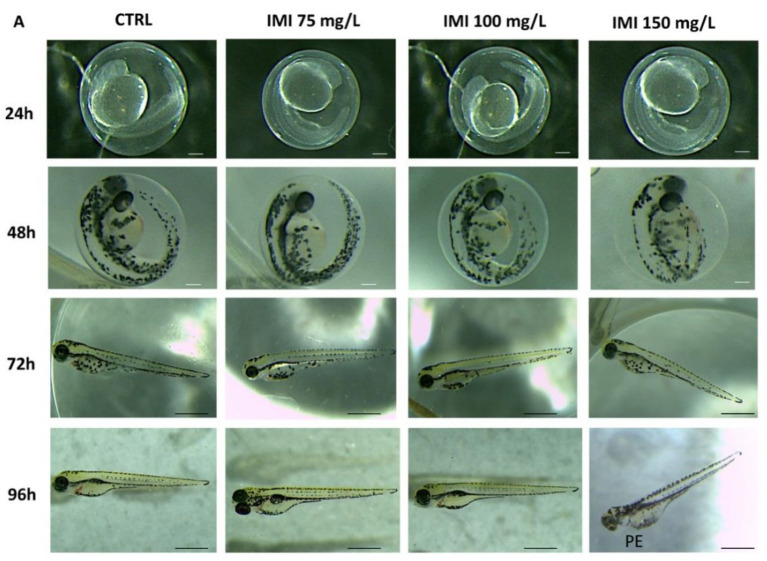
Figure 1
Figure 1
Morphological defections in zebrafish caused by different concentrations of IMI. PE—pericardial edema. Images were taken from the lateral view under a dissecting microscope (magnification 25×). Scale bar, 500 mm.
Figure 2
Figure 2
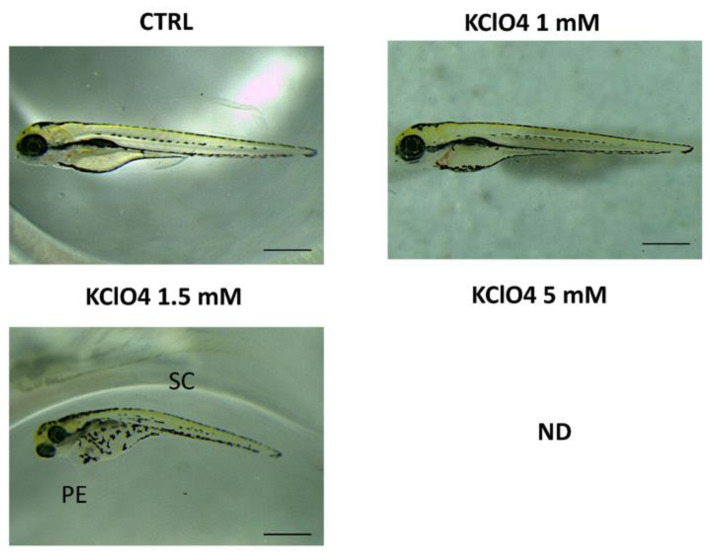
Morphological defections in zebrafish caused by KClO4 exposure to different concentrations at 94 hpf. SC—scoliosis; PE—pericardial edema. Images were taken from the lateral view under a dissecting microscope (magnification 25×). Scale bar, 500 mm.
Figure 3
Figure 3
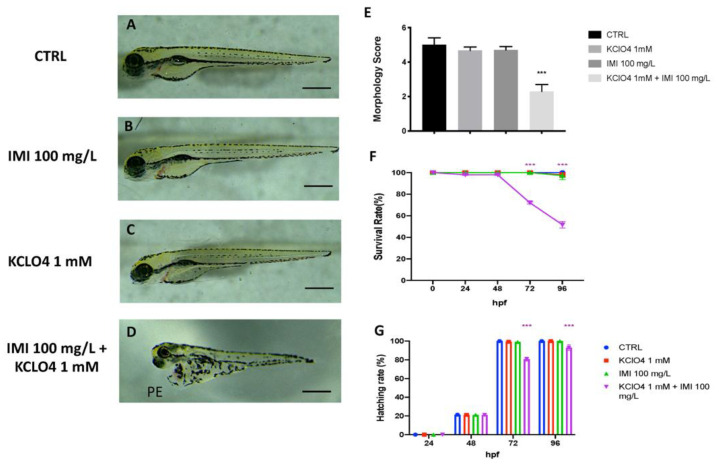
Effects of KClO4 and Cd single and co-exposure on morphological changes in zebrafish larvae at 96 hpf. CTRL (A). KClO4 (B). Cd (C). KClO4+Cd (D). Morphology score (E). Survival rate and (F) hatching rate (G) of zebrafish larvae treated. PE—pericardial edema. *** p < 0.001 versus CTRL.
Figure 4
Figure 4
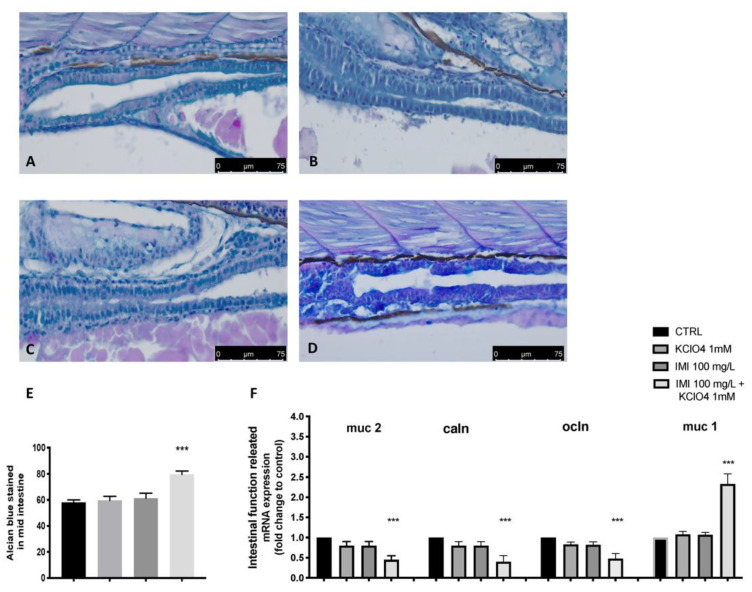
IMI and KClO4 effect in single and co-exposure on mucopolysaccharides production. Whole-mount control, IMI and KClO4 in single and co-exposure larvae stained with Alcian Blue. CTRL (A), KClO4 (B), IMI (C); IMI+ KClO4 (D). Increased mucus production (blue staining) (E). Effects of IMI and KClO4 single and co-exposure on the mRNA levels of intestinal-function-related genes (muc2, caln, ocln and muc1) (F) in larval zebrafish. Values = means ± SEM of three independent experiment data; *** at p < 0.001 against CTRL.
Figure 5
Figure 5
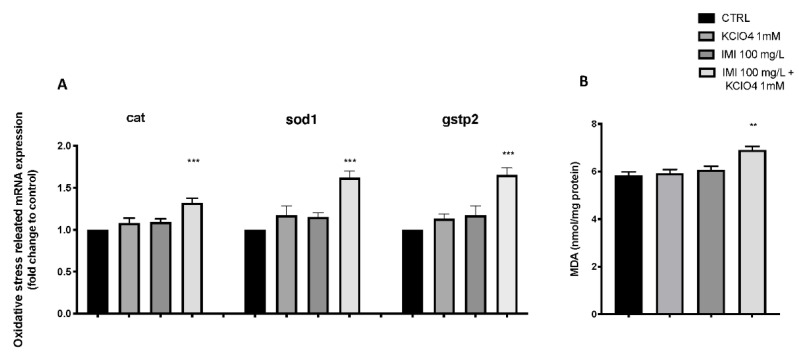
Effects of IMI and KClO4 single and co-exposure on the mRNA levels of stress oxidative pathway (cat, sod and gstp2) (A) in larval zebrafish. MDA (B). Values = means ± SEM of three independent experiment data; ** at p < 0.01 against CTRL. *** at p < 0.001 against CTRL.

References

    1. Van Dijk T.C., Van Staalduinen M.A., Van der Sluijs J.P. Macro-invertebrate decline in surface water polluted with imidacloprid. PLoS ONE. 2013;8:e62374. doi: 10.1371/journal.pone.0062374. - DOI - PMC - PubMed
    1. Simon-Delso N., Amaral-Rogers V., Belzunces L.P., Bonmatin J.-M., Chagnon M., Downs C., Furlan L., Gibbons D.W., Giorio C., Girolami V. Systemic insecticides (neonicotinoids and fipronil): Trends, Uses, Mode of Action and Metabolites. Environ. Sci. Pollut. Res. 2015;22:5–34. doi: 10.1007/s11356-014-3470-y. - DOI - PMC - PubMed
    1. Bonmatin J.-M., Giorio C., Girolami V., Goulson D., Kreutzweiser D., Krupke C., Liess M., Long E., Marzaro M., Mitchell E.A. Environmental fate and exposure; neonicotinoids and fipronil. Environ. Sci. Pollut. Res. 2015;22:35–67. doi: 10.1007/s11356-014-3332-7. - DOI - PMC - PubMed
    1. Moschet C., Wittmer I., Simovic J., Junghans M., Piazzoli A., Singer H., Stamm C., Leu C., Hollender J. How a complete pesticide screening changes the assessment of surface water quality. Environ. Sci. Technol. 2014;48:5423–5432. doi: 10.1021/es500371t. - DOI - PubMed
    1. Morrissey C.A., Mineau P., Devries J.H., Sanchez-Bayo F., Liess M., Cavallaro M.C., Liber K. Neonicotinoid contamination of global surface waters and associated risk to aquatic invertebrates: A Review. Environ. Int. 2015;74:291–303. doi: 10.1016/j.envint.2014.10.024. - DOI - PubMed

Publication types

LinkOut - more resources