


Measuring parents' readiness to vaccinate themselves and their children against COVID-19
- PMID: 35623906
- PMCID: PMC9069251
- DOI: 10.1016/j.vaccine.2022.04.091
Measuring parents' readiness to vaccinate themselves and their children against COVID-19
Abstract
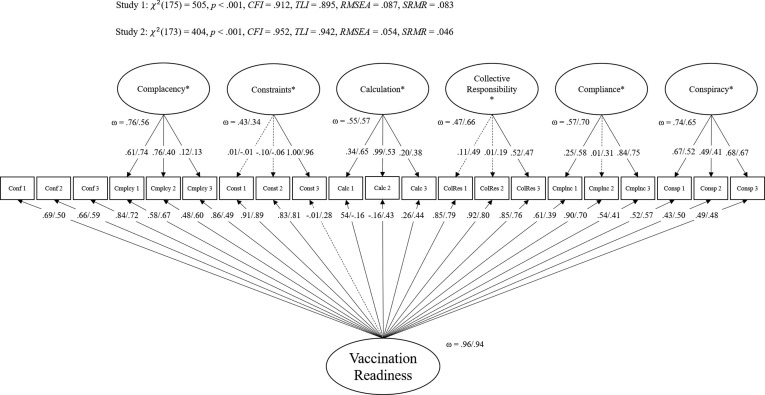
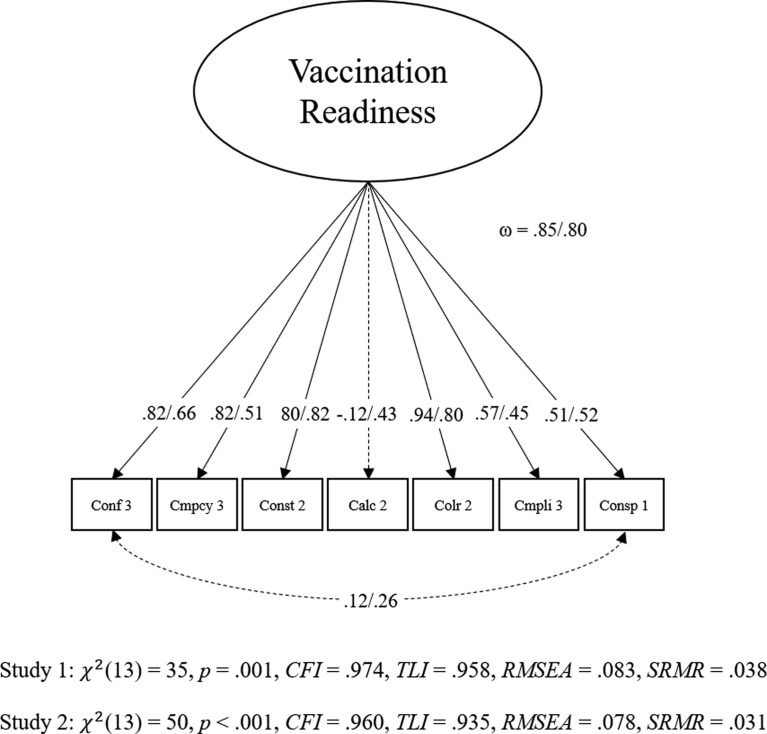
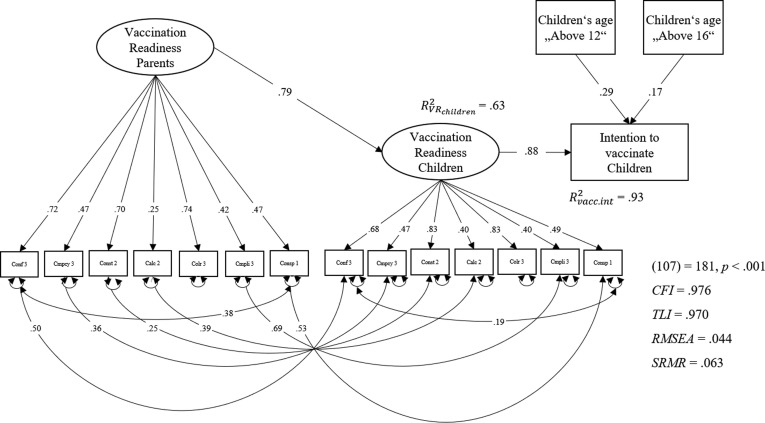
To reach high vaccination rates against COVID-19, children and adolescents should be also vaccinated. To improve childhood vaccination rates and vaccination readiness, parents need to be addressed since they decide about the vaccination of their children. We adapted the 7C of vaccination readiness scale to measure parents' readiness to vaccinate their children and evaluated the scale in a long and a short version in two studies. The study was first evaluated with a sample of N = 244 parents from the German COVID-19 Snapshot Monitoring (COSMO) and validated with N = 464 parents from the Danish COSMO. The childhood 7C scale showed acceptable to good psychometric properties in both samples and explained more than 80% of the variance in vaccination intentions. Additionally, differences in parents' readiness to vaccinate their children against COVID-19 were strongly determined by their readiness to vaccinate themselves, explaining 64% of the variance. Vaccination readiness and intentions for children changed as a function of the children's age explaining 93% of differences between parents in their vaccination intentions for their children. Finally, we found differences in correlations of components with self- versus childhood vaccination, as well as between the children's age groups in the prediction of vaccination intentions. Thus, parents need to be targeted in specifically tailored ways, based on the age of their child, to reach high vaccination rates in children. The scale is publicly available in several languages (www.vaccination-readiness.com).
Keywords: COVID-19; Childhood vaccination; Parents questionnaire; Questionnaire; Vaccination readiness; Vaccine acceptance.
Copyright © 2022 Elsevier Ltd. All rights reserved.
Conflict of interest statement
Declaration of Competing Interest The authors declare that they have no known competing financial interests or personal relationships that could have appeared to influence the work reported in this paper. Robert Boehm reports financial support was provided by Lundbeck Foundation. Robert Boehm reports financial support was provided by University of Copenhagen Faculty of Social Sciences. Ingo Zettler reports financial support was provided by Lundbeck Foundation. Ingo Zettler reports financial support was provided by University of Copenhagen Faculty of Social Sciences. Cornelia Betsch reports financial support was provided by German Research Foundation.
Figures
References
-
- Betsch C., Böhm R., Chapman G.B. Using behavioral insights to increase vaccination policy effectiveness. Policy Insights Behav Brain Sci. 2015;2:61–73. doi: 10.1177/2372732215600716. - DOI
-
- 2020 World Population Data Sheet 2020.
Publication types
MeSH terms
LinkOut - more resources
Full Text Sources
Medical
