. 2022 May 12;11(5):650.
doi: 10.3390/antibiotics11050650.

Antimicrobial Potential of Conjugated Lignin/Morin/Chitosan Combinations as a Function of System Complexity

Affiliations

Antimicrobial Potential of Conjugated Lignin/Morin/Chitosan Combinations as a Function of System Complexity

Zvezdelina Yaneva et al. Antibiotics (Basel). .

Abstract

As natural biopolymers, chitosan and lignin are characterized by their good biocompatibility, high biodegradability and satisfactory biosafety. The active polymers’ functional groups are responsible for the potential of these biomaterials for use as carrier matrices in the construction of polymer−drug conjugates with prospective applicability in the fields of medicine, food and agriculture—subjects that have attracted attention in recent years. Hence, the aim of this research was to place substantial emphasis on the antimicrobial potential of flavonoid−biopolymer complex systems by assessment of the probable synergetic, additive or antagonistic effects arising as a function of systemic complexity. The joint implementation of morin, chitosan and lignin in conjugated two- and three-component systems provoked species-dependent antimicrobial synergistic and/or potentiation effects against the activity of the tested bacterial strains Staphylococcus aureus ATCC 25923, Escherichia coli ATCC 25922, Pseudomonas aeruginosa ATCC 27853 and the clinical isolate Bacillus cereus. The double combinations of morin−chitosan and morin−lignin resulted in a 100% increase in their inhibitory activity against S. aureus as compared to the pure biocompounds. The inhibitory effects of the three-component system, in decreasing order, were: S. aureus (IZ = 15.7 mm) > P. aeruginosa (IZ = 15 mm) > B. cereus and E. coli (IZ = 14 mm). All tested morin-containing two- and three-component systems exhibited clear and significant potentiation effects, especially against S. aureus and B. cereus. The results obtained are a prerequisite for the potential use of the studied conjugated lignin−morin−chitosan combinations in the construction of novel drug-carrier formulations with improved bioactivities.

Keywords: antibacterial activity; chitosan; combined systems; lignin; morin.


Conflict of interest statement

The authors declare no conflict of interest.

Figures

Figure 1
Figure 1
Dependence between the antimicrobial activity of chitosan and lignin (expressed as IZ, mm) and the biopolymer concentrations against S. aureus.
Figure 2
Figure 2
Antimicrobial potential of single- and two-component morin–biopolymer, biopolymer–biopolymer systems against S. aureus and B. cereus. (Statistical significance of the experimental results: * p < 0.005; ** p = 0.073.): (A) Graphical representation of the experimental data, (B) Photos of the inhibition zones against S. aureus.
Figure 2
Figure 2
Antimicrobial potential of single- and two-component morin–biopolymer, biopolymer–biopolymer systems against S. aureus and B. cereus. (Statistical significance of the experimental results: * p < 0.005; ** p = 0.073.): (A) Graphical representation of the experimental data, (B) Photos of the inhibition zones against S. aureus.
Figure 3
Figure 3
Antimicrobial potential of the three-component morin–chitosan–lignin system against S. aureus, P. aeruginosa, B. cereus and E. coli. (All experimental results were statistically significant: p < 0.005.): (A) Graphical representation of the experimental data; (B) A photo of the inhibition zones against S. aureus.
Figure 4
Figure 4
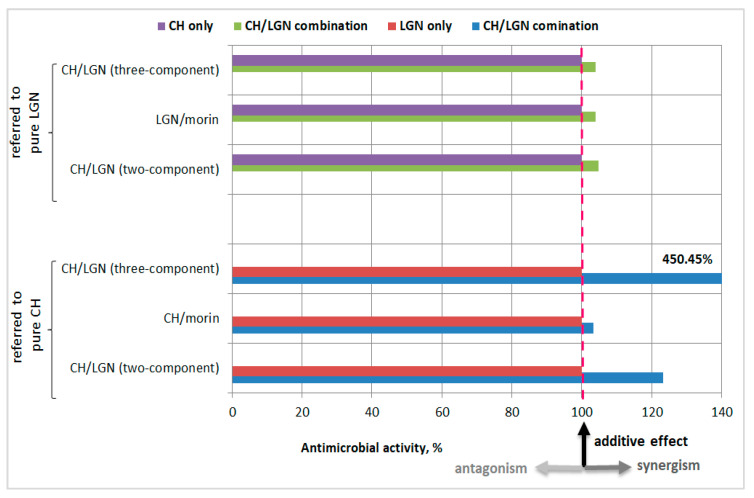
Effects of CH and LGN combinations on S. aureus inhibition as a percentage of the effect of both biopolymers applied alone.
Figure 5
Figure 5
Scheme of the possible intermolecular interactions between morin, chitosan and lignin.
Figure 6
Figure 6
Schematic representation of the postulated antimicrobial activity mechanisms of the studied two- and three-component morin–chitosan–lignin combined systems against: (A) Gram-positive and (B) Gram-negative bacteria.

References

    1. Long F., Yang H., Xu Y., Hao H., Li P. A strategy for the identification of combinatorial bioactive compounds contributing to the holistic effect of herbal medicines. Sci. Rep. 2015;5:12361. doi: 10.1038/srep12361. - DOI - PMC - PubMed
    1. Ilyasov I., Beloborodov V., Antonov D., Dubrovskaya A., Terekhov R., Zhevlakova A., Saydasheva A., Evteev V., Selivanova I. Flavonoids with glutathione antioxidant synergy: Influence of free radicals inflow. Antioxidants. 2020;9:695. doi: 10.3390/antiox9080695. - DOI - PMC - PubMed
    1. Fabre G., Bayach I., Berk K., Paloncýová M., Starok M., Rossi C., Duroux J., Otyepka M., Trouillas P. Synergism of antioxidant action of vitamins E, C and quercetin is related to formation of molecular associations in biomembranes. Chem. Commun. 2015;51:7713. doi: 10.1039/C5CC00636H. - DOI - PubMed
    1. Nikoo M., Regenstein J.M., Gavlighi H.A. Antioxidant and antimicrobial activities of (-)-epigallocatechin-3-gallate (EGCG) and its potential to preserve the quality and safety of foods. Compr. Rev. Food Sci. Food Saf. 2018;17:732. doi: 10.1111/1541-4337.12346. - DOI - PubMed
    1. Nogala-Kałucka M., Dwiecki K., Siger A., Górnaś P., Polewski K., Ciosek S. Antioxidant synergism and antagonism between tocotrienols, quercetin and rutin in model system. Acta Aliment. 2013;42:360. doi: 10.1556/AAlim.2012.0009. - DOI

LinkOut - more resources