Review
. 2022 May 10;10(5):1109.
doi: 10.3390/biomedicines10051109.

Low-Grade Inflammation in the Pathogenesis of Osteoarthritis: Cellular and Molecular Mechanisms and Strategies for Future Therapeutic Intervention

Affiliations
Review

Low-Grade Inflammation in the Pathogenesis of Osteoarthritis: Cellular and Molecular Mechanisms and Strategies for Future Therapeutic Intervention

M Alaa Terkawi et al. Biomedicines. .

Abstract

Osteoarthritis (OA) is a musculoskeletal disease characterized by cartilage degeneration and stiffness, with chronic pain in the affected joint. It has been proposed that OA progression is associated with the development of low-grade inflammation (LGI) in the joint. In support of this principle, LGI is now recognized as the major contributor to the pathogenesis of obesity, aging, and metabolic syndromes, which have been documented as among the most significant risk factors for developing OA. These discoveries have led to a new definition of the disease, and OA has recently been recognized as a low-grade inflammatory disease of the joint. Damage-associated molecular patterns (DAMPs)/alarmin molecules, the major cellular components that facilitate the interplay between cells in the cartilage and synovium, activate various molecular pathways involved in the initiation and maintenance of LGI in the joint, which, in turn, drives OA progression. A better understanding of the pathological mechanisms initiated by LGI in the joint represents a decisive step toward discovering therapeutic strategies for the treatment of OA. Recent findings and discoveries regarding the involvement of LGI mediated by DAMPs in OA pathogenesis are discussed. Modulating communication between cells in the joint to decrease inflammation represents an attractive approach for the treatment of OA.

Keywords: DAMPs; OA; cartilage; low-grade inflammation.


Conflict of interest statement

The authors declare no conflict of interest.

Figures
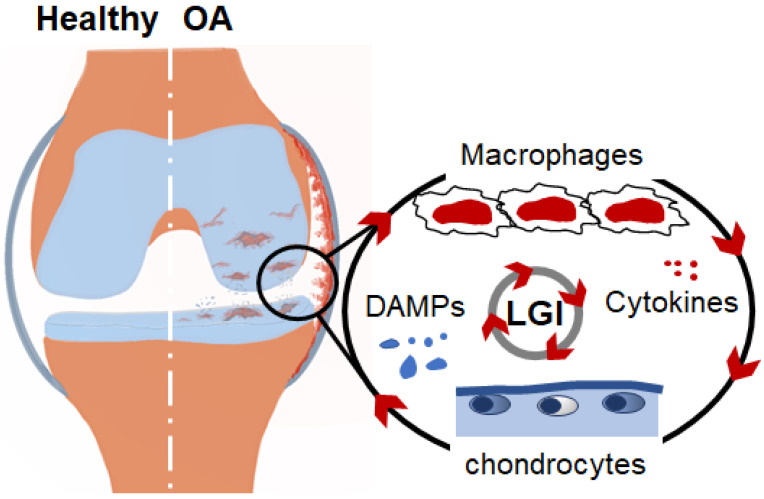
Figure 1
Figure 1
Schematic representation of inflammation cycle in the OA joint. Cartilage damage tissue and tears, crystals, endogenous molecules from apoptotic chondrocytes, and plasma proteins from vascular leak act as DAMPs which trigger local LGI in the joint, thus promoting the production of proteolytic enzymes. Continual release of DAMPs in the joint leads to chronic activation of innate immune cells, including macrophages, thus amplifying a vicious inflammation cycle leading to cartilage degeneration.
Figure 2
Figure 2
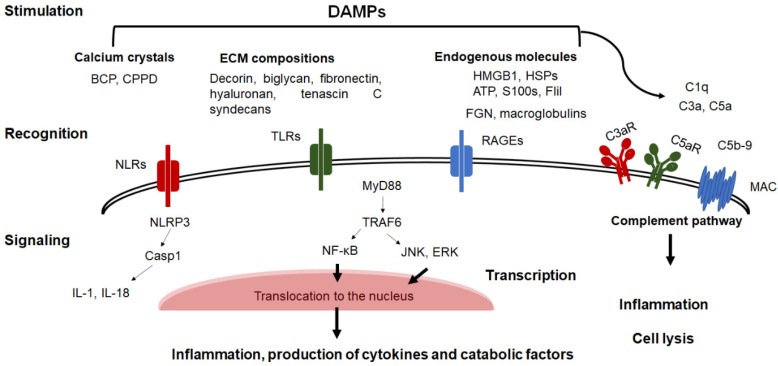
Schematic representation of the role of DAMPs in the initiation of LGI. DAMPs, including cartilage compositions, crystals, endogenous molecules, and plasma proteins, are recognized by PPRs, including NLRs, TLRs, and RAGEs resulting in the activation of several signaling pathways involved in the production of proinflammatory cytokines and proteolytic enzymes by macrophages and chondrocytes. The binding of DAMPs to complement molecules activate the complement pathway resulting in cell activation leading to inflammatory responses and cell lysis.
Figure 3
Figure 3
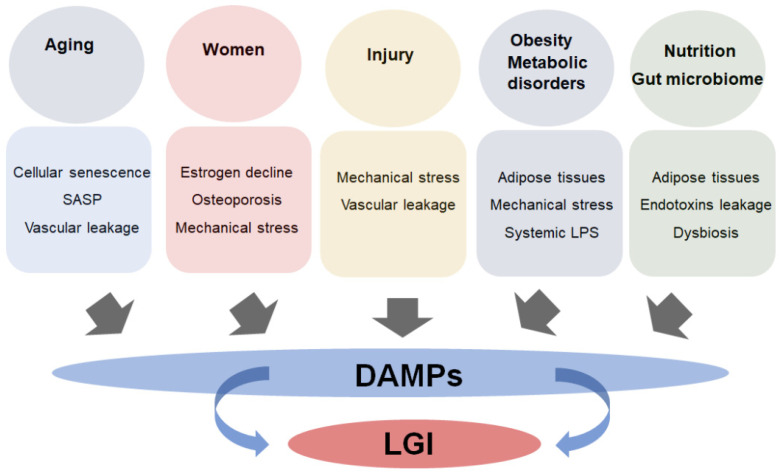
Association between LGI state and the risk factors of OA. Factors including aging, sex (women), injury, obesity and metabolic syndromes, nutrition, and gut microbiome are associated with increased production of DAMPs in the tissues, which facilitate the development of LGI.
Figure 4
Figure 4
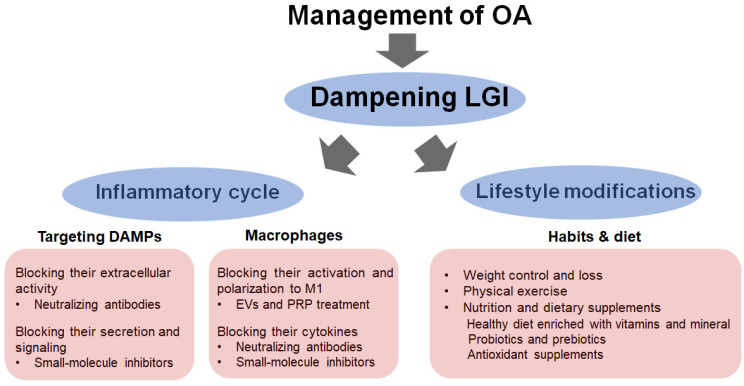
Targeting LGI for treatment of OA. Dampening inflammation by targeting the inflammatory cycle includes blocking the extracellular activity and production of DAMPs, reducing macrophage activation and polarization, and blocking inflammatory cytokines, TNF-α, IL-1, and IL-6. Lifestyle modifications include weight loss, exercise and nutrition, and dietary supplements.

References

    1. Standardization of Osteoarthritis Definitions. [(accessed on 1 April 2019)]. Available online: https://www.oarsi.org/research/standardization-osteoarthritis-definitions.
    1. Hunter D.J., Bierma-Zeinstra S. Osteoarthritis. Lancet. 2019;393:1745–1759. doi: 10.1016/S0140-6736(19)30417-9. - DOI - PubMed
    1. Hunter D.J., March L., Chew M. Osteoarthritis in 2020 and beyond: A Lancet Commission. Lancet. 2020;396:1711–1712. doi: 10.1016/S0140-6736(20)32230-3. - DOI - PubMed
    1. Loeser R.F., Goldring S.R., Scanzello C.R., Goldring M.B. Osteoarthritis: A disease of the joint as an organ. Arthritis Rheum. 2012;64:1697–1707. doi: 10.1002/art.34453. - DOI - PMC - PubMed
    1. Robinson W.H., Lepus C.M., Wang Q., Raghu H., Mao R., Lindstrom T.M., Sokolove J. Low-grade inflammation as a key mediator of the pathogenesis of osteoarthritis. Nat. Rev. Rheumatol. 2016;12:580–592. doi: 10.1038/nrrheum.2016.136. - DOI - PMC - PubMed

LinkOut - more resources