Review
. 2022 May 13;14(10):2412.
doi: 10.3390/cancers14102412.

Epidemiology of Glioblastoma Multiforme-Literature Review

Affiliations
Review

Epidemiology of Glioblastoma Multiforme-Literature Review

Szymon Grochans et al. Cancers (Basel). .

Abstract

Glioblastoma multiforme (GBM) is one of the most aggressive malignancies, with a median overall survival of approximately 15 months. In this review, we analyze the pathogenesis of GBM, as well as epidemiological data, by age, gender, and tumor location. The data indicate that GBM is the higher-grade primary brain tumor and is significantly more common in men. The risk of being diagnosed with glioma increases with age, and median survival remains low, despite medical advances. In addition, it is difficult to determine clearly how GBM is influenced by stimulants, certain medications (e.g., NSAIDs), cell phone use, and exposure to heavy metals.

Keywords: brain tumor; central nervous system; epidemiology; glioblastoma multiforme; protective factor; risk factor.


Conflict of interest statement

The authors declare no conflict of interest.

Figures
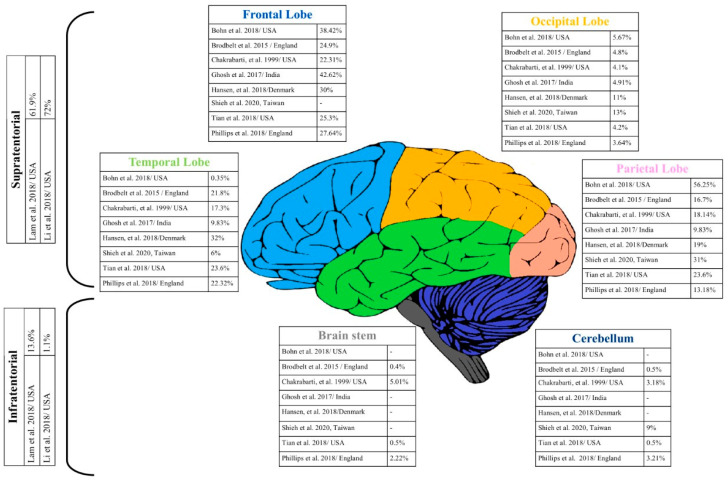
Figure 1
Figure 1
Summary of GBM locations in the central nervous system (%); some data also distinguished locations: Brain, NOS (not otherwise specified), Chamber NOS (not otherwise specified), Brain Overlapping Brain Damage, and Other, which are not shown in the figure; therefore, the sum of the percentages of the structures is not 100% [23,24,26,27,28,29,30,31,32]. own figure, no permission required for publication.
Figure 2
Figure 2
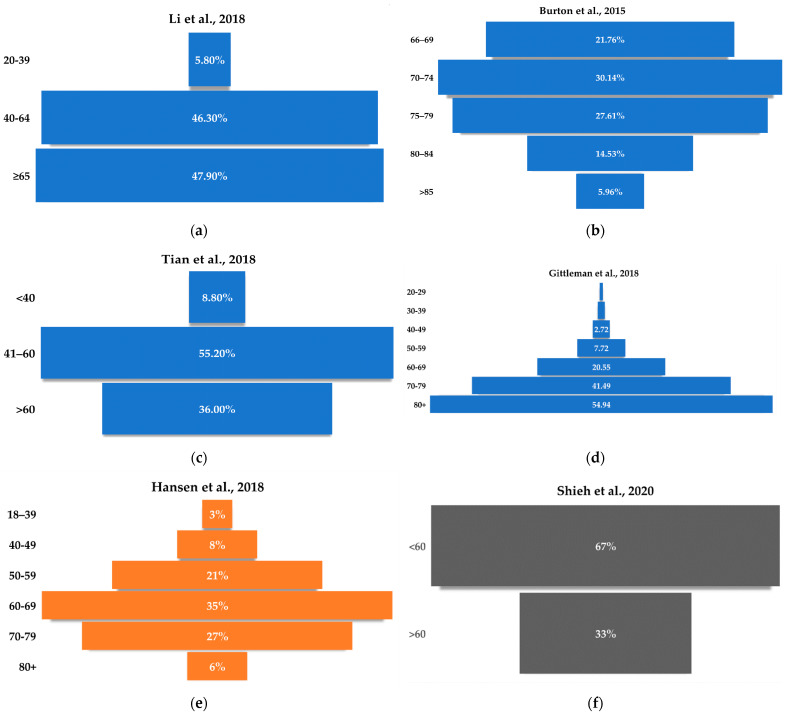
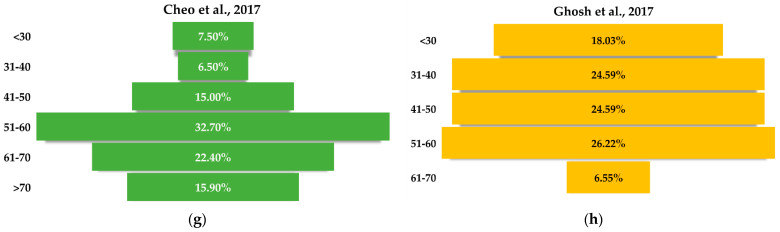
Age-related incidence of GBM in (a) [32], (b) [105], (c) [85] (d) [92] the USA, (e) Denmark [31], (f) Taiwan [106], (g) China [107], and (h) India [25].
Figure 2
Figure 2
Age-related incidence of GBM in (a) [32], (b) [105], (c) [85] (d) [92] the USA, (e) Denmark [31], (f) Taiwan [106], (g) China [107], and (h) India [25].
Figure 3
Figure 3
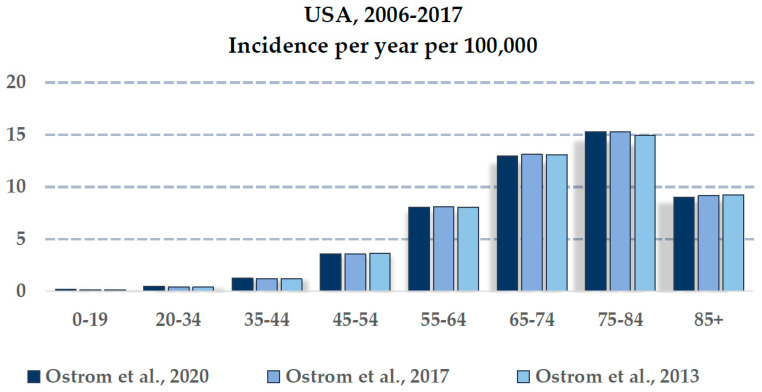
Age-related incidence of GBM (100,000/years) [14,100,101].

References

    1. Koshy M., Villano J.L., Dolecek T.A., Howard A., Mahmood U., Chmura S.J., Weichselbaum R.R., McCarthy B.J. Improved survival time trends for glioblastoma using the SEER 17 population-based registries. J. Neurooncol. 2012;107:207–212. doi: 10.1007/s11060-011-0738-7. - DOI - PMC - PubMed
    1. Tran B., Rosenthal M.A. Survival comparison between glioblastoma multiforme and other incurable cancers. J. Clin. Neurosci. 2010;17:417–421. doi: 10.1016/j.jocn.2009.09.004. - DOI - PubMed
    1. Perry A., Wesseling P. Histologic classification of gliomas. Handb. Clin. Neurol. 2016;134:71–95. - PubMed
    1. Batash R., Asna N., Schaffer P., Francis N., Schaffer M. Glioblastoma Multiforme, Diagnosis and Treatment; Recent Literature Review. Curr. Med. Chem. 2017;24:3002–3009. doi: 10.2174/0929867324666170516123206. - DOI - PubMed
    1. Razavi S.M., Lee K.E., Jin B.E., Aujla P.S., Gholamin S., Li G. Immune Evasion Strategies of Glioblastoma. Front. Surg. 2016;3:11. doi: 10.3389/fsurg.2016.00011. - DOI - PMC - PubMed

LinkOut - more resources