. 2022 May 5;12(5):1147.
doi: 10.3390/diagnostics12051147.

Motor Fluctuations Development Is Associated with Non-Motor Symptoms Burden Progression in Parkinson's Disease Patients: A 2-Year Follow-Up Study

Affiliations

Motor Fluctuations Development Is Associated with Non-Motor Symptoms Burden Progression in Parkinson's Disease Patients: A 2-Year Follow-Up Study

Diego Santos-García et al. Diagnostics (Basel). .

Abstract

Objective: The aim of the present study was to analyze the progression of non-motor symptoms (NMS) burden in Parkinson's disease (PD) patients regarding the development of motor fluctuations (MF). Methods: PD patients without MF at baseline, who were recruited from January 2016 to November 2017 (V0) and evaluated again at a 2-year follow-up (V2) from 35 centers of Spain from the COPPADIS cohort, were included in this analysis. MF development at V2 was defined as a score ≥ 1 in the item-39 of the UPDRS-Part IV, whereas NMS burden was defined according to the Non-motor Symptoms Scale (NMSS) total score. Results: Three hundred and thirty PD patients (62.67 ± 8.7 years old; 58.8% males) were included. From V0 to V2, 27.6% of the patients developed MF. The mean NMSS total score at baseline was higher in those patients who developed MF after the 2-year follow-up (46.34 ± 36.48 vs. 34.3 ± 29.07; p = 0.001). A greater increase in the NMSS total score from V0 to V2 was observed in patients who developed MF (+16.07 ± 37.37) compared to those who did not develop MF (+6.2 ± 25.8) (p = 0.021). Development of MF after a 2-year follow-up was associated with an increase in the NMSS total score (β = 0.128; p = 0.046) after adjustment to age, gender, years from symptoms onset, levodopa equivalent daily dose (LEDD) and the NMSS total score at baseline, and the change in LEDD from V0 to V2. Conclusions: In PD patients, the development of MF is associated with a greater increase in the NMS burden after a 2-year follow-up.

Keywords: Parkinson’s disease; burden; follow-up; motor fluctuations; non-motor symptoms.


Conflict of interest statement

The authors have no conflict of interest to report.

Figures
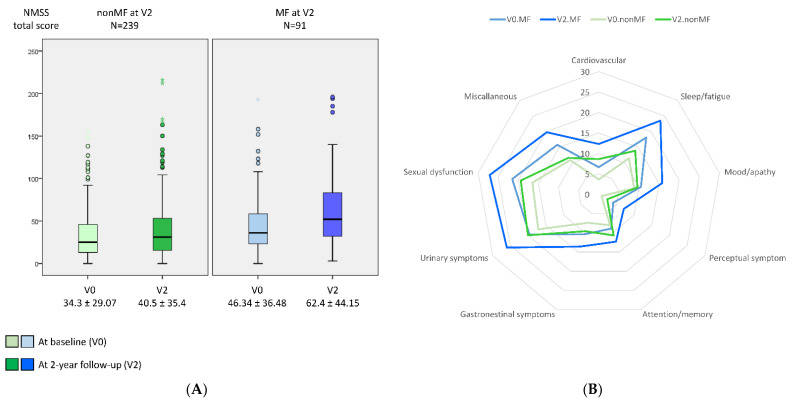
Figure 1
Figure 1
(A) NMSS total score (y-axis) at baseline (V0) and after a 2-year follow-up (V2) in PD patients who developed MF at V2 (MF at V2 (PD-MFV2); N = 91) and those patients who did not develop MF at V2 (nonMF at V2 (PD-nonMFV2); N = 239). NMSS total score at V0, PD-MFV2 vs. PD-nonMFV2, p = 0.001; NMSS total score at V2, PD-MFV2 vs. PD-nonMFV2, p < 0.0001; change in the NMSS total score from V0 to V2 in PD-MFV2, p < 0.0001; change in the NMSS total score from V0 to V2 in PD-nonMFV2, p < 0.0001; comparison between the change in the NMSS total score from V0 to V2 in PD-MFV2 vs. PD-nonMFV2, p = 0.021. Data are presented as box plots, with the box representing the median and the two middle quartiles (25–75%). (B) Mean score on each domain of the NMSS at V0 and at V2 in both groups, PD-MFV2 and PD-nonMFV2. At V0, the difference was significant between both groups in NMSS-1 (Cardiovascular) (p = 0.001), NMSS-2 (Sleep/fatigue) (p = 0.001), NMSS-4 (Perceptual symptoms) (p < 0.0001), and NMSS-9 (Miscellaneous) (p = 0.005). At V2, the difference was significant between both groups in all domains (p values from 0.024 to <0.0001) except in NMSS-5 (Attention/memory) (p = 0.364). p values were computed using the Kolmogorov–Smirnov, Mann–Whitney, and Wilcoxon tests. Mild outliers (O) are data points that are more extreme than Q1 − 1.5 * IQR or Q3 + 1.5 * IQR.
Figure 2
Figure 2
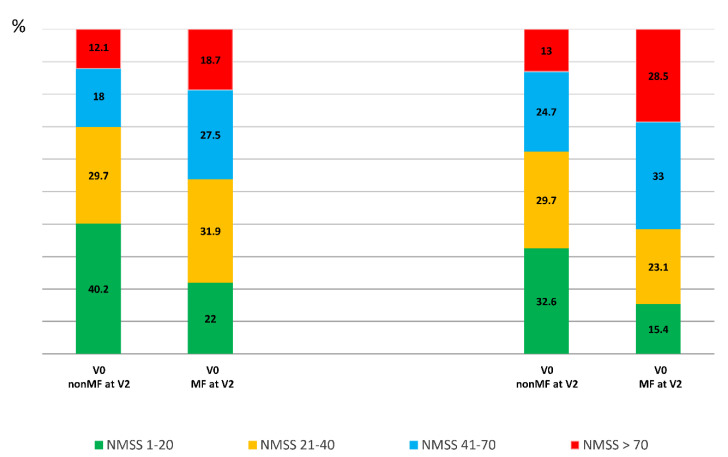
Frequency of patients with mild (NMSS 1–20), moderate (NMSS 21–40), severe (NMSS 41–70), and very severe (NMSS > 70) NMS burden at V0 and at V2 considering two groups: patients who developed MF at V2 (MF at V2 (PD-MFV2); N = 91) and those who did not developed MF at V2 (nonMF at V2 (PD-nonMFV2); N = 239). PD-nonMFV2 vs. PD-MFV2 at V0, p = 0.011; PD-nonMFV2 vs. PD-MFV2 at V2, p < 0.0001; change in PD-nonMFV2 from V0 to V2, p = 0.003; change in PD-MFV2 from V0 to V2, p = 0.001. p values were computed using the Chi-square and marginal homogeneity test.
Figure 3
Figure 3
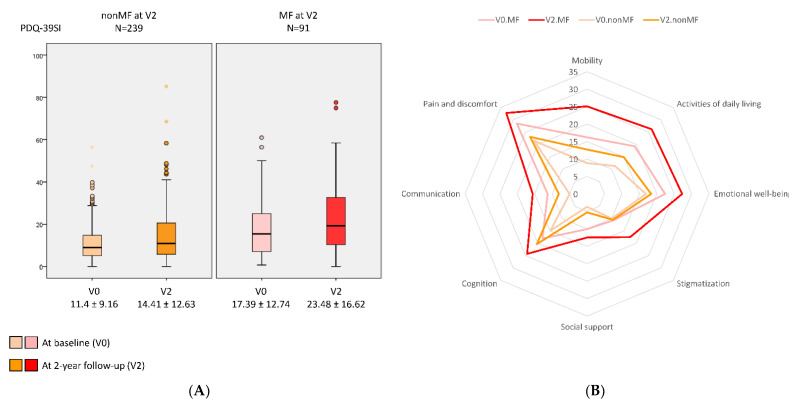
(A) QoL (PDQ-39SI) (y-axis) at baseline (V0) and after a 2-year follow-up (V2) (x-axis) in PD patients who developed MF at V2 (MF at V2 (PD-MFV2); N = 91) and those patients who did not developed MF at V2 (nonMF at V2 (PD-nonMFV2); N = 239). PDQ-39SI at V0, PD-MFV2 vs. PD-nonMFV2, p < 0.0001; PDQ-39SI at V2, PD-MFV2 vs. PD-nonMFV2, p < 0.0001; change in the PDQ-39SI from V0 to V2 in PD-MFV2, p < 0.0001; change in the PDQ-39SI from V0 to V2 in PD-nonMFV2, p < 0.0001; comparison between the change in the PDQ-39SI from V0 to V2 in PD-MFV2 vs. PD-nonMFV2, p = 0.005. (B) Mean score on each domain of the PDQ-39SI at V0 and at V2 in both groups, PD-MFV2 and PD-nonMFV2. At V0, the difference was significant between both groups in all domains (p values from 0.023 to <0.0001) except in PDQ-39SI-4 (Stigmatization) (p = 0.169) and PDQ-39SI-6 (Cognition) (p = 0.097). At V2, the difference was significant between both groups in all domains (p values from 0.005 to <0.0001) except in PDQ-39SI-6 (Cognition) (p = 0.319). PDQ-39 is expressed as a Summary Index (PDQ-39SI). Data are presented as box plots, with the box representing the median and the two middle quartiles (25–75%). p values were computed using the Kolmogorov–Smirnov, Mann–Whitney, and Wilcoxon tests. Mild outliers (O) are data points that are more extreme than Q1 − 1.5 * IQR or Q3 + 1.5 * IQR.

References

    1. Bloem B.R., Okun M.S., Klein C. Parkinson’s disease. Lancet. 2021;397:2284–2303. doi: 10.1016/S0140-6736(21)00218-X. - DOI - PubMed
    1. Armstrong M.J., Okun M.S. Diagnosis and Treatment of Parkinson Disease: A Review. JAMA. 2020;323:548–560. doi: 10.1001/jama.2019.22360. - DOI - PubMed
    1. Schapira A., Chaudhuri K., Jenner P. Non-motor features of Parkinson disease. Nat. Rev. Neurosci. 2017;18:435–450. doi: 10.1038/nrn.2017.62. - DOI - PubMed
    1. Seppi K., Ray Chaudhuri K., Coelho M., Fox S.H., Katzenschlager R., Lloret S.P., Weintraub D., Sampaio C., the Collaborators of the Parkinson’s Disease Update on Non-Motor Symptoms Study Group on behalf of the Movement Disorders Society Evidence-Based Medicine Committee Update on treatments for non-motor symptoms of Parkinson’s disease—An evidence-based medicine review. Mov. Disord. 2019;34:180–198. doi: 10.1002/mds.27602. - DOI - PMC - PubMed
    1. Chaudhuri K.R., Schapira A.H. Non-motor symptoms of Parkinson’s disease: Dopaminergic pathophysiology and treatment. Lancet Neurol. 2009;8:464–474. doi: 10.1016/S1474-4422(09)70068-7. - DOI - PubMed